

With 141 measles cases statewide as of June 30, Virginia is now among the top five states with the highest number of measles cases this year, along with South Carolina, Utah, Texas and Florida.
Out of these 141 cases, 118 are from an outbreak in Buckingham County that was first announced by health officials in May and has since spread to Cumberland County.
In 2000, the World Health Organization declared measles eradicated in the U.S., as the Measles, Mumps and Rubella (MMR) vaccine is 95% effective against the illness, according to the U.S. Centers for Disease Control and Prevention.
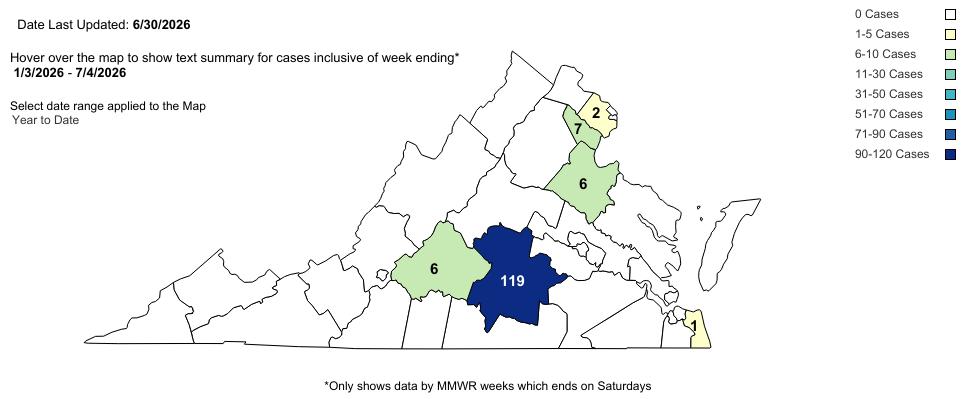
So how did the U.S. go from about 100 cases a year in the 2000s to 2,124 confirmed cases this year nationwide, according to CDC data updated on June 25? And how did Virginia, one of the states with a high vaccination rate according to the CDC, end up with a large measles outbreak?
Charlottesville Tomorrow spoke with Jennifer Reich, a sociologist at the University of Colorado Denver who has been studying the phenomenon of vaccine rejection for years. For her research, she spoke with healthcare providers and families to understand the reasoning behind vaccine resistance and the conditions under which parents are willing to reconsider. She even wrote a book on it, titled “Calling the Shots: Why Parents Reject Vaccines” and gave a TEDx talk about it.
Reich spoke about what has changed since 2000, why some people choose not to vaccinate, why the conversation around vaccines is so contentious and how to navigate it.
“It is not helpful to think about being unvaccinated as like a personal failure of the people,” said Reich. “Everyone’s doing the best they can, everybody wants healthy children and healthy communities. So the broader questions are, what are the factors that lead us to have high numbers of unvaccinated people?”
Public health messaging focused on personal responsibility instead of communal responsibility
In her research, Reich found that opting out of vaccines is, in many ways, a very logical response to the cultural shift towards individualism which had spread on the matters of health and parenting in the U.S.
For decades, a lot of public health messaging centered around the importance of taking personal responsibility in managing personal and individual health — don’t smoke, eat healthy, exercise, wear seat belts in your car — instead of focusing on systemic solutions, like taking “forever chemicals” out of the environment. For parents, this might mean questioning medical recommendations and wanting to research a vaccine thoroughly before consenting for their child.
“It’s unsurprising that people have taken that message to heart and really moved it forward ‘on their own terms,'” said Reich.
This logic of personal responsibility, however, clashes with how infectious disease management works, as it requires the whole society to act together in order to be most effective.
The COVID-19 pandemic showed that it’s impossible to predict how severe the outcome of an infectious disease can be on an individual, no matter how responsible one has been about staying healthy otherwise. The same is true for measles. Reich said it’s something doctors hear all the time — that the family didn’t realize how bad measles can get.
With COVID-19 pandemic, vaccines became politicized
When Reich began studying vaccine decision-making 20 years ago, it wasn’t a partisan question. She heard nearly identical reasoning from parents on both sides of the political spectrum: They felt personal responsibility for their children and thought that they could manage their children’s health without vaccines. The COVID-19 pandemic changed it dramatically, as vaccines became partisan: Republicans became less likely to vaccinate, according to Reich and other researchers.
Take action
Check your measles vaccine status and learn about measles symptoms
The Virginia Department of Health has declared a measles outbreak in Buckingham and Cumberland counties and is encouraging everyone to check their measles, mumps, and rubella (MMR) vaccination status.
To check your MMR vaccination status, use the VDH Record Request Portal or contact your healthcare provider. Learn more about measles symptoms and read frequently asked questions here. If you believe you were exposed, you can report it here. You can find any new exposure sites reported by VDH here.
Some politicians weaponized vaccines and vaccine mandates and the anger and confusion around them. Now, Secretary of Health and Human Services Robert F. Kennedy Jr. is a longtime vaccine skeptic under whom the messaging about the vaccines has been changing.
“It’s really hard for families right now to look for clear guidance of what is safe and what is necessary,” said Reich. “There’s a lot of confusion and a lot of chaos at the federal level, and that’s really changing how families are trying to make the best decision they can with the information available, and that becomes harder and harder as there’s conflicting information.”
So, when a family is uncertain about what’s the right choice, waiting feels like the safest option. But with infectious diseases like measles, which is one of the most infectious viruses known, delays increase risk: The vaccine is most effective and produces the fewest side effects in young children.
When it comes to vaccines, people look to their neighbors
Not many people are outright against all vaccination for ideological reasons, said Reich. A much larger group questions whether specific vaccines are necessary for their particular child, or whether it’s the best time to get it. Some remain unvaccinated purely because of the lack of accessibility: Not all doctors offer measles vaccines, and parents might face challenges finding transportation and childcare to go further to get the vaccines.
While Virginia’s overall vaccination rate is high, vaccine hesitancy tends to come in clusters. People tend to look to other community members for cues on what others are doing, and parents are no exception. They frequently ask other parents for advice, on anything ranging from their kids’ diet, which summer camp to choose or which teacher to request. Vaccination choices are a part of it as well. Reich’s research has found that when parents who are not critical of vaccines are placed in an environment with a large number of parents critical of vaccines, they are more likely to conform because that’s the norm of the community.
When talking about vaccines, start with curiosity
Most conversations about vaccines seem to be framed in terms of individual risk and miss the role vaccines play in community protection and something we do to help others, Reich said. Babies under 1 year old are too young to be vaccinated and yet they are vulnerable to measles. Some children are going through chemotherapy and they rely on their classmates to be vaccinated to protect them when they come to school. Rubella, one of the illnesses covered in the MMR vaccine, is generally mild but it’s very serious for pregnant women, and while it might not affect many people personally, it’s essential to get vaccinated to protect those who need that protection.
“We have some obligation to other people in our community. It’s why we stop at stoplights. It’s why we yield to pedestrians,” said Reich. “That’s not in our self-interest, but it’s part of living in a community and working together. And vaccines are part of that story also, and we don’t always acknowledge that.”
There are also overlooked personal benefits to making sure we live in a healthy community — the more people are vaccinated, the less hospitals are overwhelmed, the lower health insurance costs are, the longer people with chronic conditions remain in society.
For anyone who wants to talk to other families who are hesitant or opposed to vaccines, Reich recommends starting with genuine curiosity rather than a desire to teach and correct. Did they have a bad experience that caused distrust of the healthcare system? Are they afraid of a reaction to vaccines, or are they uncertain about the timing for the vaccine? Reich’s research found that many families opposed to vaccinations say they are willing to reconsider their decision in particular contexts like international travel or pregnancy, which could be an entry point for a conversation, she said.
And if you have never had a conversation with a community before, an outbreak might not be the best place to start: Being a good neighbor and helping people feel supported takes time, Reich said.