

After a last-minute addition to an Orange Town Council meeting agenda 16 years ago, councilors voted to shorten the term of mayor to just one year, which is exceedingly rare in Virginia.
Now the Town Council is deciding whether to reverse that decision.
On Monday, August 17, residents of the Town of Orange will have the opportunity to weigh in on whether the term lengths of mayor and vice mayor should be changed to two years, which was their duration prior to 2010.
Take action
Weigh in on the Orange mayor’s term at an upcoming meeting
Orange Town Council will discuss the term length for mayor and vice mayor at its next regular meeting on Monday, Aug. 17, at 7 p.m. in the Orange Public Works Building, located at 235 Warren St. in Orange. Town of Orange residents can sign up to speak during public comment at the beginning of the meeting, and agendas and minutes for all Town Council meetings can be found on the Town of Orange website.
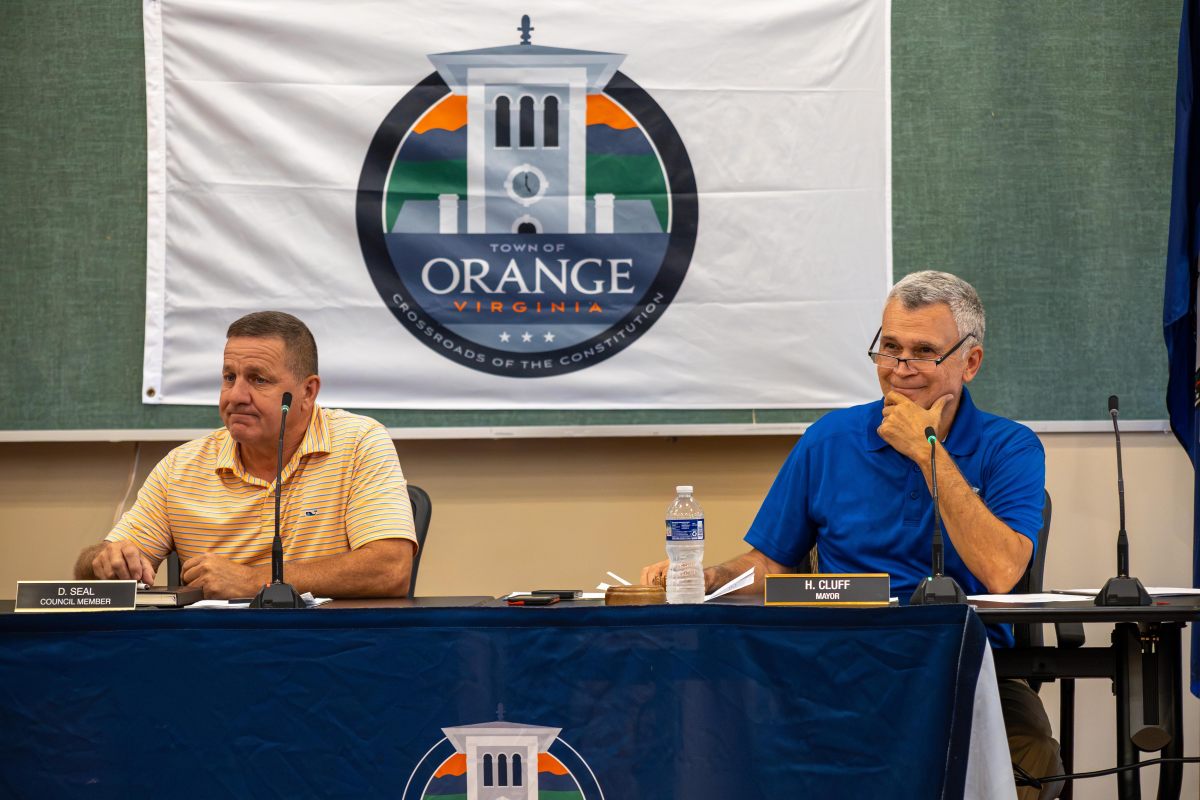
Orange Mayor Harrison Cluff put discussion of the term on the agenda for the Orange Town Council work session that took place Monday, Aug. 3. During the work session, Cluff clarified that he is not proposing for his current term as mayor, or that of current Vice Mayor Delmer Seal, to be lengthened, and that any changes passed by Council would only take effect for future terms.
“Let me say up front, this would have absolutely no bearing on the current term,” Cluff said. “The term for the mayor and the vice mayor right now runs through the end of this year, and there will be another vote held next year for that term. At that time would be when I would propose that we go back to where we were for many years, and that was as two-year terms for mayor and vice mayor.”
Cluff added that a two-year term could potentially give the incoming mayor more time to adjust to the position, since Council is usually busy working on the budget during the first half of each year. The change would also allow the selection of the mayor to align with Town Council elections, which take place every two years, as Council members serve staggered four-year terms.
The Town of Orange, like most places in Virginia with the exception of the City of Richmond, operates on a “weak mayor” system, meaning that the mayor mostly fills a ceremonial role and wields little power beyond that held by all Town Council members. The mayor is the member of Town Council who presides over meetings, and as a member of Council, gets to vote on community matters like the budget and changes to town ordinances, but does not have veto power or executive authority.
Like most “weak mayor” municipalities, Orange also operates under a “council-manager” system. This means that the town manager (in Orange, Chris Snider), who is not elected, holds most of the authority over the town’s day-to-day administration.
In many municipalities including Orange and Charlottesville, a “weak” mayor is selected from within the town council rather than directly elected by the public, although towns with a council-manager/weak mayor system often publicly elect their mayor, as is the case in nearby Gordonsville.
(If you find any of that interesting — or confusing — Charlottesville Tomorrow has an excellent article from 2022 that explains these systems of local government and their alternatives in more detail.)
While Orange’s form of governance isn’t unusual, the length of its mayoral and vice-mayoral term is. In fact, several hours of research into Virginia town charters and city data didn’t yield any examples of another locality in Virginia that chooses its mayor for a one-year term.
While the one-year term is rare, it is legal, as Virginia law grants localities substantial flexibility under their own municipal charters to determine the term their mayors should serve, and even more flexibility to localities like Orange that internally select a mayor from within town council. In practice, nearly all mayors in Virginia serve two- or four-year terms to align with council elections, but a few localities, like the city of Alexandria, serve three-year terms.
So, how did Orange’s mayoral term get so short? Reports from 2010, when the term length was changed from two years to one year, suggest that that decision had more to do with a personal grievance at the time than it did with effective governance.
According to a report by Gracie Hart in the Orange County Review (subscription required), Councilmember Kent Higginbotham added a vote on shortening the mayoral term as a last-minute item on the agenda at an Orange Town Council meeting in May 2010. The mayor, the late Henry Lee Carter, dissented, saying that a decision as significant as the term of mayor deserved more thought.
“I hate when these things come up unannounced,” Carter said. “There may be consequences. [This is] a shoot-from-the-hip motion.”
The decision followed several months of Town Council proceedings described by the Orange County Review as “tumultuous,” including a closed-door meeting possibly called in an attempt to remove Carter from his role as mayor in late August 2009, and a proposal by Higginbotham in October to limit the circumstances under which the mayor could vote and participate in discussion.
The reasons for the reported attempts to limit Carter’s power are not well known, as Higginbotham and the majority of Town Council declined to comment at the time, according to the Orange County Review. Ultimately, Council voted 4-1 in favor of Higginbotham’s proposal to shorten the term of mayor to one year.
Charlottesville Tomorrow reached out to several people, including former Town Council members, to try to gain more insight. While accounts varied slightly, one consistent theme stood out: no one can remember exactly why they made the change in the first place.
That includes Higginbotham, the Town Council member who put the item on the agenda. During a phone call with Charlottesville Tomorrow on Tuesday, Higginbotham said that he couldn’t recall specifics but that he and the former mayor were “politically opposite.”
“Obviously, it had to be we had disagreements of what direction we were going,” Higginbotham said.
Similar to Higginbotham, Carter’s son, Jack Rickett, mentioned general ideological differences as opposed to differing opinions on a single issue.
“I hate to say it, but as I recollect, I would have to agree with Kent from a standpoint of, they had two opposite ends of the spectrum — political views — on how government should run and what is the purpose of government,” Rickett said. “There was intense debate and a little bit of a struggle that went back and forth in multiple elections to where a majority would lie.”
Nancy Alexander, a former Town Council member who voted in favor of shortening the mayor’s term to one year back in 2010, mostly remembered that she had hoped the change would help to “overcome the lack of unification” at the time. Looking back, she doesn’t believe shortening the term had that effect, Alexander told Charlottesville Tomorrow.
“Ultimately? No, I don’t think there was any change. And I don’t think that’s indicative of Orange. I just think it’s small towns,” she said.
This time around, whether Orange Town Council decides to change the mayoral term back to two years or keep it at one year, the process will include one crucial component that was lacking during the surprise vote in 2010: a chance for the public to give their input during the Aug. 17 Town Council meeting.
During a phone call with Charlottesville Tomorrow, Councilmember Donna Waugh-Robinson said she’s “open-minded either way,” seeing pros and cons to a one- or two-year mayoral term, and won’t make a final decision until she hears what residents have to say.
“I want the public to come out and speak up and let us know what they want, because we represent them. You know, we’re five votes, but we represent the town, all the people of the town, and I want to hear from them,” Robinson said.
“You have to put aside your personal opinion and you have to do what your constituents want.”