

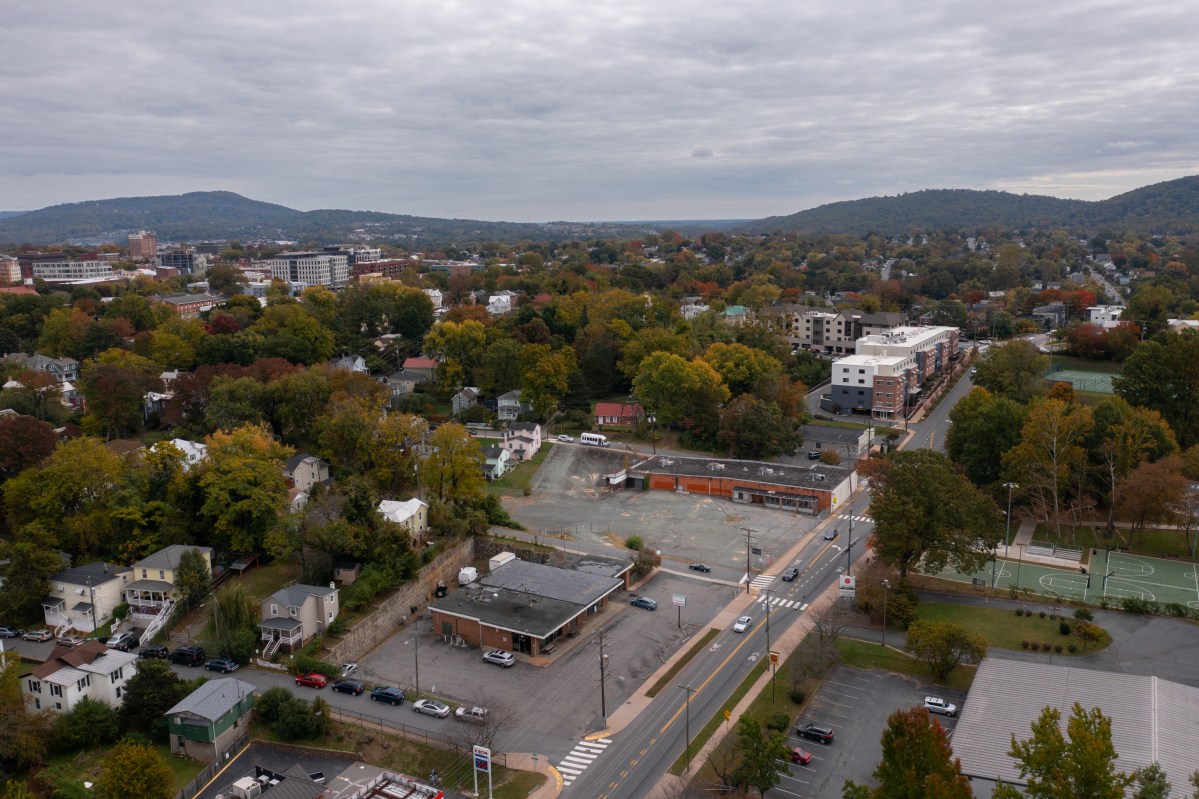
The Charlottesville Food Co-Op will not run a grocery store proposed for a Cherry Avenue development after all.
The group, which formed specifically for the opportunity to run a grocery store at the 501 Cherry Ave. development in Fifeville, announced the news in a media release the afternoon of July 20.
The Co-Op acknowledged that the news was likely disappointing for Fifeville residents, who have repeatedly asked for a grocery store, something the historically Black neighborhood hasn’t had for years. Access to fresh, healthy, affordable food is so important to them that they named it as a priority in an official city planning document.
“We sincerely apologize for the frustration and uncertainty this process may have caused,” the Co-Op wrote, explaining that it was unable to clear significant hurdles — including financing and site design — in its path toward opening a community-based, community-owned affordable grocery store at the site.
That doesn’t necessarily mean Fifeville won’t get its grocery store. The Co-Op is still hoping to find a home in the neighborhood, or at least nearby.
And the 501 Cherry project partners — the Fifeville Neighborhood Association (FNA), which is made up of neighborhood volunteers, and developers Piedmont Housing Alliance (PHA) and Woodard Properties — said in their own media release that same day that they are still committed to finding a grocery store operator for the space. It’s something all three parties agreed to when they signed a contract called a “community benefits agreement” in 2023.
But the Co-Op’s news is yet another setback for the mixed-use project, which has faced numerous challenges for both the housing component and the grocery store since it was first proposed in March 2023. Despite the news, the project partners say they’re still on track to break ground this fall and anticipate construction to be finished in spring 2028.
The Co-Op had been working on their plan for the store for about a year before withdrawing from the project.

In February 2025, the FNA officially recommended that the newly formed Charlottesville Food Co-Op operate the grocery store. The neighborhood association selected the all-local group from a list of four possible contenders, saying that the Co-Op, composed mostly of women of color, was the only one that could deliver everything Fifeville residents said they wanted in a grocery: fresh, healthy food they could afford, from a store with deep community roots.
The Co-Op was off to the races. In just a few months, the group developed a business plan with financial projections and started working on fundraising and selling memberships. Woodard Properties and PHA had those documents reviewed by grocery industry experts, who said everything looked good. In May of 2025, Woodard Property and PHA affirmed the FNA’s recommendation that the Co-Op run the grocery store at 501 Cherry Ave.
Consultants, architects and project partners’ opinions differed on the site’s suitability for a grocery store
Then, in May of this year, the Co-Op received disappointing news. It had commissioned a site analysis from the Seven Roots Group, a national consulting firm specializing in grocery store design, strategy and feasibility, and Seven Roots determined that the space at 501 Cherry Ave. “is not feasible for a successful grocery store option,” a May 4 press release from the Co-Op said.
Seven Roots’ determination, the Co-Op said, was mostly due to problems with the site design. The consultants did not reply to Charlottesville Tomorrow’s follow-up questions.
The consultants determined that large delivery trucks would struggle with the steep site exit and wouldn’t be able to make the site’s tight turns, the Co-Op said. Lack of a dedicated trash area for the store, rather than one shared with other parts of the development, was another issue.
Not everyone thought so. Anthony Woodard, CEO of Woodard Properties, disagreed with the consultants, according to a Cville Right Now report from May 5. The company’s architects and engineers planned for a grocery store from the beginning, considering that use in their site design, Woodard said.
What’s more, he added, the consultants made the determination by assuming that 85-foot tractor trailer trucks would be making routine deliveries. That wouldn’t be the case.
“Most local businesses in Charlottesville are supplied by tractor-trailers in the 40- to 50-foot range — the same trucks that back down side streets to supply restaurants and shops on the Downtown Mall,” Woodard said. “A neighborhood store of this size is typically served by box trucks up to 45 feet, which the site is designed to accommodate.”
“Some members have been encouraged by Woodard Properties’ and Piedmont Housing Alliance’s willingness to reengage around their design plan, and members are hopeful that their persistence and creativity will help ensure that the grocery store remains an option,” the Co-Op said at the time.
The same week, Woodard Properties, BRW Architects, Shimp Engineering, PHA, the FNA, the Co-Op and Seven Roots met to talk through possible changes to the design plan that would alleviate the consultants’ concerns, according to the May 5 Cville Right Now report.
People have different recollections of that meeting.
Woodard told Cville Right Now that during the meeting, folks agreed that “the site is feasible for a neighborhood-scale market, as has always been intended.”
Sunshine Mathon, Executive Director of PHA, told Charlottesville Tomorrow in an email on Aug. 6 that the groups discussed options like modifying Cherry Avenue itself, in front of the development, to create a pull-off delivery lane. That option needed to be approved by the city, and city staff were open to exploring that idea, quickly.
Deanna McDonald, a co-director of the Co-Op steering committee, remembers the developers saying they were unable to alter the footprint of the building to accommodate changes necessary to make the grocery store work there, though she believes it was more that they were unwilling to. Some of the workarounds discussed would have “significant financial impacts to be shouldered solely by the operator, which supported the lack of financial feasibility at the site,” she told Charlottesville Tomorrow in an email on Aug. 6.
There were constraints on what the developers could do with the development’s footprint at that point, Mathon said.
“Every use on the site — the affordable housing, Music Resource Center, and the grocery store space — each had to make compromises” on its design to meet the physical challenges of the “small, topologically difficult” site, Mathon said. The compromises were necessary due to the city’s requirements for storm water management and fire truck access. Some were also made at the neighborhood’s request, as residents asked the developers to reduce the height of both buildings on the site and move them further away from the single-family homes at the back of the site.
“All of these had to be made before a grocery operator was identified,” Mathon added, “and long before the Co-Op concept emerged, so that we could apply for funding for the affordable housing — which takes years to pull together.” And once that funding is in place, the funders restrict the developers from making substantial changes to the buildings’ footprints.
He’d hoped that the rent offered to the Co-Op for the space, which he described as “well below market-rate,” would help counterbalance any inefficiencies of the site.
In any case, it appears that the groups did not reach an agreement during that meeting in early May.
Co-Op decided not to move ahead, citing site challenges, lack of funding
Just two and a half months later, the Co-Op steering committee voted to not move forward as the grocery store operator at 501 Cherry Ave. The group again cited Seven Roots’ advice as a reason, pointing to site design and a lack of funding.
“Like many start-ups, we have faced challenges securing sufficient financing, building the necessary operational capacity, and navigating this particular project’s development constraints,” the group wrote in its July 20 press release.
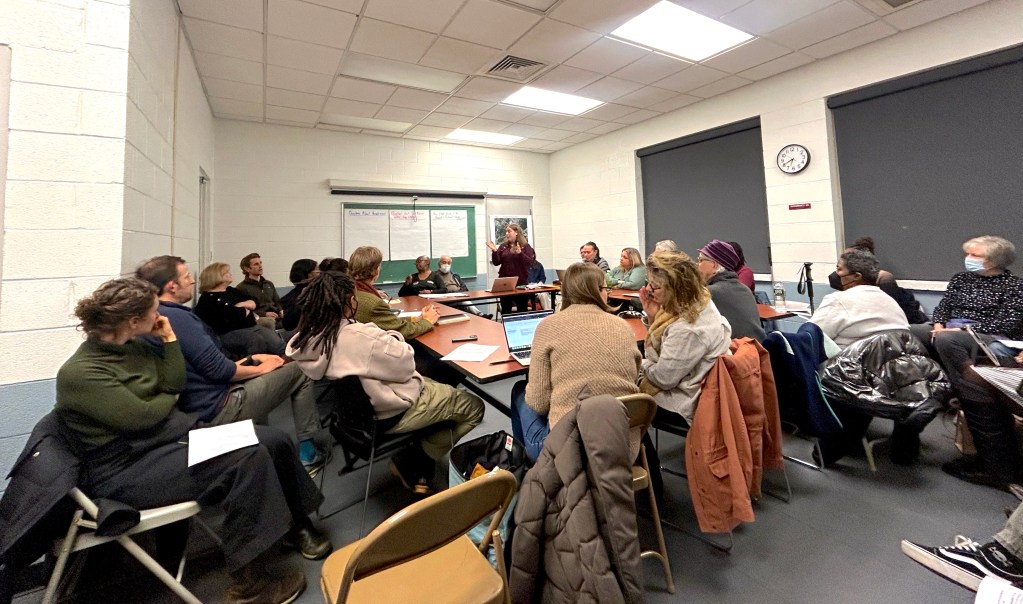
“The Co-Op’s decision does not reflect a lack of commitment to the neighborhood,” it continued. “Rather, it reflects the organization’s mission to make evidence-based decisions that protect the long-term sustainability of a community-owned grocery store and ensure responsible stewardship of public and community investment.”
One of the main problems was that the unique needs of a grocery store weren’t part of the initial design and planning phase, despite a grocery store being one of the main components of the project from the start, the Co-Op’s release stated. Expert input came into play once the Co-Op was selected as the grocery operator and hired its own grocery store design and feasibility consultant.
“The Co-Op wanted to go there,” McDonald, who is also a nurse and led the community engagement process for the FNA, told Charlottesville Tomorrow in an interview on July 21.
“But wanting to go there and being an engineer to see if you can go there are two different things,” McDonald said. “That responsibility was on the developer.” She also believes that the city should subsidize healthy food access to the extent that it subsidizes affordable housing.
The City of Charlottesville has stepped in to fill funding gaps a few times, committing around $4 million in cash to the project overall, with most of it going to the housing component. Additionally, the city agreed to a tax increment financing performance agreement, which allows certain projects to pay a lower tax rate for a certain period of time in order for the project to work out financially.
In their own release, sent a few hours after the Co-Op’s on July 20, the 501 Cherry project partners refuted the claim that a grocery store wasn’t planned for from the beginning.
“From the outset, PHA, Woodard Properties and the Fifeville Neighborhood Association have worked to create a space that is both practical and sustainable for a neighborhood-scale grocery market in a mixed-use development, while balancing the other community-focused uses on the site,” the project partners wrote in their release.
“While we are disappointed that we were unable to reach a path forward with the Charlottesville Food Co-Op, we respect their process and their commitment,” the groups wrote. “The Co-Op poured tremendous heart and expertise into this evaluation, and we are genuinely rooting for their success in finding the right home for a community-owned grocery store.”
And, as the project partners wrote in their release, they still believe that space can work for the grocery store they envision.
Operating smaller grocery stores comes with unique financial challenges
The feasibility of a grocery store in that space has been questioned since the idea was proposed, long before the Co-Op formed.
Grocery store profit margins are paper-thin, averaging 1% to 3% across the industry, according to the National Grocers Association, an organization that represents and advocates for independent grocery stores and suppliers across the country.
Most grocery stores make money on such thin margins by selling a lot of product, according to Marketplace.org, a division of Minnesota Public Radio focused on business and economics. Smaller stores that can’t buy or sell large quantities might struggle or raise prices in order to stay in business.

Early on in the process, in March 2023, City Councilor Michael Payne said that he was very much in support of the grocery store, but was concerned that Woodard hadn’t yet locked in an operator.
“We should keep in mind that there are no guarantees of a grocery store there, and the economics of making a grocery store work are extremely difficult. It’s probably likely that in order to make the economics work, you’re going to get a much smaller, boutique grocery store,” Payne said during a Planning Commission and City Council work session in March 2023. And that kind of store could be unaffordable to many of the residents in the historically lower-income neighborhood.
A year and a half later, in September 2024, when the project still did not have a grocery store operator, Mathon said during a community meeting that the grocery store component of the project needed some sort of subsidy in order to work. Otherwise, it would be “dead in the water.”
“My hope is that we are able to give the community what they ask for,” Carmelita Wood, president of the FNA, said during that same meeting. “My fear is that we will fail.”
Most of the grocery operators that the neighborhood association had reached out to at that point weren’t interested. Some said the space was too small to run a profitable grocery, that the math wouldn’t work. Others, like the owners of Reid Super Save Mart, a neighborhood grocery located on Preston Avenue, said they were not in the financial position to open another store. Reid Super Save Mart closed soon after, in early 2025.
Project partners look for new grocery store partner as Co-Op looks for a new location
Despite the uphill battle presented to them, the Co-Op, inspired by the neighborhood’s needs and desires, still wanted to try.
“It makes a difference for somebody to be able to go to the grocery store and get a pound of fresh green beans versus two cans of green beans that have hundreds of milligrams of sodium in them to preserve them to get them to the table,” McDonald said. High sodium intake is tied to a variety of health conditions, including high blood pressure, also called hypertension.
“When we start talking about the hypertension, the diabetes, the cancers,” all things that disproportionately affect Black Americans, according to the U.S. Centers for Disease Control and Prevention, “those are the things, those are the people I show up for,” McDonald said.
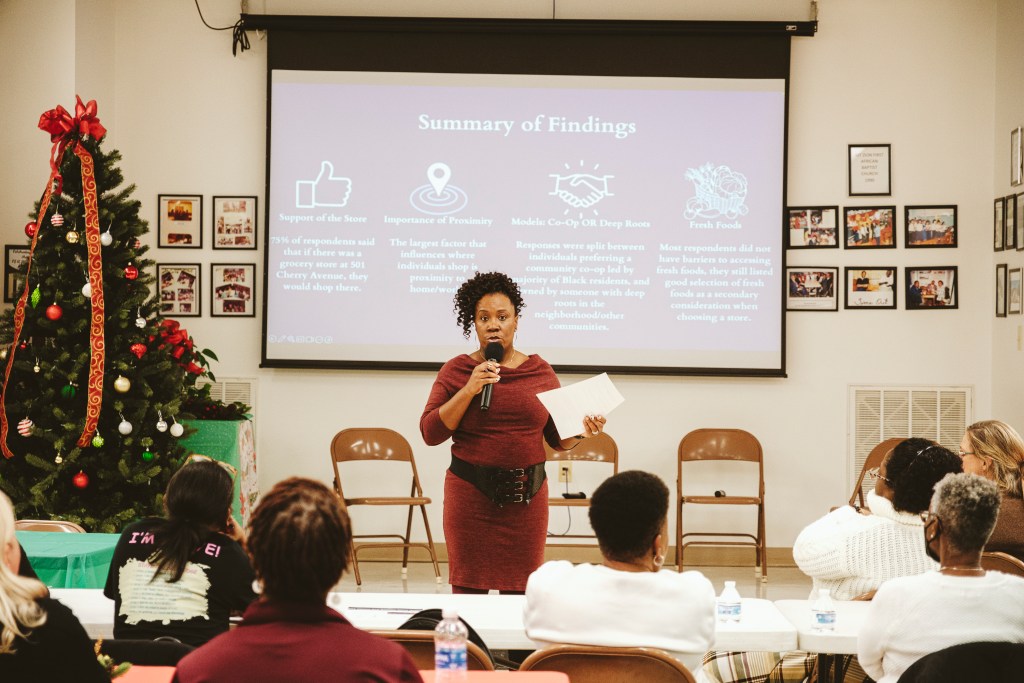
She was devastated to tell the neighborhood, where her family goes back generations, that the Co-Op wouldn’t be moving forward at 501 Cherry Ave. She also worries about the dozens of households with low incomes that will move into the affordable housing component of the development potentially without access to affordable, healthy food. But the Co-Op is determined to find another location in one of the city’s historically Black neighborhoods.
“This is not the end,” McDonald said.
The project partners said the same.
The grocery store was one of the key components of the deal (officially known as a “proffer”) that Woodard Properties and PHA made with the City of Charlottesville in exchange for the zoning changes and special use permit necessary to build the development. So, they’re moving forward with that.
“We are encouraged by ongoing conversations with other grocery operators who have concluded that the site is, in fact, a viable opportunity,” the project partners wrote in their statement. They did not say who those operators were, and Woodard Properties declined to comment further on the release.
PHA was ultimately able to help subsidize the grocery store component, Mathon said, which is how the project partners could offer the Co-Op well below market-rate rent for the space. That same deal will be offered to whatever operator the neighborhood selects in the future.
The neighborhood association will once again get residents’ opinions on whether or not one of those operators could provide the type of store the neighborhood wants, one with fresh, healthy food they can afford.
There is a possibility that a grocery store won’t work out in that space at all, the 501 Cherry project partners acknowledged in their statement. If it doesn’t, the space would be used for something else of the neighborhood’s choice.
“We are disappointed that the 501 Cherry site will not work for the Food Co-Op,” FNA President Wood wrote to Charlottesville Tomorrow in an email. A longtime Fifeville resident, she has fond memories of Estes IGA and was the driving force behind the Cherry Avenue Small Area Plan that identified a grocery store as a priority for the neighborhood years ago. Wood is still determined to work on “providing a healthy, affordable food source” for Fifeville, and, as a member of the Co-Op steering committee, hopes the Co-Op will find a place of its own as well.
“We knew we had our work cut out for us trying to provide for and fill the void of a much-needed neighbor grocery,” she said.
It is a herculean task, said Eboni Bugg, Director of Community Investment for the Charlottesville Area Community Foundation. The CACF is a local nonprofit that facilitates grants and other programs between philanthropists and organizations doing community-based work throughout central Virginia. The CACF funded the community engagement activity around the project, and had been working with the Co-Op on building up its funding.
Construction timelines rarely align with the timelines of movement building and grassroots efforts like the Co-Op, Bugg said. The Co-Op didn’t form until an opportunity for a grocery at 501 Cherry Ave. was there, and then it had to adhere to an “extremely compressed” timeline because of a compressed construction timeline.
“This is not a failure of any of the parties,” Bugg added. “I hope the community can stay focused on the plan. This is a hard and necessary inflection point, but there is still so much opportunity to make good on the community’s expressed desires and needs.”
Editor’s note: This article was updated on Aug. 11, 2026, to clarify the description of the tax increment financing performance agreement related to the 501 Cherry Ave. development.