


Alphonso Washington appeared unfazed by the sweltering mid-July heat when walking to his apartment in Charlottesville’s Fifeville neighborhood where he has lived nearly one year.
A few minutes later, while seated on a couch on the first floor of the two-story yellow duplex, Washington described the sense of freedom the modest unit has given him.
This newfound freedom is especially significant for Washington, as it’s the first place he’s called home after spending 25 years in six correctional facilities across three different states —Tennessee, Virginia and West Virginia.
His lengthy sentence was the result of a second-degree murder conviction in 1999, making this new chapter in his life all the more meaningful.
Before his release in mid-2024, Washington spent 12 years — his longest period of incarceration — in Deerfield Correctional Center, a medium-security correctional center in Southampton County. There he had little privacy in the facility designed to hold 1,080 inmates.
“They just call it a dorm, he said, referring to the unit where he lived. “It’s a big room with 88 beds.”
Knowing that his freedom was within reach when he was transferred to Deerfield, Washington, 59, decided that there was no use in complaining. It was best to “go ahead and adjust, because this too shall pass,” he said.
Robert Gray, seated across from Washington, listened and nodded in between checking messages on his cell phone. Gray is cofounder and executive director of the Uhuru Foundation, a local nonprofit organization that seeks to disrupt the cycles of incarceration through targeted intervention. Created in 2020, Uhuru’s core mission involves helping to rehabilitate youth in the juvenile justice system and offering transitional housing to support adults re-entering society after they’ve been incarcerated.
Along with helping formerly incarcerated men obtain housing through its Keys to Love Supportive Housing Recovery Program, Uhuru offers digital literacy programs to help them find employment and access to mental health and substance abuse services.
Washington, who attributes some of his encounters with the law to the anguish he felt after losing his mother when he was 13, fits the category of men Uhuru seeks to support.
“Our goal is to ensure that they can build healthy lifestyles for themselves and their communities, fostering a cycle of positive change and digital inclusion for generations to come,” according to Uhuru’s website. “Through these distinct, yet interconnected initiatives, we empower young individuals and adults to rebuild their lives, contribute positively to their communities, and secure a future filled with opportunity, dignity, and hope.”
Many justice-focused nonprofits face new federal funding cuts, but Uhuru is used to ‘sweat equity’
Over time, Uhuru met several of its goals, including raising funds to implement and bolster its programs, said Gray. In 2020, the nonprofit received $50,000 in funding from the Charlottesville Area Community Foundation, followed in 2021 by $500,000 from the City of Charlottesville. That funding was used to assist existing programs in Charlottesville and to help pilot programs at the Lugo-McGinnis Academy, a small, non-traditional academy that serves Charlottesville City Schools students in grades 8-12.
Later, in 2023, Uhuru received a $500,000 federal grant from the Office of Juvenile and Delinquency Prevention Program, which allowed the nonprofit to provide diversion programs to engage and rehabilitate youth in the juvenile justice system.
But according to the Council on Criminal Justice, an independent and nonpartisan think tank, the Trump Administration terminated 373 grants from the Department of Justice’s Office of Justice Programs (OJP) last April. The defunded grants were initially valued at about $820 million, but many were multiyear grants in various stages of payout and implementation. The administration has rescinded the remaining balances of these awards, which a CCJ analysis estimates at about $500 million. Read more about the terminated funding in the report from CCJ.
In a recent post on her LinkedIn page, Liz Ryan, former administrator for the Office of Juvenile Justice & Delinquency Prevention (OJJDP), Office of Justice Programs (OJP), wrote that, unless Congress intervenes, youth justice programs will receive “zero dollars” from the DOJ in the 2025 fiscal year.
“That’s more than $400 million dollars in fiscal year 2025 funding opportunities at OJJDP for the entire youth justice field for 40+ programs, including children exposed to violence, missing and exploited children, mentoring, alternatives to incarceration, re-entry, to name a few,” Ryan said in her post.
She also said that “the U.S. DOJ removed the FY25 notices of funding that were posted at the end of last year and in January 2025, and has yet to re-post them along with many others. If notices of funding aren’t issued, organizations can’t apply for funding.”
Undeterred by the DOJ’s action, Uhuru plans to continue its focus on other funding strategies, much like it did when the organization was founded.
Uhuru’s initial operations were grounded in “sweat equity” and money from his savings during the early days of the COVID-19 pandemic, Gray recalled.

“It wasn’t as if we got a bunch of big grants or donor funding to get the organization started,” he said.
Before founding Uhuru, Gray and Derek Rush, Uhuru’s cofounder and deputy director, established the Conscious Capitalist Group in 2020 to address the wealth gap in the Black community by teaching financial literacy and leadership to middle and high school students who were unlikely to attend college. After discovering the name was trademarked, they renamed their nonprofit the Uhuru Foundation. Uhuru means “freedom” in Swahili.
Gray’s background in community organizing and direct service work, along with experiences at the Boys and Girls Club and City of Promise, further inspired the creation of the Uhuru Foundation.
Gray, 36, who grew up in a working-class family in Albemarle County’s Esmont community, said establishing a nonprofit hasn’t been easy. People weren’t accustomed to seeing young Black men in leadership positions in the nonprofit space, which presented challenges in a predominantly white city such as Charlottesville, he said.
Despite these challenges, the foundation has made significant strides in supporting its target population, with plans to expand its impact through strategic partnerships and increased visibility.
Today, the Uhuru Foundation operates two transitional houses in Charlottesville, one for substance abuse recovery and the other for workforce development. The “Keys to Love” program has a house, owned by Habitat for Humanity, that is certified by the Virginia Association of Recovery Residencies.

So far, Keys to Love has served about 60 tenants, with six men currently residing in the recovery house in Charlottesville’s Fifeville community.
Uhuru recently leased a transitional house for adult men reentering society. Located near the west side of Charlottesville, the seven-bedroom house can accommodate six men who are 18 and over. Uhuru will relocate its headquarters from the Jefferson School City Center to the new house where workforce development programs also will be conducted.
“We have started accepting referrals for the new house, but it’s not full and we still have bed space,” Gray said in a text message to Charlottesville Tomorrow. He added that the house will provide mental health services in partnership with FOCUS INC behavioral health company.
In addition to adding new members to Uhuru’s board of directors, Gray said the organization also needs more volunteers for its workforce development initiative.
Attorney Jeree Thomas is the former program director of Borealis Philanthropy’s Communities Transforming Policing Fund (CTPF), and served as a national policy director with the Campaign for Youth Justice. From 2011-2014, she was a Skadden Fellow for Charlottesville’s Legal Aid Justice Center.
Thomas sees several issues — from congressional investigations, federal agencies pulling funds from organizations that mention diversity, equity and inclusion and expanding the use of RICO (Racketeer Influenced and Corrupt Organizations Act) — that may adversely impact nonprofits that rely on federal funding or are engaged in advocacy work.
She added that if organizations avoid mentioning diversity out of fear of federal scrutiny, they may also not be able to clearly articulate their missions and communities they serve.
In response, Thomas advises nonprofits that “now is the time to strengthen relationships with current funders. Reach out to them to discuss potential increased support or connections to new funders, as some foundations are increasing their spending from 5% to 10% or more.”
Uhuru helped Washington find freedom and new meaning in life
Shortly after that hot summer day in the Fifeville apartment where he’d lived since Aug. 3, 2024, Washington moved to a new place about 10 minutes away, he said. It is typical for clients who obtain housing through Uhuru’s Keys to Love program to stay in their housing units six months to one year, said Gray.
Before leaving his Fifeville address, Washington reflected on some of the events that led to his imprisonment and his life after being released.
Washington, who, like Gray, also grew up in Esmont, was still an adolescent and the youngest of his mother’s five children when she died in 1979.
“We were best friends,” he recalled.
After his mother passed, he no longer felt motivated to excel in school, he said. He lived with various relatives for brief periods of time, and later spent time in foster care and a home for boys. He continued to attend school, but quit in the 10th grade after losing focus.
“I went from being an ‘A’ student to a ‘D’ and ‘F’ student” at Albemarle High School, said Washington. “There was no one pushing me, and I don’t think my brain had fully developed. So, I chose the wrong path, and I ended up with, like I said, quitting school in the 10th grade [even though] I had just passed the test to go to the National Guard. All of that is like it just went out the window.
“I wasn’t in the streets robbing or selling drugs, and even though I drank, it was not my thing to go out there. I’m a country boy, you know, so I still had morals that I got from my mom.”
But by not taking life seriously, “things began to spiral” resulting in his arrests for assault, trespassing and other charges, he said.
Washington explained that the homicide that led to him spending 25 years in prison followed an initial incident in which he “had words with a guy” who pointed a gun at his face and pulled the trigger. The gun misfired.
Washington said that he walked away, “but after the same situation was rehashed two years later something in me just snapped, and I was like, I’m not trying to keep going through this every time we run into each other, because next time the gun might not misfire, right? So, at the time, I felt like I did what I had to do.”
Washington, then 33, initially was charged with premeditated first-degree murder, but after he took a plea deal, the charge became second-degree murder. He was sentenced to 40 years in prison, but because 15 years were suspended, he served 25 years and two weeks, he said.
While at Deerfield, Washington said he had “by the grace of God” resolved to serve his time without a fight because if he didn’t, “there is no more, that’s where I’ll die.”
For Washington, dying was not an option. In 2017, he earned his High School Equivalency certificate, commonly referred to as GED, through the Department of Corrections and Virginia Department of Education. He said that math was his favorite subject along with horticulture for which he also received certification.
Washington recalled feeling as if he were “floating on air” after completing what he described as college-level coursework.
“I never thought I could do it, but I did,” he said. “It was a weight lifted off my shoulders.”
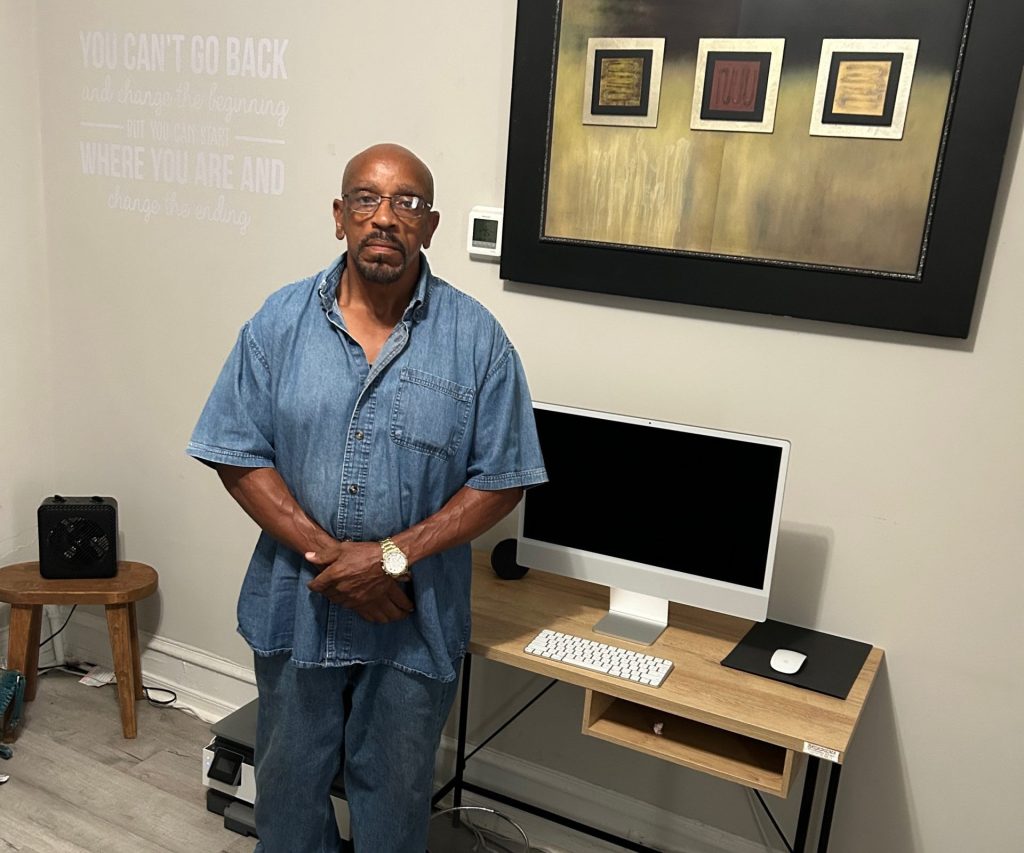
When not studying, he stayed busy from 7 a.m. to 5 p.m. during the week by working with the assistant warden in Deerfield’s administrative offices, he said. His job involved making sure that the floors were clean and setting up for events such as other inmates’ completion of certificate programs.
“So that was my every day, which I looked forward to because I could have normal conversations,” he said. “I could ask [non-inmates] different questions about what was going on in society and what had changed.”
After his release from Deerfield, Washington was sent to Dillwyn Correctional Center in Dillwyn, Va. for about five weeks before his official release.
Washington, who met Gray through a referral program, landed employment in the hospitality industry a few months later.
While life outside prison has sometimes meant doors being shut in his face, Washington said that his faith has allowed other doors to open. In addition to working, he attends weekly sessions at On Our Own, an organization that provides free peer support, self-help initiatives, education and referral services for clients who are experiencing mental health, substance abuse or trauma-related problems.
“And look at me now,” he said, smiling broadly on that warm July day. “I’m living a productive life. I have a bank account. I have a job — Nov. 10 will make a year [since he was hired]. I just went in and purchased a car in cash a few days ago.
“It feels good to be working, paying bills and living a normal life.”
Although he enjoys his new lifestyle, Washington said he tries to stay “even-keeled” and not get overly excited about his life outside of prison.
“Because at any second, it all can be taken away,” he said. “So, I just try to stay optimistic. I always look at the glass half full.”
Editor’s note: This article was updated on Sept. 29, 2025, to correct that Uhuru leased a transitional house for adult men reentering society.