


Miette Michie, the board chair of the Emergency Food Network, has been involved with the organization since 2012, and she’s never seen a surge in need like this.
The situation has been getting worse in the last year or two, she said, but the recent months have surprised her.
“We’ve been at capacity just about every day that we’re open,” she said. “Sometimes we are at capacity at 11 [a.m.], and the phone keeps ringing.”
The Emergency Food Network has been serving Charlottesville and Albemarle County for decades. Run mostly by volunteers, it opens its doors several days a week and provides three days’ worth of balanced food to 30 families who call the same day to request assistance.
“It’s 30 orders, but the size of the family differs. We could have an individual who needs food, or we could have a family of 10 that needs food,” Michie explained.
The need has been growing in recent months, in part due to increasing costs of living, but, with the government shutdown, mass layoffs of federal employees and the uncertainty around the timely arrival of Supplemental Nutrition Assistance Program (SNAP) benefits in November, food banks are worried that the need will continue to grow, driving more and more people to their doors.
“We keep anticipating that the demand’s just going to get higher,” Michie said. Just last week, laid-off government workers came to their door looking for help to get by. “We’re used to serving lower-income people, and now here we’ve got government workers who have been laid off, who are just kind of left out in the cold.”
Last week, the federal government announced that SNAP benefits wouldn’t arrive in November due to the government shutdown. On Oct. 23, Virginia Governor Glenn Youngkin declared a state of emergency to provide hunger relief. It’s not, however, clear whether the benefits will arrive in time and in full for those expecting them.
Youngkin’s Press Secretary Peter Finocchio didn’t respond to Charlottesville Tomorrow’s repeated attempts to clarify who will receive aid and when, and referred back to the news release from Youngkin’s office.
Other federal programs providing food assistance, such as the Special Supplemental Nutrition Program for Women, Infants and Children (WIC) and Temporary Assistance for Needy Families (TANF), a program providing temporary cash assistance to low-income families with children, appear to be unaffected at the moment.
“The Virginia Department of Health is actively monitoring the federal funding shutdown and assessing any impacts. The Virginia WIC Program is continuing normal operations into the foreseeable future. We remain in communication with the U.S. Department of Agriculture to stay informed of any updates,” said Virginia Department of Health Spokesperson Cheryle Rodrigez on Oct. 27. “We encourage families to keep their WIC appointments and stay in contact with their local health departments for any WIC-related needs.”
Sherri McKinney, spokesperson for the Virginia Department of Social Services, said that during November VDSS will operate as usual. However, funding status after November is uncertain. “Hopefully the shutdown will be resolved soon so this doesn’t become an issue,” she said.
Albemarle County Public Schools and Charlottesville City Schools will continue providing free and reduced priced-meals to students as normal, their respective spokespeople told Charlottesville Tomorrow.
Still, Michie is not alone in her concern about the nearing surge in need — other community leaders and those affiliated with charitable organizations providing food assistance expressed similar worry.
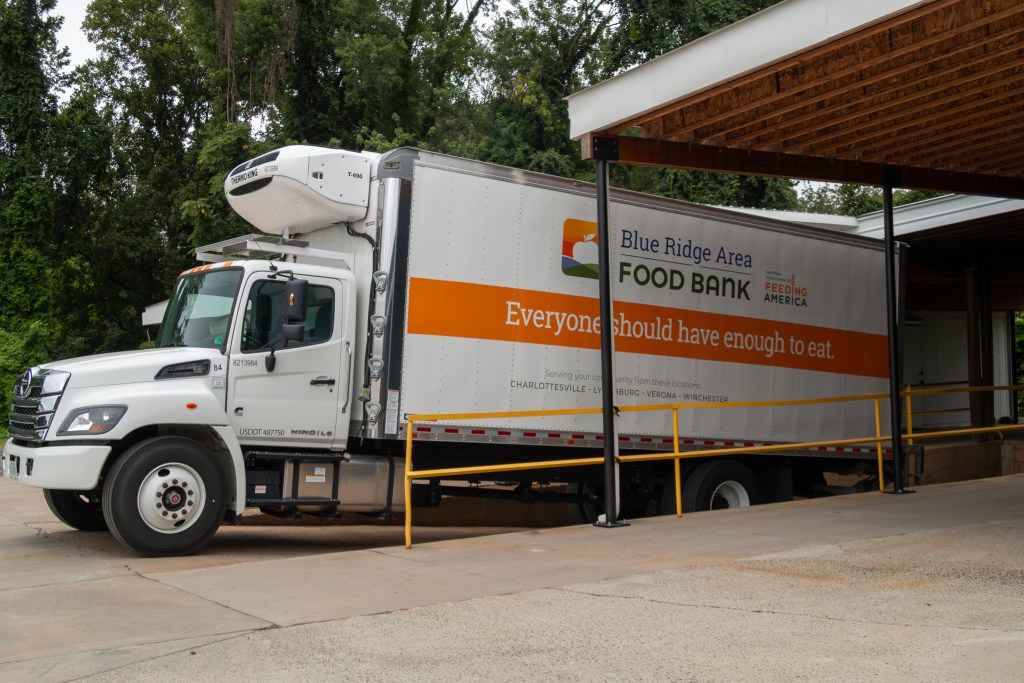
“Just in the Blue Ridge area, there are over 130,000 SNAP recipients. If all of them needed to come to the charitable food network for food, it would be a real problem,” said Les Sinclair, spokesperson for the Blue Ridge Area Food Bank (BRAFB), which provides various food pantries and distribution partners with food in 25 counties and eight cities, including Charlottesville, Albemarle, Buckingham, Fluvanna, Orange and others.
One out of nine Virginians is estimated to experience food insecurity, according to the Federation of Virginia Food Banks. Right now, the charitable food network provides one meal for every nine supplemented by SNAP benefits, he said.
“Just the 10% cut in SNAP could double the impact on the charitable food network,” said Sinclair.
While the governor’s declaration is “fantastic,” said Sinclair, those SNAP benefits don’t account for the overall effects of the shutdown and layoffs in Virginia, with thousands of people affected by federal employment and contracts.

“The folks that used to go out to eat, they aren’t going to the restaurants; the restaurants are missing that money. The wait staff aren’t getting the tips. The people who provide services, whether they’re people that would get their cars cleaned or have their houses repaired, are putting that stuff off, maybe indefinitely,” he said.
“That is impacting all sorts of people. So that trickle-down effect really does have an effect. and those folks who aren’t making enough money end up coming to the charitable food network.”
Loaves & Fishes food pantry in Charlottesville has also been seeing more traffic than before. However, it’s difficult to tie it directly to the shutdown, because Loaves & Fishes was closed from Sept. 28 to Oct. 8 to replace one of its walk-in freezers, said Jane Colony Mills, the pantry’s executive director.
“Missing 6 days of distribution means the visits have been heavier most of the month: 285 households the first day we reopened (10/9), 264 on the 2nd re-open day (10/11). Since then, the numbers are more ‘normal,’ ranging from 153-229 households/day. We usually prepare enough food to serve 200-210 households each day,” she wrote in an email.
While potentially delayed SNAP benefits are an added concern, anyone experiencing financial hardship due to the shutdown may need help from local food banks. “Anyone not getting a paycheck because of the shutdown, whether they get SNAP or not, is going to be trying to figure out where their food is coming from,” Mills wrote.
Nonetheless, anyone who needs food assistance should feel free to reach out for help, said all the nonprofits who spoke with Charlottesville Tomorrow.
Take action
How to find help or support local food banks in the looming food crisis
If you or someone you know is experiencing food insecurity, the Blue Ridge Area Food Bank maintains a searchable map of pantries providing food and other items here. You can also dial 211 to find more food banks and pantries or chat or email Virginia 211 for assistance.
Monetary donations are the best way to support local food pantries to ensure they can stock up on nutritious foods for those in need, they said.
If you’re able, you can donate to the Blue Ridge Area Food Bank, Loaves & Fishes Food Pantry or Emergency Food Network. Loaves & Fishes Food Pantry also accepts food donations and volunteers. Read more information about these opportunities here.
“You won’t be taking from someone else if you need food,” said Sinclair.
He particularly encouraged people who are not used to getting assistance to reach out for help if they need it.
“There’s still a stigma involved here, especially for folks that maybe never have received charitable food, and we want them to know that we’re here for them. They may have been donors at one time. Maybe this is the time when they get to receive, and we look forward to helping them get back on their feet again so that they can be givers again.”
And those in a position to help are encouraged to do so, even if it’s just checking on their neighbors and friends and helping them to figure out where to turn for help, said Sinclair.
La Shawn Pagán contributed to this story.