

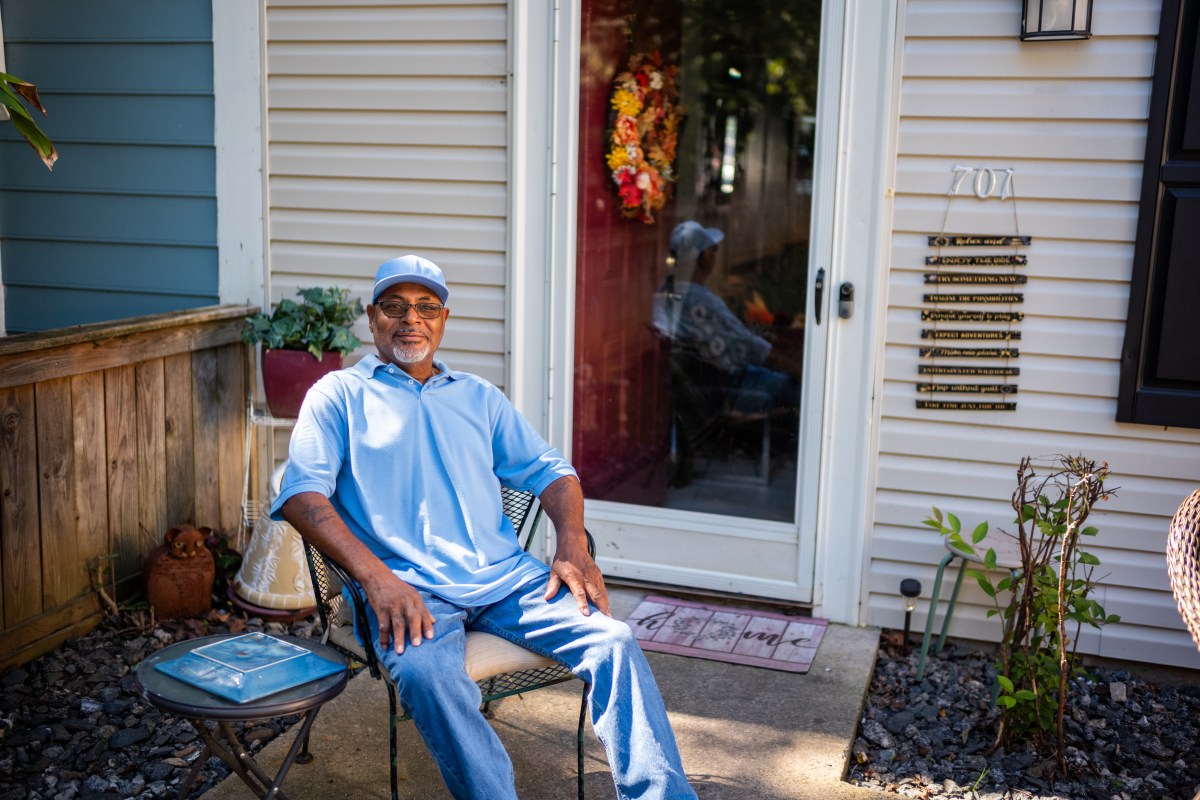
Larry Spencer had walked through the front door of his home thousands of times. But this time was different.
It was springtime, and soft afternoon light trickled through the windows. Spencer walked into the kitchen and lifted a glass out of a cabinet. Standing at the counter, he poured a bit of cognac into the glass, took a sip and smiled.
“It belongs to me,” he said. “It belongs to me.”
Spencer no longer rented his home. He owned it.
For years, homeownership was out of reach for Spencer, who works as a maintenance person. Debt kept him from saving for a down payment or qualifying for a mortgage. High home prices didn’t help — in spring 2026, the median home sale price was about $500,000, according to the Charlottesville Area Association of Realtors housing market report for the second quarter of 2026.
But Spencer’s dream of owning his own home never wavered. He wanted to leave something to his three children, and he wanted to stop paying a landlord for the roof over his head. It felt like giving away his hard-earned money.
Spencer’s situation isn’t unique. Many community members are shut out of homeownership for a variety of reasons, including debt, loan discrimination and high home prices, to name just a few. But the Piedmont Community Land Trust (PCLT) and Piedmont Housing Alliance’s Financial Opportunity Center — two local nonprofits that helped Spencer buy his home — are changing that.
Land trust model expands homeownership to more potential buyers by lowering prices
PCLT’s mission is to preserve and create a permanent supply of low-cost homes in the Charlottesville area, making homeownership accessible to more people.
Like other land trusts across the country, PCLT is able to do that by tweaking the normal homebuying process. It’s not as simple as owning the title to a property, said Luis Oyola, PCLT director.
Here’s how it works: A family or individual purchases a house that sits on land owned by the community land trust. The home price is more affordable because it’s just the home — not the land. The homeowner leases the land from the community land trust in a long-term lease, often for 99 years, and that lease is renewable.
That can help a home stay in a family for generations. For instance, Spencer’s 99-year lease will transfer to his children, and, if his children so choose, their children. Once the 99 years are up, they can choose to renew it.
With this model, the homeowner also agrees in writing that if they sell the home, they’ll do so at a restricted price in order to give the next family a shot at homeownership.
PCLT embeds a resale formula in every ground lease that determines that price. That formula adds 25% of the market appreciation of the home’s value during the owner’s tenure.
This part usually stumps folks, Oyola said. If the sale price is restricted, how can the homeowner build wealth?
The homeowner builds equity by paying their mortgage. And, as the value of the home appreciates over time, so does the amount of money a homebuyer earns when they sell.
For example, a homeowner — we’ll call them Alex — purchased a home on Nassau Street in Charlottesville with PCLT in 2019. The property and house together were appraised at $300,000, and PCLT sold the house to Alex for $215,000. By the time Alex sold the house in 2022, the property and house together appraised at $400,000, an increase of $100,000.
Going by the PCLT formula, 25% of the total appreciation value — $25,000 — was added to the sale price of the home. The next buyer purchased it for $240,000.
Alex got to keep that $25,000 in addition to the equity they built in the time they owned the home.
Factoring in Alex’s down payment and the amount they paid on their mortgage loan over the 2.5 years they lived in the house, Alex gained $10,000 in equity. All told, between the appreciation value and their equity, Alex walked away with $35,000 and used it to purchase a market-rate home in Blacksburg.
Using the community land trust model also results in fewer foreclosures than other types of home purchases, according to a January 2026 report in TIME Magazine. That’s for a few reasons: residents are involved in decision-making, they work with responsible lenders on their loans, and there’s usually a strong relationship between residents and the landowner. The 2007 foreclosure crisis put the model to the test, and people who owned their homes via a community land trust fared better than those who did not.
Even in the worst-case scenario, if the trust dissolves, for instance, the priority is to keep the homeowner in the home, Oyola said. PCLT would give the homeowner the opportunity to buy the land (which they might be able to do with the equity they’ve built up on the home), or see if another nonprofit could take over ownership of the land and the ground lease while maintaining the same affordability terms.
Many community land trusts partner with larger nonprofits to stabilize operations and support fundraising, and to give another layer of security for the ground lease, Oyola said. PCLT partners with Piedmont Housing Alliance.
Homeownership through a community land trust model isn’t for everyone, said Tasia White, Director of Program Management and Strategic Initiatives at Piedmont Housing Alliance (PHA). In addition to her role at PHA, White is a Realtor. But for some, it can be a crucial stepping stone.
“I will say, even for me, when I first got to PHA, I struggled with it,” White said. “But then I understood this is a tool. It’s just an option.” Other options include becoming a homeowner through Habitat for Humanity, or utilizing PHA’s down payment assistance program on its own.
“If you don’t want to rent anymore, but you’re not quite ready to go to the market to purchase a house because of the sales prices, it’s a good space right in between,” White added. “And then you can take the equity from that and go into the market.”
That’s exactly what Alex did with their Nassau Street home.
“At the end of the day, there are pros and cons to the model,” said Oyola. “But what this model is really, really good at is making sure that there’s a number — hopefully a growing number — of homes that will always be sold below market value. No one else is doing that right now. So the fact that a community land trust can do it and is very effective at it, I think that’s worth supporting.”

Spencer had some qualms about the community land trust model. He said he worried “a little bit” about owning the home but not the land, but the 99-year renewable lease and the ability to build equity convinced him. Having guidance from PCLT and PHA helped, too. Otherwise, he might have gotten lost in the process and never had that moment of pride in his kitchen, cognac in hand.
The path to homeownership is not just expensive; it’s complex, said White. A person has to have everything in order financially to be eligible or to even realistically consider it. The language in the contracts is dense. It’s hard to navigate on your own and for the first time. It’s intimidating, and one of the major barriers to homeownership.
There are other significant barriers, especially for Black communities, said White.
“There was a moment where there was so much wealth in homeownership, and then that was ripped away from us,” she said. “There’s this generational gap. So if you haven’t seen anybody close to you do it, it feels very ‘mission impossible.'”
Housing discrimination led to a gap in homeownership that persists today
Generations of Black and other communities of color throughout the country have faced housing discrimination in many different forms, according to an NPR report from May 2021. There was “redlining,” the practice of systematically denying mortgages, loans and other services to residents of certain neighborhoods based on race or ethnicity instead of individual financial standing. These outlines were often made in red on insurance maps, which gave the practice its name.
Racially restrictive covenants included in property deeds prohibited the sale of a property to an individual or household of color. Real estate agents and developers did something called “blockbusting,” convincing white people to sell their homes below market rate and move, on the basis that people of color were moving into their neighborhoods. The agents would then turn around and sell those homes at inflated prices to homeowners of color.
These same communities were later targeted by subprime mortgage lenders, were victims of predatory lending practices and were disproportionately affected by the 2007-2008 housing market collapse and financial crisis, according to research from the Federal Reserve, Economic Policy Institute, the U.S. Department of Housing and Urban Development and others. Many people lost the homes they’d worked so hard to buy, or lost homes that had been in their families for years.
Redlining, blockbusting and racially restrictive covenants are now illegal, but their effects still ripple through communities. Nationally, the 2025 homeownership rate for white households was 75.1%, significantly higher than for Black (44.2%) and Hispanic (48.7%) households, according to the 2026 Generational Wealth & Housing Report published by Realtor.com. The report analyzed data from the Panel Study of Income Dynamics, the longest-running longitudinal household survey in the world, conducted by the University of Michigan; data from the National Association of Realtors; and U.S. Census data.
Those rates are lower in Charlottesville, where 44% of residents own their homes (but UVA students push the number lower), according to the 2025 Community Wellbeing Profile researched and compiled by the UVA Center for Community Partnerships and the City of Charlottesville. But the trend is similar. Locally, 50% of white households own their residence, compared with 26% of Black households and 35% of Hispanic households.
Those numbers are troubling, the local researchers wrote.
“Notably, Black residents are the only racial group to see a possible decline in homeownership in the last ten years,” they wrote. “Addressing disparities in homeownership rates is critical for ensuring equitable access to economic stability and wealth-building opportunities for all Charlottesville residents.”
But new research from the Roosevelt Institute, a nonprofit that advances policies that rebalance corporate and public power, shows that it shouldn’t be the only solution.
“Increasing Black homeownership seems like an easy fix for the racial wealth gap,” Zawadi Rucks-Ahidiana, Associate Professor in the Department of Sociology at the University at Albany, State University of New York, wrote in a study published Oct. 8. But the reality is that “the racism embedded within the housing market makes homeownership an uncertain investment for Black Americans.”
Rucks-Ahidiana’s research suggests that the housing market must be reformed.
Still, the community land trust model is providing more equitable access to homeownership. And it’s doing so by prioritizing housing as a means of community stability, rather than a profit generator, according to a 2024 study from The Brookings Institute, a nonprofit independent public policy research organization.
Black farmers in the South pioneered the model in 1969 in order to preserve access to their land for future generations. And since then, it has spread throughout the U.S. and Europe.
PCLT is one of at least 346 such programs in the United States, according to the Grounded Solutions Network, a nonprofit that promotes equitable and permanent affordable housing. Currently, PCLT has been able to make 55 homes available to low-income households in Charlottesville and in Albemarle, Greene and Fluvanna counties.
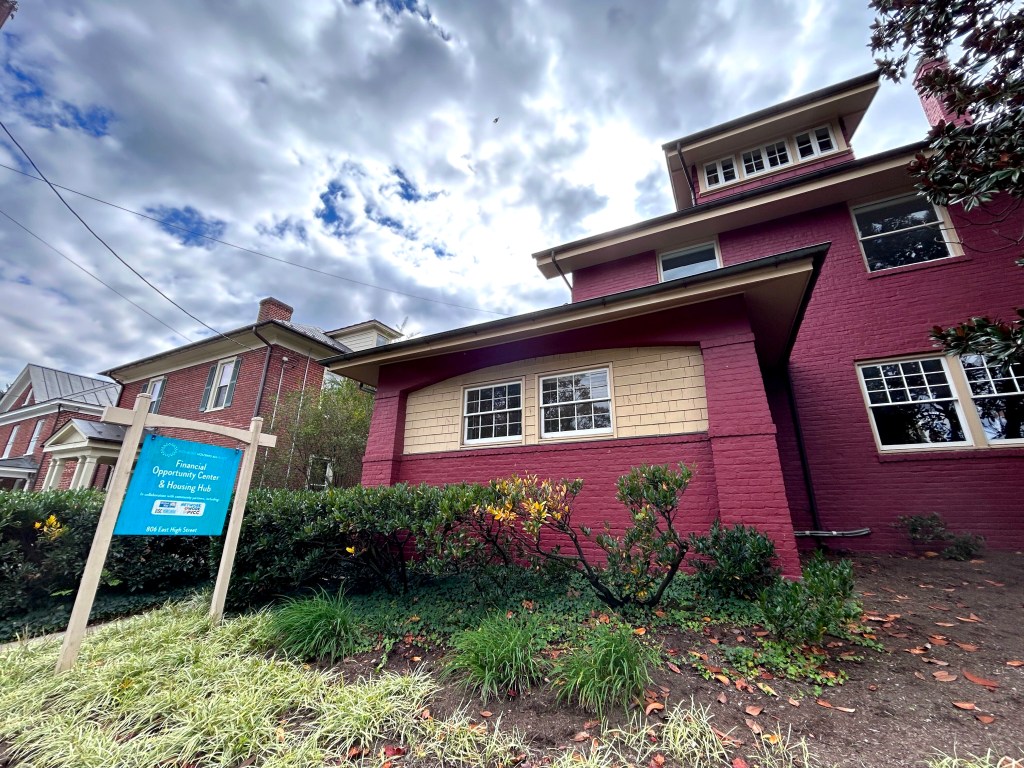
Oyola believes the organization could do more with additional funding.
“If we were able to say ‘yes’ to every opportunity, we’d easily be over 200 homes,” said Oyola. Sometimes a seller approaches PCLT with an opportunity, and there’s just not enough cash in hand to make it happen.
That’s disappointing, he said. But when it works out, and Oyola gets to work with a buyer, it’s wonderful.
‘A lot of folks really wanted to see him get there’
Spencer worked toward his dream for years. He completed a homebuyer education class with Virginia Housing, the state’s housing office, and attended a homebuyer information session at PHA. After that, he started working with housing counselors at PHA on paying down his debt so that he could start saving money, repair his credit score and eventually qualify for a loan. That took a few years, and it wasn’t easy.
“I followed every step that they asked me to follow, and sometimes it got a little rough, a little frustrating,” Spencer said. “But I say, ‘Patience. Patience.'”
When Spencer first started renting his home, he asked if his landlords were open to a rent-to-own agreement. But the landlords weren’t ready to give up the property, Spencer said.
After five years, Spencer’s landlords were ready. They agreed to sell to PCLT, with the stipulation that Spencer buy the home.
He was close to his goal — but there was still a lot of work ahead.
Oyola’s job was to figure out how much Spencer could realistically pay on a mortgage each month, and he used that information to set the sale price. From there, Oyola fundraised to fill the gap between the amount PCLT purchased the land and the home for, and the sale price of the home alone.
At the same time, PHA staff did a lot of “program stacking” to make the home even more attainable for Spencer, White said. With knowledge of all kinds of resources, tips and tricks, and experience doing the same for other homebuyers, PHA got Spencer significant downpayment assistance and showed him a way to get a 1% reduction on his mortgage rate. Together, those things amount to tens of thousands of dollars in savings over the life of the loan and lead to deeper affordability for the buyer.
“If you start stacking all those things up together, you’re cooking,” she said.
White wasn’t involved in Spencer’s work with PHA — instead, she acted as Spencer’s real estate agent. It’s hard to get agents to do community land trust deals, she said, because the lower sale price means a lower commission. But for her, seeing Spencer become a homeowner was the real payoff.
“A lot of folks really wanted to see him get there,” White said. She sees Spencer as “a perfect example” of how the community land trust model, paired with housing counseling and assistance programs, can work.
“The system is the system, and it takes so much to change the system,” White said. “We can. It’s a long process, but creating these programs is our way to maneuver through this system.”
Spencer’s former landlords did not want to participate in this story. “They are private people and don’t find themselves personally very interesting,” Brooks Wellmon, then-Director of Mission Investment and Communications at PHA, told Charlottesville Tomorrow in an email in April 2026.

For his part, Spencer is loving life as a homeowner. When PCLT renovated the home before he purchased it, he got a say. On a recent Saturday morning, he pointed out that the flooring and the cabinets match, and that all of his decor and wall colors, in varying shades of soft blues and grays, with lime green accents, are complementary. For the paint, his maintenance colleagues suggested he go with semi-gloss because it’s easy to wipe down if it gets dirty. He took their advice, and he’s been pleased.
He planned to spend the rest of the day watching college football. He’d already set his living room up for it, a comfy pile of pillows on the couch and a Mountain Dew on the coffee table. Dressed in head-to-toe Carolina blue, he was especially looking forward to the University of North Carolina Tar Heels game.
As he sat on the couch, catching glimpses at the TV out of the corner of his eye, he talked about how he tells everyone that he can about his journey to homeownership.
“I try to help other people,” especially young people, he said. “With the mindset I have now, 30 years ago, I would have been right on.”
“Oh God, I sleep good at night,” Spencer said, laughing gently. “I slept good at night before it was mine, but just knowing my purpose of getting up and going to work is to pay for something that’s mine? That’s an accomplishment. I’m very proud.”