

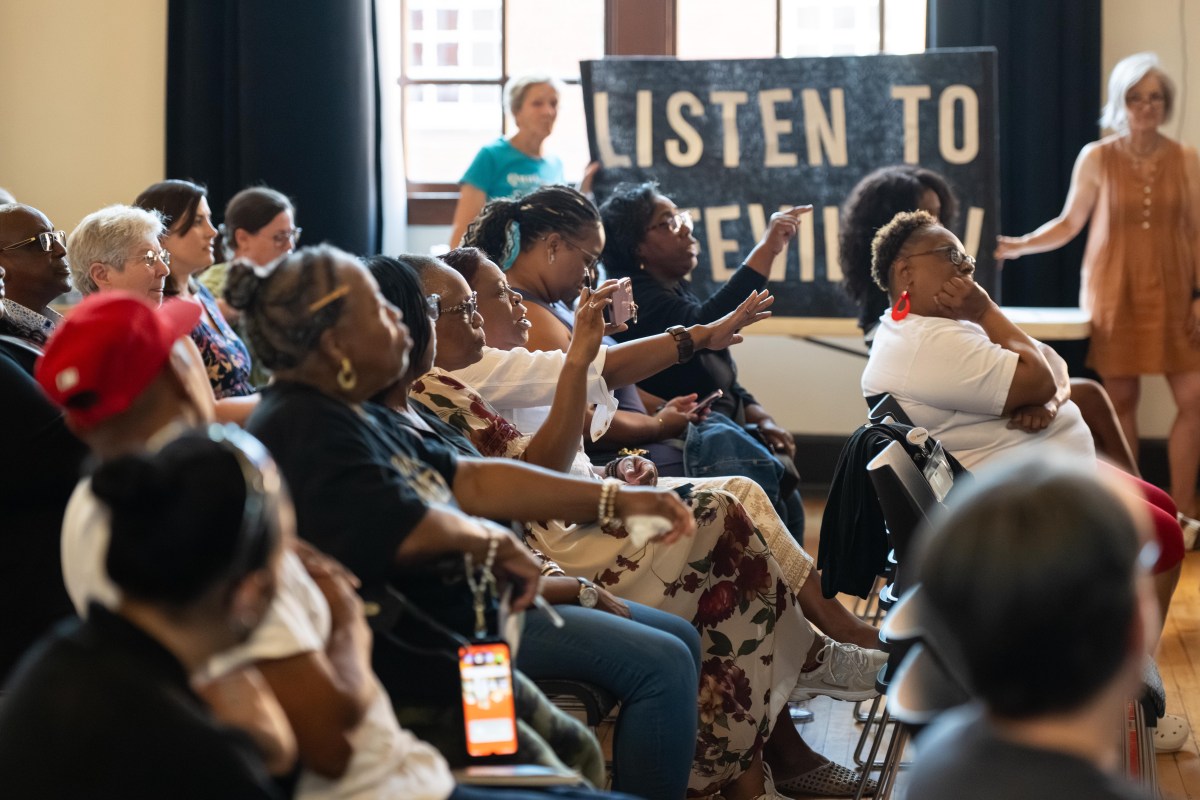
Fifeville residents packed the auditorium of the Jefferson School African American Heritage Center auditorium June 24. It was the first time the neighborhood had the opportunity to meet face-to-face with representatives from Landmark Properties, a developer who, for the past year, has planned to build a seven-story luxury student housing complex in the heart of their neighborhood, one of the city’s last remaining majority-Black areas.
Charlottesville City Council has already approved the project, despite the city’s Board of Architectural Review saying no, and despite Fifeville residents showing up to official meetings and community forums over the past year to oppose it.
And while the residents plan to continue to push back, they also continue to hit barriers that prevent them from turning their concerns into change. Currently, they don’t have a way to compel City Council to reconsider its decision, and they must work within a zoning ordinance that they say gives them little agency in the future of their neighborhood.
“I was not feeling optimistic,” John Mason, a retired University of Virginia professor who has lived in Fifeville for 14 years, told Charlottesville Tomorrow a few days after the meeting.
During the meeting, residents demanded that City Council reverse its recent decision to approve a Certificate of Appropriateness for the building, called The Mark. In order to do so, they said, one of the councilors who voted ‘yes’ — Vice Mayor Natalie Oschrin, Councilor Lloyd Snook or Mayor Juandiego Wade — would have to want to change their vote and call for a re-vote. Residents talked about getting together to pressure them.
The most recent version of City Council’s rules and procedures, adopted in March 2024 and posted on the city’s website, states that a City Councilor can make a motion to reconsider, “subject to the restrictions set forth within City Code Sections 2-73 and 2-74.” The Code states that a motion to reconsider can be made, but only during the same meeting at which the original vote was taken.
The rules and procedures document also says that a motion to reconsider “may not be used in a land use decision involving a rezoning or a special use permit,” and The Mark decision did not involve either.
But there will be no re-vote, Charlottesville City Attorney John Maddux told Charlottesville Tomorrow in an email on Tuesday.
“The Development Code does not contain a procedure by which City Council may re-vote on, rescind, or otherwise undo its decision once it authorizes a Certificate of Appropriateness,” Maddux said, citing Section 5.2.7 of the city’s Development Code and Section 15.2-2306 of the Virginia Code.
That section of the Development Code has to do with Major Historic Review, which the Board of Architectural Review must undertake when a project involves any property located in an Architectural Design Control District or Historic Conservation District, and for any Individually Protected Property.
There are two Individually Protected Properties on the land where Landmark intends to build The Mark, which is why it needed a Certificate of Appropriateness from the BAR. The BAR did not issue the certificate, but Landmark appealed that decision to City Council, and Council voted to overturn the BAR’s decision and issue the certificate.
Even if they could re-vote on the decision, Snook and Oschrin both said that they wouldn’t change their vote in favor of the Certificate of Appropriateness for The Mark.
“I am sorry that our decision on this matter has upset so many people in the neighborhood,” Snook told Charlottesville Tomorrow. “I still think it was the right decision.”
“Ultimately, there is no way to reach affordability without building more units to meet or exceed demand,” Oschrin said in her email. “It’s like musical chairs, if there aren’t enough, no matter how much subsidy is available, someone will be left out.”
With a re-vote out of the question, residents are figuring out their next steps.
“I’m realistic about how difficult it will be to prevent The Mark from being built,” Mason said. “I also don’t think we’ve reached the end of the road.”
‘What you’re doing is not right. I hope you hear us.’
The neighborhood has been fighting The Mark for more than a year. Landmark Properties, a Georgia-based real estate company with more than $15 billion in assets, filed preliminary plans for The Mark in mid-June 2025. Since then, Fifeville residents have attended every City Council meeting and many Board of Architectural Review meetings to voice their opposition to The Mark and to the zoning ordinance that is allowing it to happen.
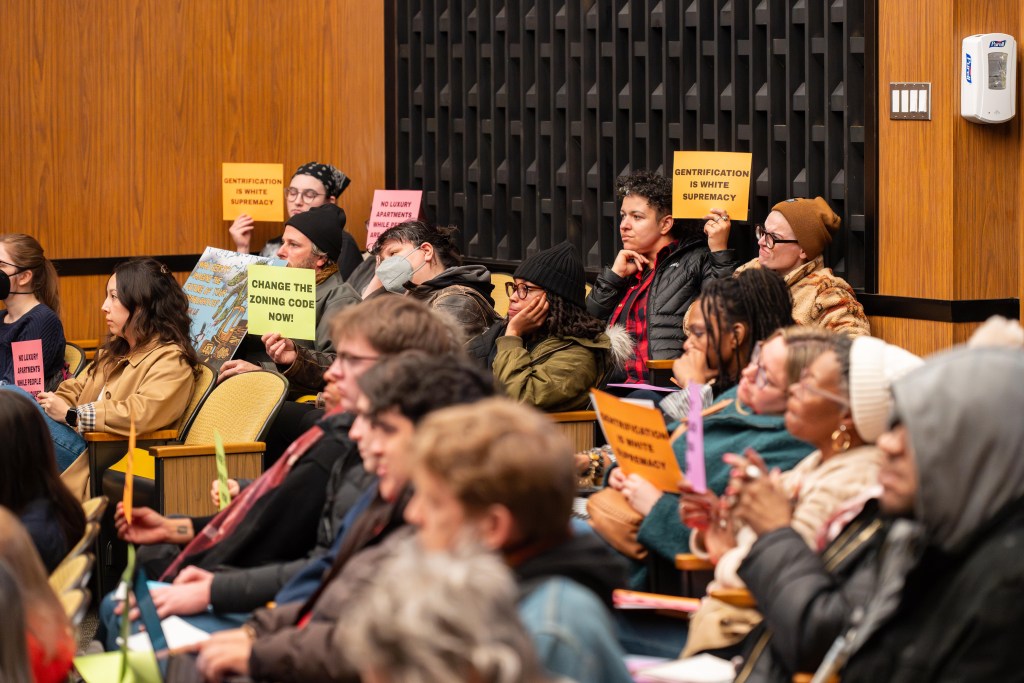
They have been joined at all of these meetings by allies from other neighborhoods, most notably 10th and Page, another of the city’s historically Black areas. Residents of 10th and Page are watching a similar story unfold in their neighborhood, as LV Collective, a Texas-based real estate company with more than $6 billion in assets, plans to build an eight-story luxury student housing complex on West Main Street, right behind the Westhaven community.
As people arrived at the June 24 meeting, some Fifeville residents talked amongst themselves about what they envisioned for their neighborhood. Housing for seniors on a fixed income, one said. Housing for people who are struggling to stay in the neighborhood as housing costs rise. Townhomes. Affordable housing for low-income students would be nice, another person said. None mentioned luxury student housing.
As Landmark project lead Hamilton Reynolds and attorney Valerie Long started a presentation full of information about the project, four community members held up two large bold-lettered banners on either side of the stage.
“Listen to Fifeville,” one said. “Fifeville Residents Over $$!” said the other.
Reynolds and Long talked about The Mark’s size, location, zoning, and the number of car and bicycle parking spaces, among other things. They also talked about the $4.5 million the project will contribute to the city’s affordable housing fund.
“Oh, my God,” someone whispered when Long and Reynolds got to a slide with an architectural rendering of the building as it would look among the small one- and two-story homes along 7th Street SW.
A few slides in, community members had seen enough.
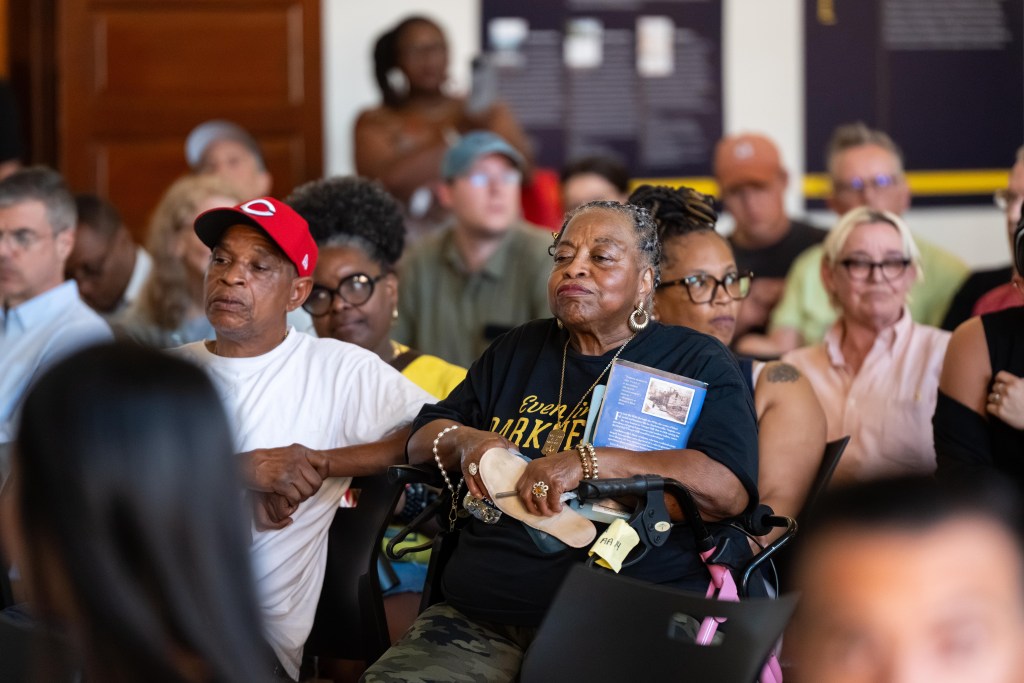
“I don’t see the church,” Gloria Beard said, referring to First Baptist Church, the oldest continuously operated Black church in the city, and one of the oldest in the state.
“You can see the church in the distance,” Long said, gesturing to the projection screen, where a sliver of the church peeked out from behind The Mark.
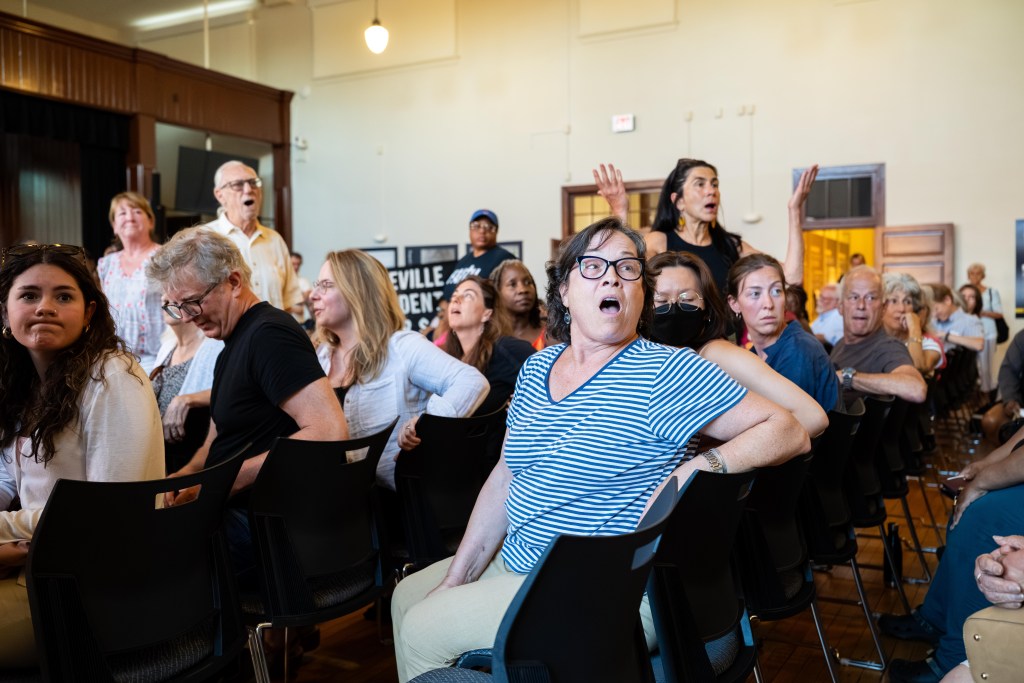
People in the crowd burst into laughter, and when Long tried to quiet them and continue the presentation, the laughter turned into a torrent of admonishing comments, with multiple community members shouting at Long and Reynolds at once.
“We’re not interested in the presentation,” an older Black woman called out. After many months of city meetings, residents knew the ins and outs of the project. They didn’t need a slideshow to tell them what they already knew. Instead, they had questions to ask and comments to make.
Residents didn’t hold back when they repeated the litany of reasons why they don’t want The Mark in their neighborhood. They’re worried about increased traffic on already-narrow streets, about their property values and therefore their tax bills going up. They’re worried about being pushed out of homes they can no longer afford, and about transient UVA students taking over the neighborhood Black residents built. They’re worried about that because it’s been happening in their neighborhood for years.
Kelly, a Black man who did not give his last name when he spoke, is a member of a family who has lived on 6th Street SW in the Fifeville neighborhood for more than 60 years.
“I’ve seen that neighborhood change to the point where my neighbors are no longer my neighbors, to the point where I look like a foreigner,” he said. “We’re probably one of the very few Black families in that neighborhood.”
He asked the developer to have “an ounce of compassion” for the residents before them. “What you’re doing is not right. I hope you hear us.”
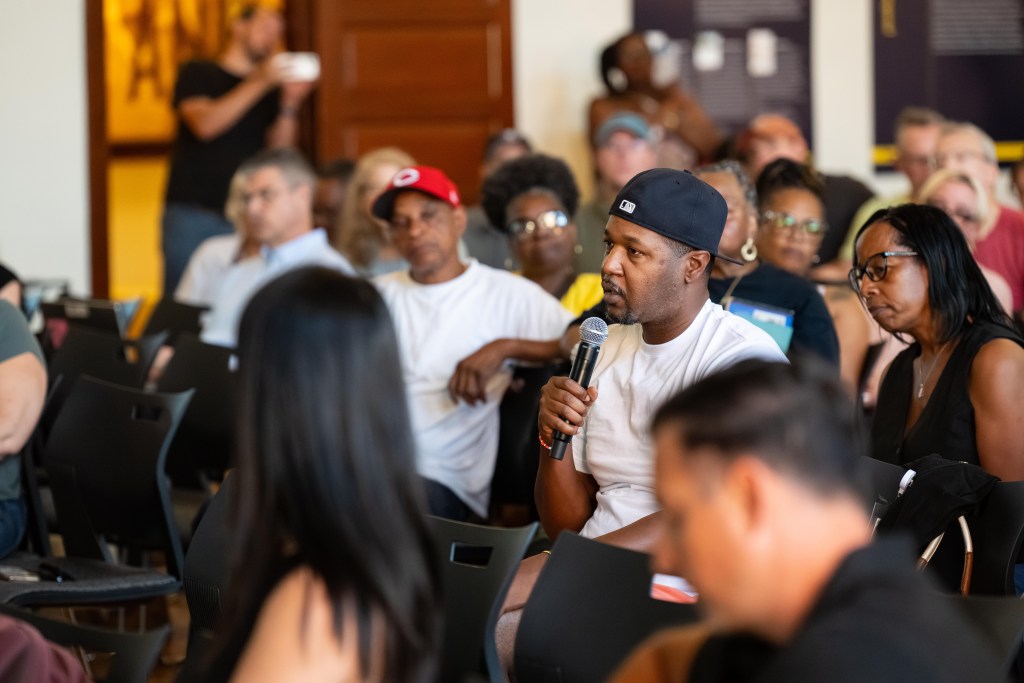
Rosia Parker asked why Landmark chose this particular spot.
Three reasons, Reynolds replied: proximity to the university, the zoning ordinance and the property was for sale.
Some people sucked their teeth at that. Others groaned. A few laughed.
Zoning code gives residents little power to influence development
Throughout the meeting, residents accused Landmark of holding the meeting as a box-checking exercise.
The city’s Development Review Procedures Manual advises, but does not require, developers to meet with the neighborhood they’re hoping to build in at the start of the development process.
The Mark is being built “by right,” meaning that it fulfills all of the requirements laid out in the zoning ordinance and doesn’t need special approval. The only thing it did need approval for was the exterior design and its plan for two historically protected structures on the property. Per the ordinance, that decision was up to the Board of Architectural Review.
Because the BAR is looking at design and historic preservation only, it could not legally take residents’ comments into consideration. The BAR ended up denying the certificate, on the grounds that they believed the building wasn’t appropriate for the neighborhood, in December 2025.
The developer immediately appealed it to City Council, and in a 3-2 vote, City Council overturned the BAR’s decision in May 2026. That gave Landmark the Certificate of Appropriateness it needed in order to proceed to working with city staff on next steps, including a development review and plan approval.
Throughout the entire process, residents learned again and again that they have relatively little power within the zoning ordinance to control the future of their neighborhood.
“It removes a lot of leverage and potential to actually make their concerns heard and translate into changes,” City Councilor Michael Payne said of the zoning ordinance in a phone call with Charlottesville Tomorrow a couple of days after the June 24 meeting.
“The new development code requires a community meeting, as we saw on Wednesday, that meeting is almost meaningless,” Payne said.
Residents wanted to know why Landmark only decided to meet with the neighborhood after The Mark had approval from the city, and not at the beginning of the process. No one on the development team answered that question.


Community members didn’t hold back when it came to telling Valerie Long (right, in blue), Landmark Properties’ attorney, and Hamilton Reynolds, a Landmark project lead, what they think of the company’s plans for Fifeville. Residents wanted to know why Landmark only decided to meet with the neighborhood after their luxury student housing complex had approval from the city, and not at the beginning of the process. No one on the development team answered that question. Credit: Kori Price/Charlottesville Tomorrow
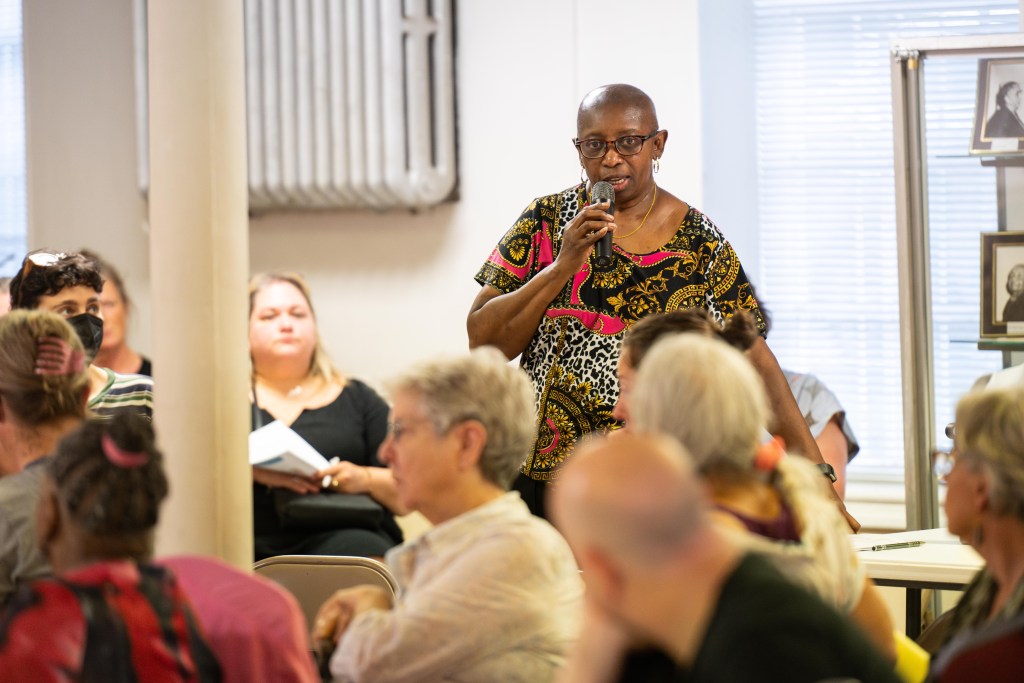
Dozens of people spoke up during the meeting, some giving impassioned speeches about their own experiences, others asking questions that they hoped would further reveal the developer’s intentions and attitudes toward the neighborhood.
Fifeville resident Frank Bechter asked Landmark why, after hearing all of residents’ concerns, the company doesn’t abandon the project.
“It’s complicated,” Reynolds said. “We’ve spent a significant amount of money already towards this. We have a fiduciary responsibility to complete this.”
For many in the room, that response confirmed what they said they’ve known all along, that money, not people, is the concern.
Residents discuss other options to push back
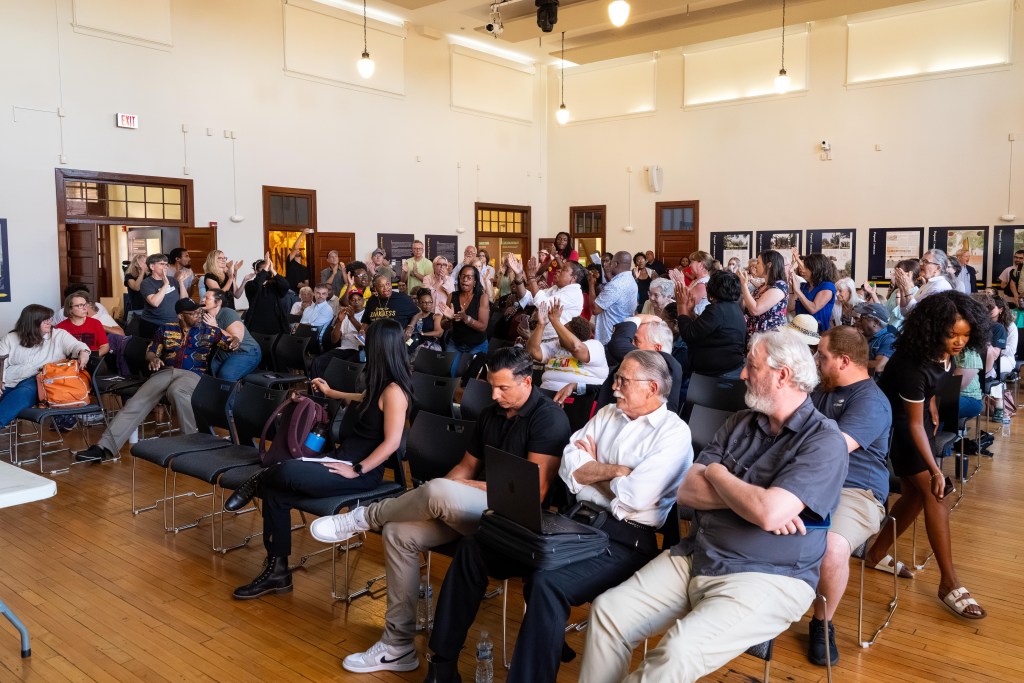
Throughout the meeting, residents repeatedly talked about showing their power as a neighborhood.
“It’s time for us to rise up as a people,” Zyahna Bryant, speaking as a community member and not in her capacity as a Charlottesville School Board member, said. “We don’t want to see Vinegar Hill happen again. We need to see that the people have the power.”
Residents’ takeover of the meeting was a reminder of that, Mason said afterwards.
“I was really happy with the way the citizens of Charlottesville took over the meeting,” Mason said. “It was no longer the developer’s meeting. They had to listen to the anger of the people of the community, the sorry and sadness of the people in the community at the disappearance of Black Charlottesville, of Black neighborhoods, of the sharply declining African American population in the city. They had to listen to both anger and heartbreak.”
So, what power do residents have in this situation now that pressuring City Council to re-vote isn’t an option? It depends on who you ask.
Some residents want City Council to change the zoning ordinance.
Oschrin and Snook, who were put on the spot by residents during the June 24 meeting, are interested in amending the ordinance, but in ways that don’t necessarily line up with what the community wants.
“What I would be in favor of is revisiting the question of how the zoning ordinance will treat neighborhoods like Fifeville going forward,” Snook told Charlottesville Tomorrow in an email on Monday. However, Snook believes that because so few parcels in Fifeville have the high-density zoning that The Mark properties have, “this project isn’t likely to spread in Fifeville.” Still, he’s open to reviewing the ones that do.
Oschrin has different ideas. She wants to see the zoning code amended to allow for more mixed-use commercial areas, something that makes neighborhoods like downtown and Belmont, as well as Fifeville and 10th and Page, attractive. That way, “development pressures can spread out,” she said.
She’s also open to reducing limitations on Jefferson Park Avenue, where a lot of off-campus student housing is currently located. The idea is that encouraging greater density along that corridor would draw more student-oriented housing in that direction, she said.
City Councilor Payne, who voted against The Mark and who has repeatedly amplified residents’ concerns, has an entirely different idea of how, and when, the ordinance should be amended.
Payne wants to expand the “Core Neighborhood Overlay,” which in the zoning ordinance covers parts of the city’s neighborhoods that were deemed most vulnerable to gentrification pressures. He is also interested in either banning student housing altogether in the expanded Core Neighborhood areas, or making student housing allowable not by right, as it largely is now, but by special exemption permit only. In the previous ordinance, buildings of a certain size needed approval from City Council.

That could give Council leverage to require developers to collaborate with the neighborhood on what is known as a “Community Benefits Agreement” (CBA). It’s a type of contract between community-based organizations and the developer of a proposed project. In these agreements, the community commits to support the development of the project in exchange for the developer’s commitment to things that would benefit the neighborhood.
So far, only one development in Charlottesville has a CBA. That’s the 501 Cherry Ave. project, also in Fifeville. And the CBA exists because residents asked for it, City Council supported that request and the developer, Woodard Properties, agreed.
Previously, city officials have said that the 501 Cherry Ave. project and its CBA should be a model for how development should happen throughout the city. But that’s not what’s happening under the current zoning ordinance.
It is unclear whether Landmark Properties is willing to work with the neighborhood on a CBA. As of publication, Reynolds had not responded to Charlottesville Tomorrow’s questions on the matter.
Oschrin said she hopes that the neighborhood and the developer can come up with a CBA, despite the limitations of the agreements, including their enforceability under the current zoning ordinance and development code.
“Even if a CBA is not currently legally enforceable, it can still be the difference between nothing and something,” she told Charlottesville Tomorrow.
Another thing City Council could do, quickly, is change the definition of “student housing” in the zoning ordinance, Payne said. Currently, it is defined as housing that is rented by the bedroom and that is within one-half mile of the edge of UVA Central Grounds or UVA North Grounds as determined by the city’s zoning administrator.
And, when a project is defined as “student housing,” it is not required to include affordable units, and it pays 60% less into the city’s Affordable Housing Fund than non-student housing projects, Payne pointed out. (In The Mark’s case, the non-student housing rate would mean putting about $10 million, instead of $4.5 million, into the Affordable Housing Fund.)
If Council decides to go in that direction, they could also let residents of the neighborhoods decide what to do with that money, Payne said.
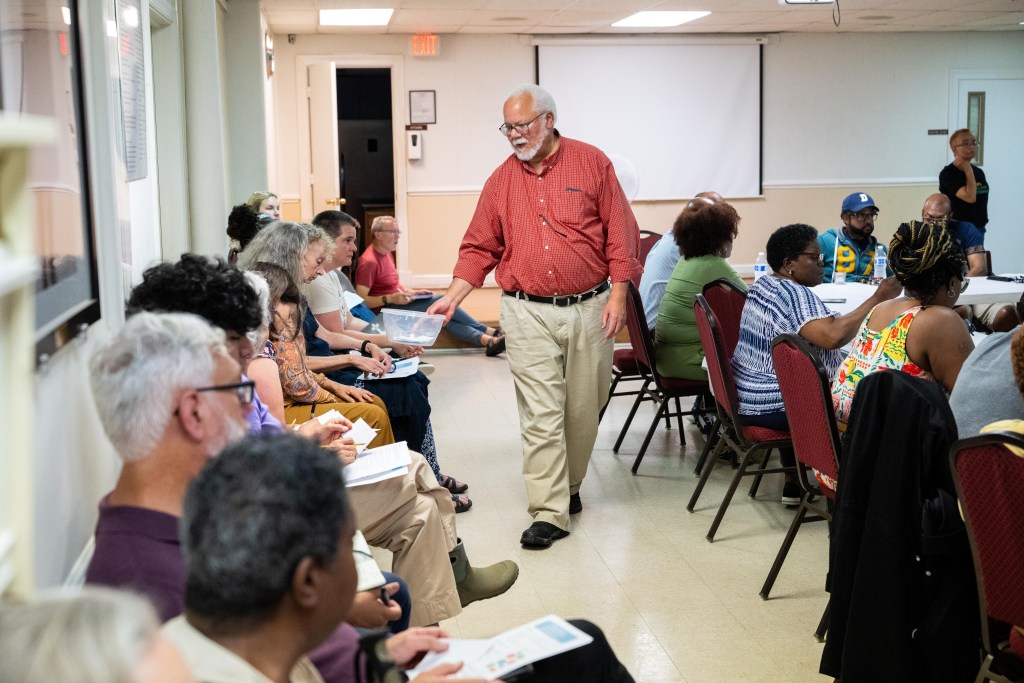
During a community meeting in the basement of First Baptist Church on June 22, community members discussed the options before them, including a CBA. They seemed wary, wondering how it would be enforced if it’s not required under the zoning ordinance.
Other options on the table include asking Landmark to contribute money (on top of its contribution to the Affordable Housing Fund) to a community land trust, which could help ensure affordable housing in the neighborhood, or having the area designated as a historic conservation district, which could limit future development.
Both have their pros and cons, said resident Deanna McDonald. McDonald is part of the Charlottesville Food Co-Op, a community group trying to open a grocery store in the 501 Cherry Ave. development.
“It is important that people understand what they are signing up for and signing off on when they decide to do or not to do these things,” McDonald said. She urged everyone to make the effort to understand the upsides and downsides of each option.
The best way to do that, she said, is to show up to meetings.
Some community members are debating taking yet another action: petitioning to remove from office the three councilmembers who voted to overturn the BAR’s decision and allow The Mark.
Virginia law lays out possible reasons for removal, including “neglect of a clear, ministerial duty of the office,” “incompetence in the performance of the duties of the office” and the conviction of certain crimes. In order to bring such a petition before the Circuit Court, the petition must detail the reasons for removal and be signed by a number of registered voters who reside within the jurisdiction of the officer equal to 10% of the total number of votes cast in the last election for the office that the officer holds.
Charlottesville City Councilor seats are at-large positions, meaning that they represent the entire city. According to the Virginia Department of Elections, 25,619 votes were cast in the most recent City Council elections, when Wade was last elected. Based on those numbers, a petition to remove Wade would need the signatures of 2,562 registered voters.
Both Oschrin and Snook were last elected in the 2023 City Council election, when 27,036 votes were cast, according to the Virginia Department of Elections. A petition to remove either of them would require 2,704 signatures.
If a petition for recall gets enough signatures, it would go to the Circuit Court for a trial.
It’s up to the Fifeville community and their allies what they’ll do next, and the Fifeville Neighborhood Association is ready to listen and facilitate further conversations, FNA president Carmelita Wood told Charlottesville Tomorrow on Wednesday.
“Why adopt our residents’ vision into the Comprehensive Plan, if the City is not going to follow it?” Wood continued. “Our neighbors feel abandoned. We will continue to listen to Fifeville residents and try to find a path forward.”
That’s what Wood and others have done for years, and they’re not stopping now.
“One thing about this neighborhood is that its people will not go down without a fight,” Mason said. “The alternative is giving up, and we are not a giving up set of people.”