
Charlottesville will receive four of the 1,000 election monitors that the U.S. Department of Justice announced it will send across the country on Tuesday in the agency’s largest-ever monitoring effort.
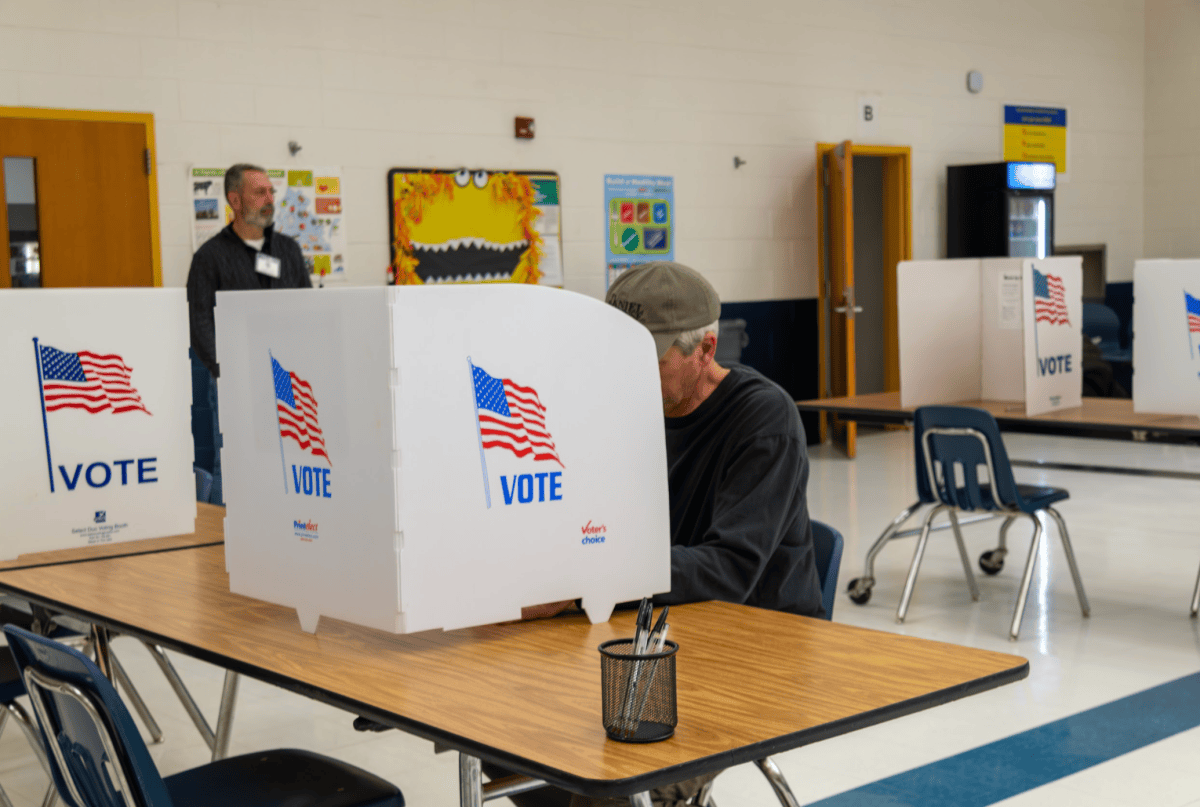
Like previous elections, the DOJ has said its staff will only observe and not interfere in the voting process. They will be in plain clothes and work in teams of two, traveling to various polling locations throughout the day, said Charlottesville Registrar Taylor Yowell.
“We use the term ‘authorized representatives’ inside the polling place,” Yowell said. “They’re trained to make sure that the election officials that are working and operating the election are doing things correctly.”
Election monitoring is a common feature of American elections, including in Charlottesville.
“We have two up front right now,” Yowell said on Friday afternoon.
Virginia law allows “neutral observers” inside polling places at the discretion of the locality’s registrar or electoral board. In Yowell’s experience, folks who ask to be neutral observers come from civic groups, political parties, and even candidate representatives. They come to watch that various laws are being followed, Yowell said. They want to ensure that polling places are complying with the Civil Rights Act or the Americans with Disabilities Act. Sometimes they are watching for more specific issues, such as whether election officials are adequately explaining how provisional ballots work.
Because monitoring happens so frequently, the state of Virginia has regulations on how monitors must behave.
“They are not able to talk to voters inside the polling place,” Yowell said. “They’re not actually even able to talk to election officials. The only election official they are able to talk to is the chief. And if they do not adhere to these specific guidelines that are set forth by the state, then they would be asked to leave.”
Though the DOJ sends out monitors for most elections and has called this year’s plan “routine,” officials and individuals across the country have raised concerns.
The DOJ’s plan to send 1,000 monitors to elections in all 50 states is significantly more than in prior years. During the midterm elections in 2022, for comparison, the Biden administration sent out 388 monitors, according to reporting by PBS.
In Virginia, the DOJ sought permission to monitor Fairfax County, Virginia Beach, Charlottesville and Prince William County. Each locality tends to lean Democratic, though Virginia Beach can sometimes oscillate between Democratic and Republican victories. In the 2024 presidential election, for example, 83% of Charlottesville voters chose Kamala Harris, while she received 65% of the votes in Fairfax, 57% in Prince William and just over 50% in Virginia Beach.
“Requests to monitor were submitted to each locality, as it is the decision of election officials in those localities whether to permit monitors in polling locations,” a Virginia Department of Elections spokesperson said in an email. “The DOJ also provided notice of these requests to the Department of Elections, confirmed their knowledge of the requirements and limitations for monitors in polling locations under Virginia law, and stated that monitors will be trained on and adhere to those requirements.”
In addition to the scale of this year’s monitoring, more concerns stem from the Trump administration making unprecedented efforts to interfere with elections across the country.
Last summer, Trump urged Texas to redraw its congressional maps mid-decade to favor Republican candidates, sparking a wave of other states doing the same. Throughout the last year, Trump pushed for changes to federal voter ID requirements and mail-in ballot laws, although those efforts were ultimately blocked by the courts.
In recent weeks, the DOJ has filed a lawsuit in Alaska, in an attempt to block the certification of the Senate race if the Republican candidate does not win. There is another candidate on the ballot with the same name, and the agency suggests it could confuse voters. Just days before the election, the DOJ requested California to stop processing more than 20,000 ballots, which the DOJ has identified as “likely” noncitizen voters, and has asked the Supreme Court to step in.
Here in Virginia, Prince William County’s General Registrar Eric Olsen denied DOJ monitors access to his county’s polling places, telling the Prince William Times that he wants to avoid “inappropriate federal intervention.”
Apart from several locations that were contacted ahead of time, the DOJ said in a statement shared with Charlottesville Tomorrow that it will be at numerous other locations around the country “but we will not share the full list until Election Day.”
Take action
Trouble voting? Here’s how to report
While the registrars Charlottesville Tomorrow spoke with don’t anticipate any issues on Election Day, if you do encounter a problem while voting, you have options.
Nelson County Registrar Jackie Harris and others encouraged voters who encounter issues or have concerns on Election Day to speak directly with the chief officer of election at their specific polling location.
“They know how to notify us and then we can escalate it or contact emergency services, party chairs or whoever may be appropriate at that time,” Harris said.
If you have an issue that cannot be resolved successfully in person, voters can call the Election Protection hotline at the following numbers:
- English: 866-OUR-VOTE
- Spanish: 888-VE-Y-VOTA
- Asian Languages: 888-API-VOTE
- Arabic: 844-YALLA-US
You can learn more about your rights as a Virginia voter at the Fair Elections Center website here.
In central Virginia’s rural counties, registrars reported that they have not received any formal notice of federal observers on Election Day and don’t anticipate their presence, but remain prepared for all contingencies.
“We don’t anticipate any issues, and we’re prepared to respond if anything were to arise,” said Jackie Harris, Nelson County Registrar. “It’s our goal to make sure that everyone’s safe, and that the voting experience is honest and fair and consistent across voter to voter.”
Harris has previously worked as the registrar for Fairfax County and as an international election observer. She said her office will follow standard protocols on Election Day and that if observers do show up, federal or otherwise, they will be expected to adhere to state law.
“It’s basically an observation role,” said Patricia Morton, the General Registrar for Appomattox County, who says it’s unlikely any monitors will be in her area. In her experience with campaign monitors, she said they are allowed to “sit and listen, not see records directly, not interfere in any way, not bug the staff with questions.”
The DOJ itself makes clear that its monitors will be uninvolved observers.
“All monitors must meet the same legal and ethical requirements, including that they not interfere with the voting process,” the agency said in an emailed statement. “Every monitor has the same role: observe for potential violations of federal law and report concerns to the Department, which the Department will review after Election Day and act where appropriate.”
Harris noted that her office has already prepared identification lanyards and “dos and don’ts” guidance for any authorized representatives who may appear at Nelson County polling locations. For example, election monitors are prohibited by Virginia law from viewing private voter information or disrupting the check-in process.
Virginia Code § 24.2-604 also prohibits any firearms within 100 feet of a polling location, with limited exceptions for law enforcement. Election observers are not law enforcement and are generally considered subject to the same guidelines and prohibitions as the public.
On Wednesday, the DOJ said in a court filing that federal election monitors would not act as law enforcement, have been trained not to interfere with the voting process, and will not be allowed to carry firearms, according to reporting from The Hill.
According to that same court filing, employees of the FBI and U.S. Immigration and Customs Enforcement (ICE) will not serve as election monitors. Greene County Director of Elections Jennifer Lewis-Fowler said that despite the county’s existing 287(g) agreement, she does not anticipate any ICE presence at polling locations.
Like Harris, Lewis-Fowler said that she had not received any requests from the DOJ or any other group to send election monitors. She added that her staff has experience working with election observers, as local party representatives often monitor polls in Greene County without advance notice.
Registrars in Orange, Madison, Louisa, Buckingham and Prince Edward counties also confirmed that they had not received requests for federal monitors, but have established communication channels with local law enforcement to ensure security. Voters who encounter issues or have concerns on Election Day are encouraged to speak directly with the chief officer of election at their specific polling location.
In Charlottesville, Yowell said the DOJ monitors will watch for compliance with a long list of federal laws, including the Help America Vote Act, the Americans with Disabilities Act, the Voting Rights Act and the Civil Rights Act, among others.
If monitors see something amiss, state law prohibits them — or any observer — from bringing it up. They must simply take note and report back to their agency.
“We know that elections are run well in Charlottesville, so I’m not necessarily worried about something being found,” Yowell said. “That is not something that we are stressed about in our office at all.”