

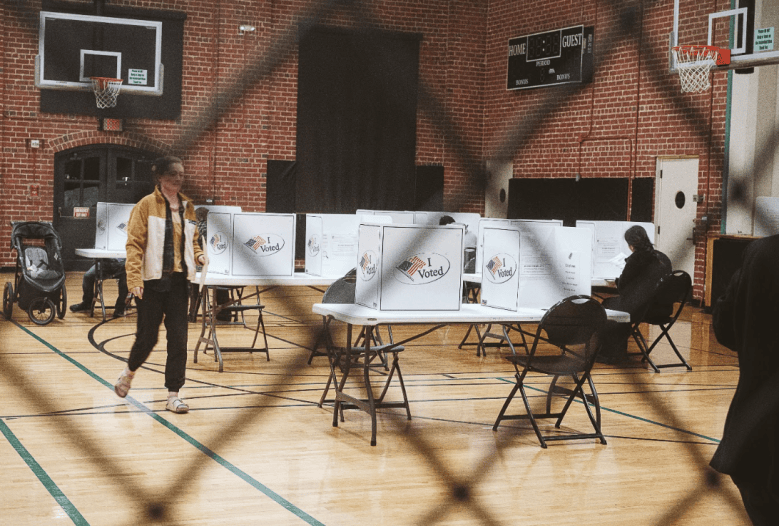
This year, over 200,0000 Virginians with past felony convictions regained their right to vote, and are eligible to vote in the upcoming Nov. 3 elections.
All Virginians with felony convictions are now automatically granted voting rights upon release from prison, except for those with convictions of murder, voluntary manslaughter and involuntary manslaughter, according to the Virginia Department of Elections. Residents with these convictions still need to petition the governor to restore their rights to vote.
The Virginia Department of Elections has mailed 234,852 Virginians notices about the policy change, as reported by VPM.
Even so, there has been widespread confusion. Groups that work with formerly incarcerated individuals say many do not realize they are now eligible to vote. And that when someone is released from prison, registering to vote isn’t exactly top of mind.
“What I’m hearing and seeing is that there’s still a lot of confusion. A lot of people who are already home don’t even know that their rights have been restored,” Martize “Tez” Tolbert, who leads programs for people re-entering society after incarceration (often called “re-entry services”), told Charlottesville Tomorrow. “To me the biggest issue right now is making sure people actually know that they have the right, and understand how to exercise it.”
Take action
Register to vote
To register to vote in Virginia you can submit an online application before midnight on Friday, Oct. 23, or fill out a paper application at a local voter registration office (also known as the registrar). Paper applications should also be available at your local library or DMV, among other locations, which you can mail (postmarked on or before Oct. 23) or drop off at your registrar before 5 p.m. Oct. 23.
You should get a confirmation of your registration status by mail. If you don’t, you should contact your local voter registration office.
If you miss the deadline, you can register and vote between Oct. 24 and Oct. 31 at your local registrar or register and vote on the spot on Election Day (Nov. 3) at your designated polling place. These ballots will be “provisional,” but all provisional ballots are counted.
Here is updated guidance from the ACLU of Virginia on registering to vote with a past felony conviction, plus a nationwide tool to help check if you can vote.
Kate Fraleigh, a local volunteer who registers voters and gives people rides to the polls, said she has encountered multiple people with past felony convictions who said they weren’t eligible to vote but she suspected that they likely were eligible under the new policy. She was concerned a lot of Virginians might be in the same boat. (Fraleigh is also involved in The People’s Coalition, a criminal justice reform group.)
This reflects the confusion among state officials.
This all started on Jan. 22, when a judge ruled that Virginia law violated a federal law from the Reconstruction era. U.S. District Court Judge John Gibney sided with plaintiffs Tati Abu King and Toni Heath Johnson in a class-action lawsuit filed by the ACLU of Virginia and co-counsel partners against the state of Virginia. The attorneys argued that preventing Virginians with felony convictions from voting violated the 1870 Readmission Act and that the state was illegally denying citizens’ rights to vote based on convictions that didn’t exist in common law at the time. (Common law refers to a law developed through judicial decisions rather than statutes.)
The judge’s ruling affirmed that this practice violated the 1870 Readmission Act. This Act had allowed the state of Virginia back into the Union after the Civil War and stipulated that “the Constitution of Virginia shall never be so amended or changed as to deprive any citizen or class of citizens of the right to vote by the Constitution herein recognized, except as a punishment for such crimes as are now felonies at common law.”
At first, the office of Attorney General Jay Jones interpreted the Jan. 22 court decision to mean 284 modern-day felonies that correlated with “felonies at common law” in 1870 could rescind someone’s right to vote. The U.S. District Court Judge John Gibney issued an opinion on Aug. 19, 2026 that only 11 modern-day felonies aligned with the common-law felonies at the time.
Ultimately, in mid-September the Virginia Department of Elections updated its website with their new policy, which only denies the right to vote for people with three types of felony convictions.
Advocates worry that the confusion caused by all of these changes decreases the likelihood that formerly incarcerated people will vote, compounded by the fact that for many people released from prison, voting isn’t a top priority.
Tolbert directs One Stop Shop, a bimonthly resource fair for central Virginians recently released from prison and is also a national director at The Fountain Fund, an organization that offers low-interest loans and financial coaching to formerly incarcerated people in Charlottesville, Richmond, Philadelphia and Boston. Tolbert himself regained his right to vote in 2019, but that was only one part of reacclimating to life after incarceration.
“For me, it was about rebranding, rebuilding my identity, and getting a voice and getting connected back to the community,” he said. He described making amends with his family and friends, and going back to school.
“People are dealing with so many day-to-day things,” he said. “Two, three jobs. You’ve got to deal with kids, and childcare is up to $250 a week, $300 a week.”
It’s hard for some recently released people to feel like their vote matters, he said. But whenever he works with a client who thinks that, he pushes back.
“That’s when I come in,” he said. “Yes, excuse my language. Yes, the hell it does. Collectively, yes, it definitely matters. Trust me, I’m the one who definitely believes in it.”
The One Stop Shop resource fairs are every other month, and the election is coming up fast. For people who haven’t been able to get advice in person, there are still plenty of resources available and many ways to register to vote and cast their ballot.
In order to vote in the state of Virginia, registration is required, which voters can do ahead of the registration deadline, during “early voting,” or on the spot on Election Day.
The registration application includes a question about having a felony conviction as well as a question about restoration of rights. The ACLU of Virginia has published updated guidance on how to fill out these questions:
Applicants should answer “yes” to the question about having a felony conviction, even if their record has been sealed or expunged. They should answer “no” to the question about if their right to vote has been restored, unless they have received clemency from the Governor. If they are not sure, they should answer “no,” the ACLU of Virginia said.

Taylor Yowell, the Charlottesville registrar, said that the registration process is the same for voters who just got their right to vote restored as it is for all Virginians. Rather, it’s the back-end process that’s now slightly different.
Before, a felony conviction and no confirmation of clemency from the governor meant the registrar would automatically deny the registration application, said Yowell. Now, registrar staff look up applicants with previous felony convictions to verify their eligibility.
Yowell confirmed that many residents with past felony convictions have already been added to the eligibility verification system as a result of information sharing between the Virginia State Police and the Department of Elections.
If the registrar can’t find the applicant in their system, they will contact the Department of Elections to get additional information.
As of Oct. 16, 2026, Yowell said she herself had processed a handful of applications from people with felony convictions, and they all showed up in the eligibility verification system. She wasn’t able to provide Charlottesville Tomorrow with an estimate of the total applications from people with felony convictions that the Charlottesville registrar has processed.
Though voters can register and vote on the spot, Yowell advised against waiting until Election Day to avoid mistakes that could delay or completely disqualify the registration and the vote. For example, if someone forgets to fill out their full Social Security Number and only writes four digits, and the election officer doesn’t catch the mistake, the same-day registration and ballot will be rejected.

Subscribe for Voter Guide updates
The latest from the 2026 Voter Guide

Gordonsville Town Council candidates agree EMS wait times must improve, diverge on how to tackle affordability challenges in Q&A
Nick Paxton said the town should make better use of services and resources it already has, and Mary “Cyd” Black says the town needs more affordable housing.
Can Scottsville grow without pricing out its own? Town Council candidates describe their visions in Q&A
Candidates also weigh in on traffic safety, lost pharmacy access and how to mitigate flood risk.

Major chains, Latin American grocers or a bigger farmer’s market? Orange Town Council candidates split on how to land a second grocery store
Candidates also offer diverging views on data center development, housing costs and public spaces in Q&A.