


There are bullet holes in the red brick walls of the 700 block of Prospect Ave. — a reminder of what this neighborhood experienced just a few years ago.
It felt like Afghanistan, said Sterling on a hot evening on July 16, standing in front of his two-story apartment building marked by one of the bullet holes. This one, he explained, was from a shootout at the end of the block a few years earlier. He and his friend were sitting in chairs outside, enjoying the weather, when it happened. A few bullets strayed their way, one of them hitting that wall.
Later, the police said that if it hadn’t been for a tree standing between them and the spot where the shooting broke out, one of the bullets would have hit Sterling’s friend. Instead, it was caught by the tree, leaving a mark. Sterling, who asked to be identified only by his first name, has more stories like that from his 20 years in the neighborhood.
The area used to be so dangerous that almost every long-term resident who spoke with Charlottesville Tomorrow had a story of gun violence, crime and loss. Someone was robbed at gunpoint entering their building, others hid under the bed when shooting broke out at night.
Shootings broke out so often it felt like they were happening every other day, Sterling recalled. Children weren’t playing on the streets then. Not the way they play now — running around the parking lot with their friends and siblings.
It didn’t happen overnight. But, slowly, things started to change around Prospect Ave. It became safer, said Sterling.
There were a few changes — steps taken by the city, community organizations and the management company of the Greenstone on 5th apartments — meant to improve neighborhood safety. Many believe the changes were a result of a combination of those.
Though some residents, including Sterling, credit Central Virginia Violence Interrupters (CVVI), a Charlottesville-based nonprofit formerly known as Buck Squad. It’s a group of locals, most of whom have a criminal record or past experience in the criminal world, who became fed up with the gun violence tearing through their community in 2020 and started patrolling the streets, hoping to intervene in conflicts before shots were fired.
“We hardly had any shootings here since these guys have been here,” said Sterling.
This, he worries, might change. CVVI lost a lot of its funding this year.
The group has already let go of half of its staff, bringing the number of paid members down from 18 to 10, according to CVVI leadership.
Part of it — $250,000, which the group hoped to use to expand — was a casualty of federal funding cuts from the Department of Justice, which reduced various violence prevention initiatives because they no longer aligned with the Trump administration’s objectives.
The other part — the part that emotionally hurt the CVVI leadership more than the federal funding losses — was a reduction in the financial support from the City of Charlottesville. Last year, they received roughly $200,000 in local taxpayer money. This year, with more nonprofits requesting the City’s support, they received $94,000. It costs about $450,000 to run their operations for a year.
There is a Virginia Department of Criminal Justice Services’ grant CVVI has been approved for, but the final approval from the federal agency has been slow, said Tommy Everett, CVVI’s accountant. They just need to make it until then.
“It’s very tight until then,” he said.
Created in the wake of violence
CVVI was formed at the beginning of 2021, when the whole nation was facing a spike in gun violence and gun-related deaths.
Charlottesville wasn’t an exception. The Charlottesville Police Department doesn’t track “gun violence” as a single measure. Instead, it collects different data points that, taken together, give a picture of trends. Charlottesville Tomorrow examined three of those: publicly available 911 calls reporting “shots fired,” and CPD records of assaults or homicides involving a firearm.
In 2021, the 700 block of Prospect Ave. stood out. Police received 13 calls of shots fired there — about 15% of the citywide total of 88 that year. That was more than twice the number of calls from the same area in 2020, and higher than in previous years. Police also reported four aggravated assaults with firearms that caused injuries in 2021.
After that spike, the numbers fell sharply. Officers recorded just two shots-fired calls from that block in 2022, four in 2023, and one in 2024. In 2023, one person was shot.
CVVI takes credit — and pride — in the decreased gun violence rates in areas where they are present.
According to data on its website, the group interrupted more than 300 cases that were on the verge of becoming violent, and answered many additional calls from community members since 2021.

That’s the idea behind their approach: Intervene before shots are fired. Community members can call them on the group’s hotline, and CVVI staff respond to de-escalate the situation, even if it’s not in their primary 700 Prospect Ave. zone. Other times, they might spot trouble brewing within the patrol zones and step in.
It’s a thorough operation — CVVI members in bright orange or neon yellow shirts are stationed along the road by the entrance down to the Prospect Street so they’re visible to anyone arriving with bad intentions, a reminder that the area is protected, explained Bryan Page, CVVI assistant executive officer and a founding member.
This position, said Page, also helps CVVI members spot people who they know could cause trouble entering the neighborhood, so they can alert others to step in before violence breaks out.
A lot of this model relies on CVVI’s familiarity with the criminal world, he said. Since all CVVI members have interacted with the criminal justice system or had experience on the streets, the group draws on their reputations and connections. They talk to currently incarcerated people to know if a troublemaker is about to be released — or to persuade someone to join CVVI instead of risking going back to their old ways.
And whenever they suspect someone is about to cause trouble, on the 700 Prospect Ave block or elsewhere, they try to find a staff member who knows the individual. That personal connection gives them a chance to talk the person down, explained Page.
This intervention model was built on research by Dr. Gary Slutkin, a renowned epidemiologist, who suggested that gun violence spreads in a way similar to the HIV/AIDS epidemic — it sparked in clusters among the most vulnerable communities. The public health approach to HIV/AIDS is to identify individuals at risk before they contract the disease. The model relies on education so communities can contain the virus’ spread.
Gun violence, he believed, can be treated the same way — a trusted community member can intervene before shots are fired and follow-up from there, ensuring the person has resources needed not to reach for a gun again.
That’s what CVVI does. The group recruits people with criminal backgrounds to be “credible messengers” — to persuade those with guns in their hands that shooting is not a solution. They were trained by Chicago-based nonprofit Cure Violence Global, founded by Slutkin, which prepares select community members to be such credible messengers and de-escalators.
CVVI is certain this model works. It might be hard to prove to outsiders that they are behind the decrease in shootings, said Herb Dickerson, executive director and one of the founders, because the absence of shootings is harder to quantify than shots fired. But they know when they helped avoid a bad situation.
“We’re in front of guns all the time,” he told Charlottesville Tomorrow in late May.
And their involvement doesn’t stop at intervention.
“It’s all about community work,” said Page, walking around their “zones” on a hot and humid Charlottesville evening in late July. Some people walking or driving past him nod in acknowledgment.
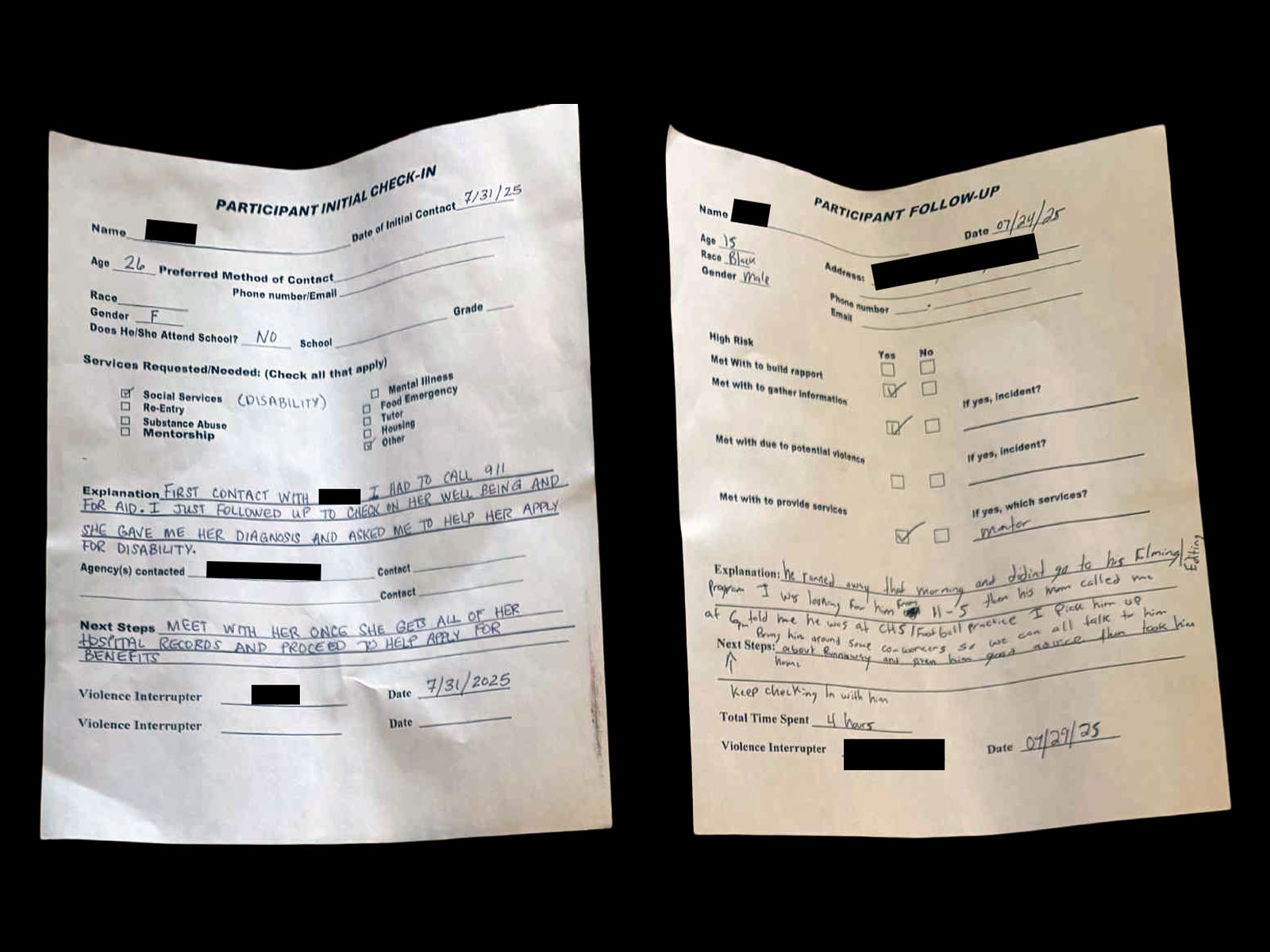


Every time CVVI members step in to de-escalate a conflict, they have to file a report. They file another after checking in on the person’s wellbeing and figuring out how to help them avoid getting into trouble in the future.
Some group members also mentor area youth, Page and Dickerson said. The group does follow-ups with individuals they determine are “at-risk” of dropping out of schools or engaging in criminal behavior, connecting them with mental health resources, GED classes, and employment opportunities. They have also helped residents obtain their Virginia Identification Cards.
“We can’t sit and wait for the government,” Page says. The Black community has to find a way to uplift itself, he added.
During a walk on a different day around the five blocks of Prospect Ave. they patrol — zones one through five — Page talked a lot about the issues he sees in the area. And all of them have one root cause, he says: poverty.
These are all low-income housing complexes. And growing up poor can make kids more vulnerable to choosing a wrong path, like joining a gang, he said.
With so few resources available — whether it’s mental health support to address generational trauma, recreational spaces for kids to play in or the financial means to afford sneakers that help kids fit in at school — it can feel easy to say “yes” when someone offers money for a small errand.
But that’s often how it starts, Page said. One step leads to another, and suddenly a kid is caught up with a gang and buying a gun — because everyone else has one, and they’re afraid not to.
Some residents say Abundant Life Ministries, CPD have helped make a difference
Charlottesville Police Chief Michael Kochis says Charlottesville does not have a gang problem. How much gangs have a presence in Charlottesville can be debated, he believes.
There are different ways to define what makes a gang. The way Code of Virginia defines it, it’s a group of three or more people with an identifiable name or symbol whose goal is criminal activity and whose members committed at least one violent crime. And, based on this definition, Charlottesville has gangs.
Kochis himself thinks of gangs as an organization with a centralized structure, and Charlottesville does not quite have that, he said.
“I would just say we have neighborhood gangs that aren’t as organized, but they do exist,” he said.
He appeared to be in a great mood, leaning on the couch in his office and chatting easily with Dorenda “Rennie” Johnson, a member of the inaugural Police Civilian Oversight Board and a longtime resident of the Prospect Ave. neighborhood. He had invited her to join the conversation with Charlottesville Tomorrow.
Rennie, he said, could speak about the neighborhood in a way he could not. They met during one of Kochis’ weekly neighborhood walks, when he makes rounds in Charlottesville communities to meet the residents that CPD serves. One day, they started talking about the neighborhood and about how much Rennie grew to dislike CPD. Kochis wanted to improve the relationship between CPD and the community, she said, so they grew to be friends.

Now he calls her when something happens in the neighborhood to ask how everyone is, Rennie said.
Fifeville used to be very dangerous, Rennie recalled. All of Fifeville. In the 1990s, it was unsafe to walk down Prospect Ave. because of gang activity. And some nights, shooting broke out.
“You are lying in bed, so scared that one of those bullets is gonna come through your window. So you roll off your bed like you in Iraq or somewhere. My kids would come running ’cause they would be scared, and I would tell them, ‘Get down, get down, stay down. Don’t stand up, stay down.’ And so we would do that until those shots stopped,” she said.
She hates guns, she said. Her 3-year-old brother was shot by a stray bullet more than 50 years ago elsewhere in Charlottesville. The family eventually moved to Fifeville, but it didn’t feel safe there either.
Kochis described that part of Fifeville as one of the “pockets of underinvestment” in people. Many nonprofits in the area are working to improve the situation, but they are not as connected as they should be to address it, he said.
“A lot of things we can do,” he said. The question, however, is who needs to do it. “There are other cities that have gun violence coordinators, there are other cities that have different things. We don’t have that. We have a very fractured system, if you will.”
Now, Kochis said, most issues come from people who do not live in the neighborhood but visit and cause trouble — echoing a point made separately by Page.
Neither Rennie nor Kochis had an opinion on what role CVVI played in improving the neighborhood. Considering where she lives, Rennie said she should have heard more about the group.
Kochis said his distance from CVVI is intentional — the group is designed as an alternative to police, and its independence is important.
He does, however, think that other models of violence interruption could be more effective than the model CVVI uses. Under the current setup, if someone has a complaint against CVVI, they would submit it to CVVI itself. The group, in turn, will investigate and report to its board.
Other models in other Virginia cities like Norfolk and Richmond have violence interruptors either work directly with or accountable to the city government.
That accountability piece can help to build trust, Kochis believes.
“The idea of community-based violence interruption is one that I support. And it’s one that has shown to work in other places.”
When it comes to neighborhood safety changes, Rennie credited the recent improvements in the neighborhood to the police. “This guy,” she said, pointing to Kochis. She believes his desire to bring back community policing — a philosophy in which police work together with the community and build relationships with them instead of just policing — improved trust.
That, and the work of Abundant Life Ministries made a difference, Rennie said. Abundant Life, a nonprofit focused on the Prospect Ave. community and providing resources ranging from food assistance to education, has been working in the neighborhood for almost 30 years, helping families and investing in kids. Those two things, in Rennie’s eyes, came together to improve the area.
“I feel like we made progress in that neighborhood,” Kochis said. City-wide, there is a 40% reduction of gun-related incidents over the past three years, he added.
But data on shots fired and crime alone does not capture the improvements, the way people perceive safety. “How do you measure impact?” he asked.
That’s the same question that CVVI faces.
CVVI feeling the decrease in city funding
Nathaniel Grooms, CVVI “field general,” was leaning against his car, parked in front of the Greenstone Apartments leasing office during his shift on Aug. 7. It’s twilight, and the evening is quiet apart from a group of little kids running around the parking lot.
Grooms is in charge of coordinating the teams on the ground, and since staff numbers have dropped, he already feels the difference.
“We can’t be everywhere all the time,” he said.

When they got a call to come and de-escalate a possible shooting in the past, they sent about seven CVVI members in response. Now, they send only two — the most they can spare without leaving patrol zones understaffed, explained Page.
After the Fourth of July shooting on Orangedale Ave., which isn’t part of CVVI’s patrol zone, CVVI has been answering questions from Fifeville residents about where they were.
“Why weren’t you there to prevent it? What do you contribute?” one of CVVI’s staffers who didn’t want to be named, recalled from attending the Fifeville meeting afterward held to offer community members space to process.
Page believed if they were in Orangedale at that time, there would have been no shooting.
“I think at the time it was just out of the fact that people were grasping for any hope,” said Eddie Howard, executive director of Abundant Life.
And in light of the shooting, which injured five people, including kids, the community wants to know what could have helped.
“There is a fear of losing control,” Howard said.
CVVI isn’t universally popular, of course, said Howard. He hears mixed reviews about the group, but the negatives mostly come from community members who don’t quite understand their approach, he said. How could they tell the difference between CVVI just hanging out or patrolling? How could residents tell the difference between CVVI preventing violence and the groups they don’t want in their neighborhoods? It’s just a matter of outreach, he thinks.
Howard himself believes CVVI has made a positive impact on the community. Was the group solely responsible for the decrease in gun violence in the area? No, he said.
“There is not just one entity that’s helping to make the difference,” he said. There are various nonprofits working in the area and trying to make a dent in poverty. Abundant Life Ministries has been helping people with employment, food equity, education.
But CVVI has been consistent. Constant. They haven’t given up, he said. They have been playing a role in the decrease of violence.
“One life lost is one life too many,” he said. And CVVI has saved lives, he said. “I know the testimonies.”
It is sad to see them lose their funding, he added.
“I think the majority of the community supports them in what they do.”
CVVI, however, aren’t the only ones patrolling these streets.
Private security firm patrols Prospect Ave.
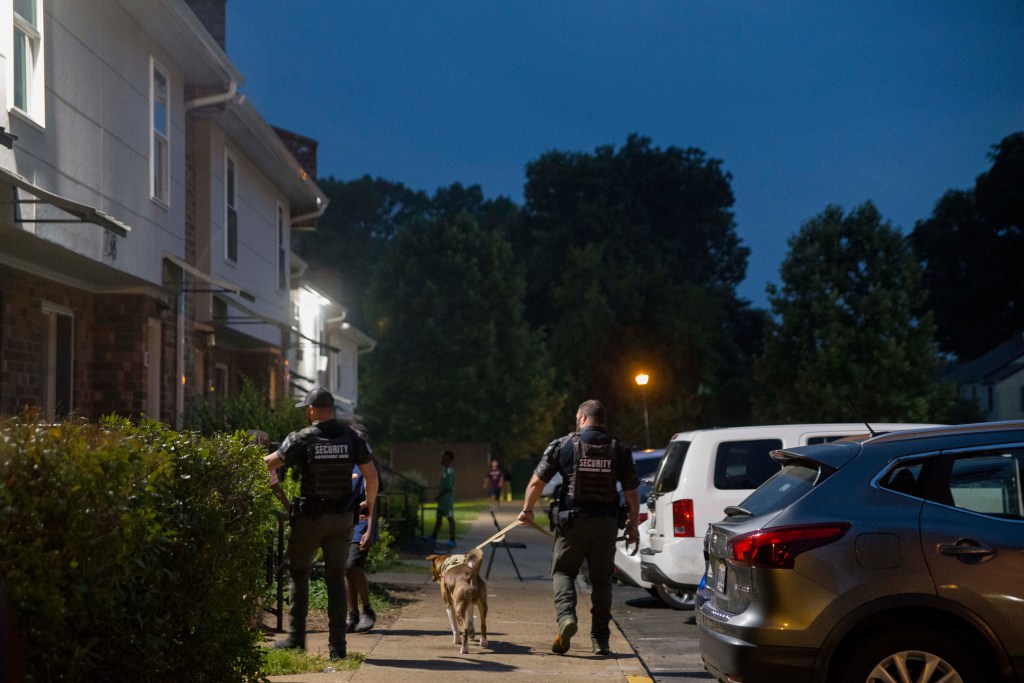
At unpredictable times, there are two armed men in bulletproof vests labeled “security” walking around the same area as CVVI. They are private security hired by Community Housing Partners, the company managing the Greenstone on 5th apartments.
The company hired them a couple of years ago when it took a proactive approach in promoting a safer community, Michael Sutphin, spokesperson for Community Housing Partners, wrote in an email to Charlottesville Tomorrow explaining the decision to hire armed guards.
“We have seen a measurable decrease in crime and disruptive activity as a result,” wrote Sutphin. “Our understanding is that many residents have expressed appreciation for having on-site security.”
In July, one of those security guards paused to speak with Charlottesville Tomorrow during the interview with Sterling.
He is a war veteran, the guard said.
When asked about changes he’s seen in the area since he started patrolling, he shrugged. It’s not as bad here as Iraq or South Sudan, he said.
“Community Housing Partners has an active Resident Services program that supports families and individuals in the community through resource referrals, community engagement, and partnerships with local organizations,” the spokesperson said.
CVVI, the Community Housing Partners Spokesperson wrote, is permitted on the property as long as they follow the same rules as other guests and visitors.
“We have not had any concerns about their presence, and we support a broad-based, collaborative approach to community safety,” he said.
In the end, protecting the community is a shared effort — a partnership between those who step in to help and those who live there every day, many residents and community leaders who have witnessed the transformation around Prospect Ave. believe.
It can be seen in a peaceful interaction that evening: When twilight turns to darkness, the two security guards, CVVI members, and a few community members gather together by the leasing office. Some are smoking, others are just chatting. A little girl plays with one of the security guards, who turns his flashlight on and off for her.
It’s a quiet evening.