

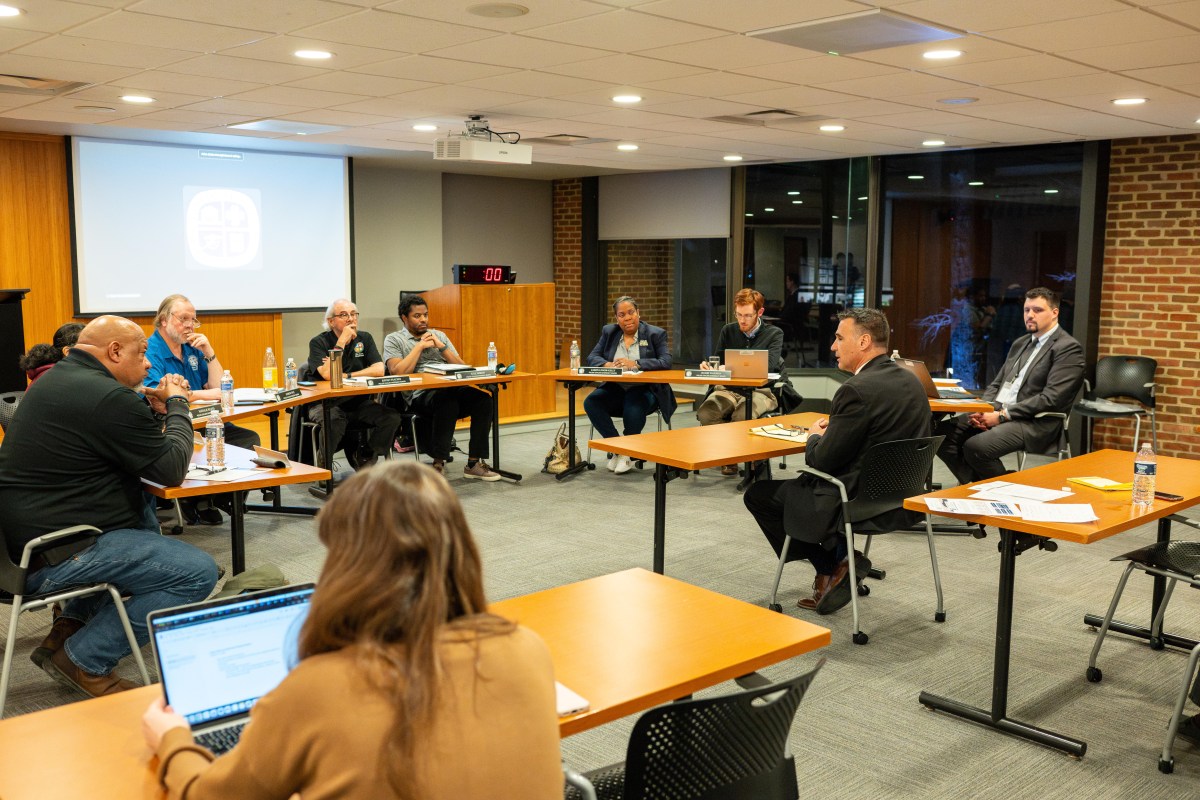
After losing half of the Board last summer due to a wave of resignations, the Charlottesville Police Civilian Oversight Board (PCOB) finally filled all of its seats and is planning to review its first case next month.
The Board has never, in the seven years since the ordinance guiding its work was passed by the City Council, reviewed a case — one of the main functions the community rallied for it to perform, said PCOB’s new chair, Jeffrey Fracher.
Now, with a full board, the chair plans to steer it toward active work and community engagement while the Board is considering a new oversight model that reviews internal police investigations rather than conducting its own.
“In several years we have not held a single hearing due to problems with our ordinance, which we are actively working to fix,” said Fracher. In 2022, the Board held a trial-run hearing just to learn how such hearings would go, but no official hearings were ever held. This upcoming review won’t be a hearing — a review is a lighter form of oversight in alignment with PCOB’s vision for a new, scaled-back form of oversight to maximize the Board’s capabilities.
“My mission as chair is to get this thing up and running and working. Either get it done or die trying to do it,” Fracher said.
The Board was conceived in 2017 in the aftermath of the “Summer of Hate” protests, when different far-right and white supremacist groups flooded the city streets. The community criticized the police over their handling of the clash and the lack of transparency.
PCOB became functional a few years later and was tasked with conducting independent investigations, reviewing the police’s own internal investigations into possible misconduct and making disciplinary recommendations and policy changes. The investigative function never came together due to several limitations, ranging from the unreasonable time demand from volunteer board members to PCOB’s inability to compel an officer accused of wrongdoing to testify, rendering findings of any investigation limited.
Earlier this year, the Board discussed the best ways forward. One of the leading options that emerged was dropping the investigative function altogether and solidifying its current model instead, which focuses on reviewing internal police investigation findings and issuing opinions. Late last year, City Councilor Michael Payne told Charlottesville Tomorrow that such a change would require time and a significant amount of community input before it will be finalized.
Fracher said he wouldn’t talk about the case the Board is set to review, but he did say it was from late 2025. The Board’s director, a full-time City employee supporting the functions of the volunteer Board and providing some oversight, will put together a concise brief, which the Board members will review, along with relevant statements and police body camera footage.
It’s a way for the full Board with its eight members to learn about the process Fracher wants them to perform much more frequently going forward.
“We anticipate doing a lot more of these once we get the ordinance in shape,” he said.
Overall, Fracher is very enthusiastic about the Board’s current state. It took a lot of time and effort to fill the Board’s empty seats, for which Fracher and others had to lobby people they thought were a good fit to apply. It wasn’t an easy task, considering that the conversation about the Board was centered around its challenges. Several new members came through that way, while others applied and were appointed naturally.
Now, Fracher is pushing for two working sessions a month on top of the regular open monthly meeting. That’s the way to really get things done and address their two main priorities, he said. The first is to get the ordinance to a functional state — the Board’s next joint session with the City Council is on May 18, and they are planning to discuss proposed changes. The first joint meeting in September 2025 resulted in a cleanup of the ordinance language that the City Council passed last year.
The second is community outreach.
Fracher said that the Board wants to engage with all members of the community, including those who may not have made their voices heard in the past. “We want to really sit down with people from all over Charlottesville and say, ‘What is your experience of the police? What is your perception of the police? What do you want us to be doing with regards to accountability of the police?'” he said.
“That will help inform some of the direction that we take with our oversight.”
Editor’s note: This story was updated to reflect a new date for the joint meeting between the Police Civilian Oversight Board and the Charlottesville City Council.