



Alex arrived at The Salvation Army shelter Monday afternoon after he woke up in the woods with his sleeping bag covered in ice.
“I don’t like to deal with shelters, because I’m not a groupie,” he said Monday evening at dinner. “But this time, I didn’t have a choice.”
Alex did not want to share his last name because he rail-hops. He comes to Charlottesville regularly, but does not live here full-time.
Initially, his plan was to wait out the storm at the Wawa convenience store on Pantops. But when he learned that the Route 10 Charlottesville Area Transit bus wasn’t running, he took the 7 bus to the Downtown Transit Center instead and made his way to The Salvation Army on Ridge St.
He wasn’t the only unhoused person in the city making some difficult decisions Monday, Jan 6. In order to stay warm as the Arctic blast envelops central Virginia this week, many are converging on the city’s limited shelters, which — so far — have been able to accommodate them.
On Monday night, The Salvation Army at 207 Ridge St. was near capacity, serving 54 overnight guests. The shelter has space for roughly 66 people, if they squeeze. During the day, the agency helped keep 60 people warm, said James Battaglia, The Salvation Army Charlottesville Corps development director.
People and Congregations Engaged in Ministry (PACEM), a seasonal shelter that operates in the cold months, was over capacity, serving 54 people between its men’s and women’s shelters, said PACEM Executive Director Cindy Chambers. PACEM’s shelters typically hold 50.
More than 100 people sought shelter from the storm
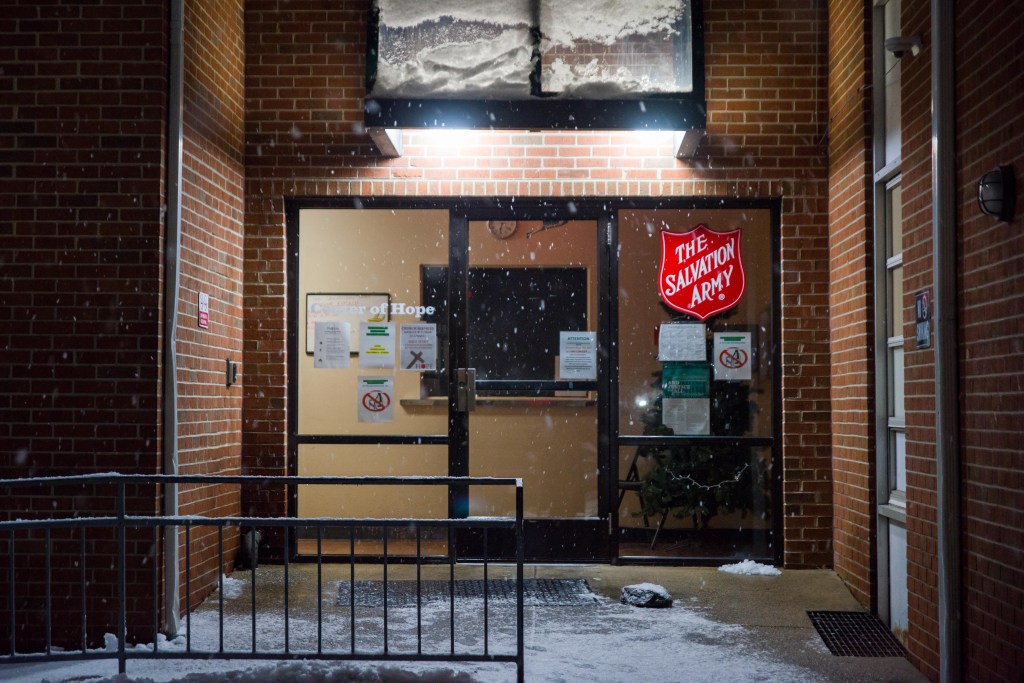
About 40 people gathered in a noisy cafeteria at The Salvation Army for dinner Monday night. A few people talked to one another, while others were obviously trying to avoid someone at a nearby table. A few folks talked to no one in particular. Others took their dinner into the hallway and ate there, in relative quiet, instead. Shelter staff moved around the room, asking folks where they were staying that night. It was warm, but most people kept their winter coats, hats and gloves on.
A white-haired woman bent over a cane walked slowly around asking if anyone had seen her cell phone.
A few guests started cleaning up the room after they finished their meals. One woman swept the floor while another man mopped. After eating, some of them walked over to the shelter rooms to stay. Others left into the snowy night.
As of Tuesday morning, The Salvation Army shelter hadn’t had to turn away anyone who is eligible to stay.

For Alex, the journey to The Salvation Army on Monday was particularly difficult — both his legs are amputated near the knee, and he uses a wheelchair to get around.
Alex didn’t say where he had been camping, but he described leaving the site. To get out of the woods, he tipped his wheelchair on its back, put his belongings in the seat, and pushed it in front of him. He walked and crawled on his residual limbs through the snow toward the road, he told Charlottesville Tomorrow. Once he was on the sidewalk, he got back in his chair and wheeled it over the uneven snow to a bus stop. When he arrived at the shelter, staff and guests had to carry him over a snowbank that had formed in front of the fire station next door.

Alex wasn’t sure how long he’d stay at The Salvation Army. He prefers to sleep outside, but this weather was too much for him. When he thought more about it, he realized he’d never been in Charlottesville during winter, and didn’t expect to see this much snow.
Edward, another shelter guest, had been at the shelter for nearly three months. He didn’t want to share his last name because of the stigmas associated with homelessness and incarceration.
He’s in the shelter because he can’t find a landlord who will rent to him. He was incarcerated for robbery, he said, and has been struggling to find a steady place to live in the 17 months since he’s been out.
He said he works two jobs and has started doing some of his fellow guests’ hair to boost their confidence when they go on job interviews.
Edward, who is 38 years old and grew up in Charlottesville, is certain that if he weren’t in the shelter, he’d find a sofa to sleep on. He doesn’t have many friends or family in his life right now, but he said there’s no way he’d be sleeping outside in this weather.
The Salvation Army shelter is the only permanent overnight homeless shelter in town and is known as a “high-barrier shelter,” meaning that people must abstain from drugs and alcohol in order to stay there. People who are on the sex offenders’ registry also cannot stay at that shelter. There are transitional apartments for families with children on the site.
Folks who are not eligible for high-barrier shelters can often stay in low-barrier ones — like PACEM.
The organization posts its shelter locations on its website. For the storm, its men’s shelter has been operating out of the Royal Inn Motel on Premier Circle off Route 29 in Albemarle County; the women’s shelter is currently located at Laurel Hill Baptist Church at 3595 Grand Forks Blvd., also in Albemarle County.
“PACEM has been working extra hard to provide safe shelter for our unhoused neighbors during this storm,” said Heather Kellams, one of PACEM’s case managers, in an email Monday. “We have also had tremendous support from our community partners and host congregations,” she added.
Organizations expand services to accommodate more guests

But when it’s this cold out, people need a place to go during the day, too.
Both The Salvation Army and PACEM, which are typically open only overnight, operated continuously to keep guests out of the freezing weather. This was partly because the snow made roads impassable.
Guests from both shelters usually go to The Haven, a day shelter located at 112 W. Market St. just off the Downtown Mall, during the day. That system might resume once the roads are clear, at least for PACEM guests.
“If the forecast holds, we will resume our normal service tomorrow [Wednesday], operating nightly only,” said Chambers.
The Haven adjusted its schedule for the storm, too. The shelter operated continuously from 7 a.m. to 5 p.m. on Monday, Jan. 6 and Tuesday, Jan. 7. Usually the shelter closes from noon to 1 p.m. on weekdays to allow for staff breaks and shift turnover. It is open from 7 a.m. to noon on weekends.
Some of The Haven staff who live outside of the city stayed overnight at the shelter Sunday to make sure it could open Monday, a staff member told Charlottesville Tomorrow photographer Kori Price.

The shelter is providing all standard day shelter services, said Community Engagement Manager Ocean Aiello. Those services include breakfast, laundry, showers, phones, computers, and places to rest.
“We have a much smaller group of guests within the shelter today, directly linked to the strong response from other homeless service providers, making it possible for people accessing overnight shelters to stay put,” Aiello said in an email on Monday.
Despite these efforts, not everyone who visited one of the shelters was able to stay put.
One person who ate dinner at The Salvation Army Monday night was preparing to sleep in her car in a nearby parking lot. She asked to remain anonymous.She was asked to leave the shelter a few months ago for not following the shelter’s program, she said.
At The Salvation Army, guests can stay for 30 days. If they start working toward concrete goals, such as finding a job or applying for Social Security or disability benefits, they can stay another 30 days. As they accomplish some goals and set others, they can earn more time — that’s how someone like Edward has managed to stay for almost three months. People who don’t follow that program have to leave after 30 days, Charlottesville Corps Officer Major Mark Van Meter told Charlottesville Tomorrow last fall.
The woman planning to sleep in her car wasn’t the only person staying outside Monday night.
Some choose to brave the weather outside

For the past three days, Red (who asked to be identified by his “street name”) and his friend Gregory had a campfire going next to their tents under the US-250 bridge over the Rivanna Trail. In his four years on the streets, this isn’t the coldest winter he has seen, he told Charlottesville Tomorrow.
“We’re fine,” he said.
They add wood to the fire every now and then, shuffle it around, and the flame burns red again. It would be nice to get new shoes, though — he said he is going through this winter in sneakers.
Red likes the Rivanna Trail. When it flooded during Hurricane Helene, many of the people living in the campsites were driven away. Red was in jail, so he hadn’t seen what it looked like, but he did lose all of his possessions in the flood. He can’t imagine how cold it would need to get this winter to drive him out from his new spot.
“It’s f—ing real, but we are good,” Gregory, who, like others, didn’t share his last name, agreed.
Gregory and his friends don’t see themselves going to shelters. He said that local nonprofits don’t have “enough philanthropy” in them and that, overall, he doesn’t trust them. He had negative experiences with them in the past, he said.
They said they are managing just fine with the fire going through the cold nights, but collecting the firewood needed to do so isn’t easy.
Nick, the youngest of the group and one of their friends who stays in a different location but came for a visit, explained.
“It depends,” he said. “If you’re in a spot that’s fresh to you, you can find wood pretty easily. After you’ve been there for like a week or two, you’re gonna have to go further and further out.”
He said they need at least five to 10 pounds of wood to last through a night — one to two packs of firewood bought from a store.
“If it’s cold like this, probably four or five,” Nick said.
Nick doesn’t burn a fire through the night. He has a decent little wood stove, he said, but walking around and freezing his hands collecting the wood and cutting it doesn’t feel worth it. He just bundles up, watches YouTube, smokes, and goes to bed.
“I just wrap up. I’m tough. I don’t need nothing.”
He is planning to do it on the nights when the temperature is going to drop down to 10°F.
“I’ll live,” he shrugged.
Take Action
For anyone experiencing homelessness right now, homelessness service providers suggest calling the Homeless Information Line at 434-207-2328 to see what resources are available. PACEM’s “Get Help” page has additional information about food and shelter resources available throughout the area.