


University employees who had hoped Virginia’s Democratic-controlled legislature would grant them the right to collectively bargain are now confronting a different reality: One of the bills passed at the recent legislative session would exclude most public university workers altogether.
Lawmakers passed HB 1263 in the legislative session that wrapped up on March 14, which would allow most public sector employees to collectively bargain but excludes most employees at public universities with the exception of “service workers” such as janitors, cafeteria, recycling staff and similar roles. After years of pushing for the right to negotiate for better wages and more stable working conditions, the exclusion came as an unexpected and bitter disappointment to many faculty, staff and student workers at UVA.
What’s more, as conservative groups have increasingly targeted university faculty over what they teach, employees say they need a way to protect themselves and preserve their right to teach freely.
Supporters of collective bargaining, the negotiation process to determine working conditions between employers and a group of employees, usually represented by a union, say the exclusion could also have a broader impact on worker rights for everyone in Charlottesville, at a time when the cost of living is rising.
The legislation had become a central focus of advocacy for University of Virginia union organizers this legislative session, with many traveling to Richmond in January, alongside members of Virginia Tech, William & Mary and Virginia Commonwealth University unions, to support collective bargaining efforts and share their personal experiences with lawmakers. They returned to the Virginia Capitol on March 11to rally for full inclusion in the collective bargaining legislation, as reported by Virginia Mercury.
Higher-education employees from across Virginia held a virtual press conference on April 8, calling on Gov. Spanberger to amend HB1263 to include all higher-education workers before signing the bill, and launched a petition with the same request. However, while Spanberger did propose some amendments to the bill, the inclusion of higher-education workers was not among them.
Instead, her amendments, which were ultimately rejected by the General Assembly on April 22, excluded additional workers, including Virginia Port Authority workers, and specified that the exclusion of university employees extends to university healthcare workers, which would include all employees at UVA Health.
“If we allow higher-ed and home care medical workers to be carved out as exceptions, I think you could plausibly say that this collective bargaining bill is dead on arrival,” UVA politics professor Kevin Duong told Charlottesville Tomorrow. “Because you’re carving such huge exceptions — massive industries — out, so that everyone’s ability to negotiate for a better life will actually be damaged. And that’s because UVA is such a large employer, universities are such large employers, that they can actually set wage floors for whole cities.”

Duong is a member of UVA’s chapter of United Campus Workers of Virginia (UCWVA-UVA), a union for staff, medical workers, graduate students, faculty and undergraduate student workers at UVA.
At the end of the day, cutting UVA workers out of the collective bargaining bill won’t just affect UVA workers, he said, but Charlottesville workers at large.
“UVA is the largest employer in Charlottesville, and if the largest employer in your town is carved out as an exception for public-sector collective bargaining, I don’t know how much collective bargaining you have left,” Duong added. “If UVA employees don’t get collective bargaining, Charlottesville will suffer, even people who think they have no connection to UVA.”
Duong added that the exclusions were especially disappointing because they came from Democrats.
“It makes a lot of us, it makes me, not trust legislators who a few months ago made us feel that this was really going to happen,” he added. “I don’t think they should be surprised if large sectors of higher-ed are cynical toward getting workplace reform through statewide politics in the future. That trust is going to be pretty much zero.”
And while state legislators and universities are largely silent on the issue, University employees say that university presidents and lobbyists have spoken to lawmakers behind closed doors to ask them to exclude most higher-education workers.
No public rationale for exclusions from legislators, universities
Virginia legislators did not publicly express a rationale for the exclusions during or outside of the legislative session. Multiple House legislators did not respond to Charlottesville Tomorrow’s repeated requests for comment inquiring about the reasoning behind the exclusions.
UVA’s spokesperson, too, declined to share the university’s stance on collective bargaining rights for higher-education employees with Charlottesville Tomorrow. But union organizers at the university said that UVA’s leadership has privately opposed collective bargaining for its workers, arguing that it would increase labor costs for public universities and force a tuition hike, although UVA’s tuition is already set to rise by 3.6% for the 2026–27 academic year.
Other universities have expressed similar concerns internally among their employees.
During a VCU Health System panel discussion in late March, Vice President for External Affairs and Health Policy Karah Gunther said that VCU Health is “not actively supporting the bill” due to “very significant financial implications for the health system” and administrative difficulties with implementing the infrastructure that the bill requires in a “very short” period of time.
William Herbert, executive director of the National Center for the Study of Collective Bargaining in Higher Education and the Professions at Hunter College, told Charlottesville Tomorrow that collective bargaining would not necessarily lead to increased tuition.
He cited a 2025 study published by the National Bureau of Economic Research, which looked into the effects of unionization on the salaries of public Canadian university faculty between 1970 and 2022. The study found that, while unionization on average leads to a modest salary increase spread out over a period of years following unionization, largely stemming from the introduction of salary floors, the salary increases were financed by an increase in student enrollment and did not impact tuition.
Collective bargaining provides an opportunity for representational democracy within universities, but it doesn’t necessarily mean that employees will be granted exactly what they’re seeking, Herbert added. Instead, it gives them a seat at the table to negotiate.
A fiscal impact review by the Joint Legislative Audit and Review Commission, which conducts program evaluation, policy analysis and oversight of state agencies on behalf of the General Assembly, estimates that administering collective bargaining in Virginia’s postsecondary institutions would require roughly $10 million to $14 million in additional staffing and administrative costs, depending on the structure of negotiations.
“Overall the impact of unions on public sector earnings is small. It depends on the scope of bargaining,” Jeffrey Keefe, research associate at the Economic Policy Institute and professor emeritus at Rutgers University’s School of Management and Labor Relations, told Charlottesville Tomorrow. “The subjects of bargaining are often limited.”
Keefe noted that many key benefits, including health insurance and pensions, are often set by legislation rather than negotiated through collective bargaining. While wages are the issue most often discussed, the process for resolving disputes can be limited, as public-sector unions often lack the ability to strike or access binding arbitration.
“In a right-to-work state I suspect unions will not be powerful, except maybe teachers and police,” he added. “Additionally, unions are not immediately able to raise earnings, it takes time.”
“Right-to-work” states bar employers and unions from requiring workers to pay union dues or fees as a condition of employment, even if a union represents their workplace. Federal law already prohibits mandatory union membership, but in states without right-to-work laws, unions and employers can agree that workers covered by a union contract must pay fees to support bargaining and representation. In a right-to-work state like Virginia, workers can’t be required to pay those dues or fees. As a result, unions in right-to-work states often have fewer resources and lower membership, since some workers opt out of paying while still receiving the benefits of union contracts.
Universities allegedly lobbied lawmakers behind closed doors
Despite the public silence of lawmakers and universities on the exclusions, university union members told Charlottesville Tomorrow and other news outlets like VPM that university presidents and lobbyists across Virginia allegedly lobbied lawmakers behind closed doors to remove higher-education workers from collective bargaining bills during the recent legislative session.
They noted that, in particular, Chairman of the House Appropriations Committee Luke Torian allegedly had extensive conversations with lobbyists, and was a main proponent of the exclusions. Torian did not respond to multiple emailed requests for comment from Charlottesville Tomorrow.
“We do have knowledge from some folks who have let us know that these university presidents are lobbying behind closed doors and asking for their workers to be excluded from this legislation,” Katie Baker, Spokeswoman for the Virginia Public Sector Labor Coalition, said during the April 8 press conference asking Spanberger to include all university workers in the collective bargaining bill.
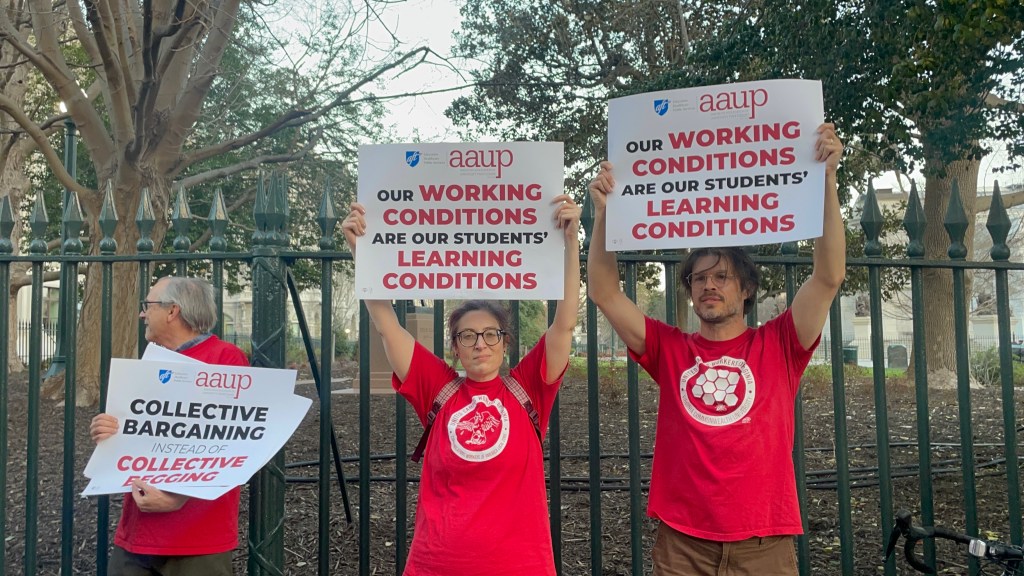
“We mostly know that the university presidents were lobbying against the bill because members of the public-sector labor coalition saw them in the General Assembly,” Graduate student worker and UCWVA-UVA member Kelsey Levine told Charlottesville Tomorrow. “But they’ve not been public about their opposition.”
The University of Virginia Foundation hired five new lobbyists from McGuireWoods on Jan. 12, 2026, two days before the start of the 2026 legislative session, to lobby on behalf of “matters of interest” to the foundation. Some of the same lobbyists were hired by other Virginia university foundations, including Virginia Tech, Virginia Commonwealth University, the Virginia Military Institute and Marymount University. However, UVA’s spokesperson would not confirm or deny whether lobbying on the collective bargaining issue occurred, and legislators did not respond to inquiries on the matter from Charlottesville Tomorrow.
“I think we share a lot of common goals with our administrators and our university presidents — we all care really deeply about providing the best educational experience that we can — and it’s just really frustrating to see them working against their own people in that way,” UVA librarian and UCWVA-UVA member Cecelia Parks told Charlottesville Tomorrow.
“It feels like a slap in the face to have your president going and saying, ‘Well, we actually don’t want to have you at the table where important decisions are made,'” she added. “’We actually don’t care what you think. We don’t care that you can’t afford to live in Charlottesville while we make, you know, six- and seven-figure salaries.’ It’s really disheartening.”
UVA workers push for stability and a living wage
One of the main things that union organizers hoped to gain through collective bargaining was the right to negotiate for higher wages to keep up with the rising cost of living.
“We have an abundance of staff who work at UVA who can’t afford to live in Charlottesville because it’s so expensive, and wages don’t keep up with the cost of living here,” Parks told Charlottesville Tomorrow.
The average cost of rent in Charlottesville has risen to $1,950 per month, as reported by CBS 19 in August 2025, around 20% higher than the average rent in Richmond and Norfolk. More than half of Charlottesville’s households are not earning enough to afford the cost of living in the city, including nearly a quarter of households that are below the poverty level, according to an August 2025 Charlottesville City Council report.
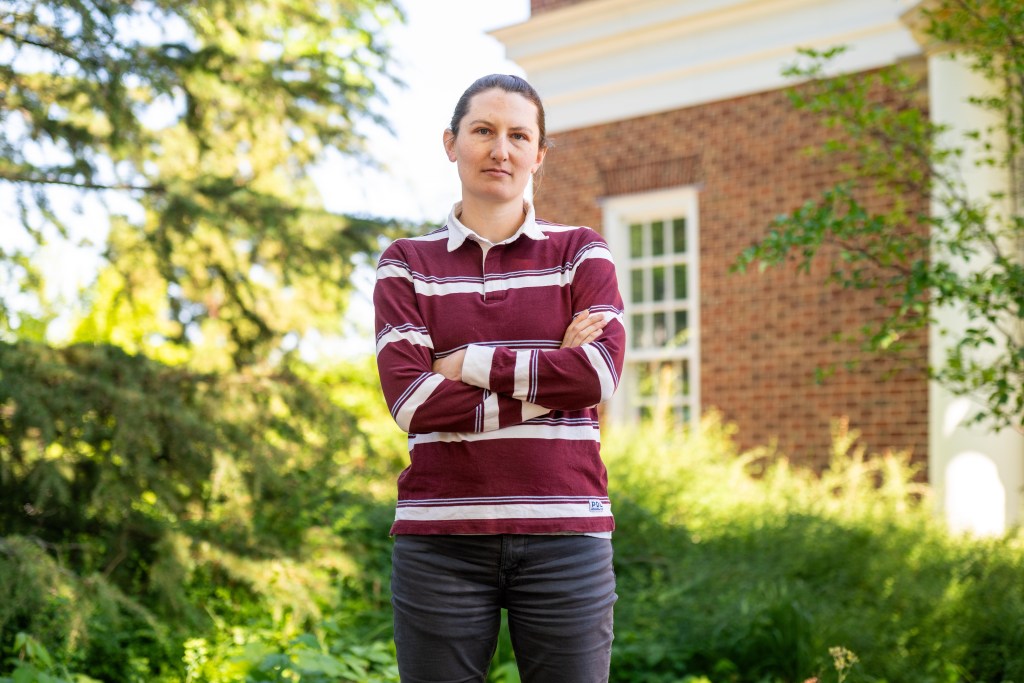
Andy Gneiting, a member of UVA’s recycling staff, is considered a “service worker” and would be included within the collective bargaining legislation. He told Charlottesville Tomorrow that being able to negotiate a contract with predictable raises tied to the rising cost of living and inflation would make a huge difference in reducing financial stress and uncertainty for himself and his colleagues.
But Gneiting added that he’s disappointed that collective bargaining rights wouldn’t extend to many of his colleagues, many of whom experience similar financial insecurity living in Charlottesville.
“The demands that people have, they’re not crazy, they’re not out-of-this-world expectations, they’re very base-level,” Gneiting said. “They’re not asking to be millionaires, they’re just asking to be able to live. And it’s an absolute shame that that’s not already the standard.”
Now that higher-education workers have been cut out of the bill, the ability of those working at UVA to negotiate for higher wages has been greatly diminished, Stephanie Gunst, a senior administrative coordinator at UVA and the chair of UCWVA-UVA’s living wage campaign, told Charlottesville Tomorrow.
“There is this idea that because you’re in higher education that you automatically get paid a lot, especially for faculty,” Gunst said. But many UVA faculty are not tenured, she added. “They’re not protected. They’re often adjuncts, and their pay for the hours that they work is actually quite low.”
UVA currently has a total of 3,383 faculty members, UVA spokesperson Bethanie Glover told Charlottesville Tomorrow. 1,858, around 55%, are either fully tenured or on track to be tenured. 1,525, around 45%, are considered general faculty, meaning that they are not tenured or tenure-track.
Adjuncts, meanwhile, are instructors that are typically hired on a per-semester or per-course contract basis. They are often considered “temporary” workers and usually do not receive standard employee benefits or long-term job security.
“In a typical academic year, UVA engages several hundred individuals as wage faculty, primarily in a part-time capacity,” UVA spokesperson Bethanie Glover told Charlottesville Tomorrow.
“Many employed by the professional schools (such as Education, Law, and Nursing) are professionals in their field and thus, employed elsewhere in a full-time capacity.”
While members of UVA’s general faculty are making an average of $106,387 for the FY2026 payroll, the average pay for the 672 individuals employed as full or part-time “temps,” or temporary faculty, is $35,887, according to The Cavalier Daily.
“UVA has billions of dollars in an endowment, but higher administration is not necessarily willing to come to the table with us, even though they have expressed outwardly that they are interested in people earning a living wage and it is ostensibly part of UVA’s 2030 plan,” Gunst added. “But we have seen nothing that indicates a move to actually give everyone a living wage.”
For the majority of the 11 years that she’s been at UVA, Gunst has lived paycheck-to-paycheck, she told Charlottesville Tomorrow. That only changed in the last couple of years, after she secured a better position with higher pay at the university.
“The reason I have what I have is because of specific managers who were willing to look out for me and advocate for me and see my value as an employee, and not everyone has that,” Gunst said.
Postdoctoral researchers like Megan Wiessner describe the challenges they face: long hours in temporary positions, limited savings and, for many international scholars, the added anxiety of visa restrictions and family far away.
“Most of us have sacrificed a lot to do this work, and there are very few guarantees that it will lead to anything,” Wiessner, who is a member of UCWVA-UVA, said.
For her and other early-career researchers, collective bargaining rights could mean the opportunity to negotiate for access to modest but meaningful supports like minimum notice for contract renewals, paid time off for family leave or reimbursements for visa fees, which cost the university relatively little but would have a tangible impact on their daily lives, she said.
“Even totally aside from things like cost-of-living issues and compensation, just the instability and the precarity and the lack of informal support resources that other people take for granted, all of it can be really brutal,” Wiessner told Charlottesville Tomorrow. “It can really feel like your life is on hold.”
One key way to secure a greater sense of stability, UVA employees say, is through the use of collective bargaining to negotiate guaranteed annual raises in their contracts.
“That would really change my life in terms of being able to plan for the future, being able to save for something like buying a house, even being able to be like, okay, I’m pretty sure my rent’s gonna go up this much this year, I will be able to afford that,” Parks said. “Instead of being like, well, I hope I get a raise that covers the amount of my rent going up every year.”
Undergraduate and graduate student workers have also faced challenges at UVA, Parks told Charlottesville Tomorrow. Throughout the years, student workers have experienced recurring issues with late or missing payments, causing financial strain for many. At the end of 2022, for instance, around 60 to 120 graduate student workers did not receive on-time payments due to university staff turnover and administrative errors. It was not the first time, or the last, that incidents like this occurred.

“Every year we’ve had issues with graduate student workers not getting paid,” Parks said. “We have graduate student workers who don’t have contracts. It’s sort of not clear anywhere how many hours they’re supposed to work or even how much they’re getting paid.”
Ava, a UCWVA-UVA member and fourth-year student who has worked as an undergraduate teaching assistant and research assistant, told Charlottesville Tomorrow that UVA’s system for handling student employees is a “mess.” There have been cases where she and other student workers didn’t know how much they were going to be paid until after they had received their first paycheck, she said, and having the ability to negotiate contracts could help address these kinds of pervasive issues. She asked to be referred to by just her first name out of concerns of potential retaliation.
Graduate student worker and UCWVA-UVA member Kelsey Levine agreed. “When university workers have the ability to advocate for themselves, then that makes things better for students and for the community,” she said, adding that it’s difficult to be “a good TA and be invested in your students” when you don’t have good working conditions.
Beyond wages and job stability, UVA employees told Charlottesville Tomorrow that they had hoped to use collective bargaining to negotiate contracts with meaningful protections after recent experiences of external scrutiny and harassment made clear the limits of relying on the university alone to defend them.
Faculty members like Duong and UVA sociology professor Ian Mullins described being targeted by conservative groups critical of diversity, equity and inclusion efforts at UVA that disseminated their names, courses or other personally identifiable information online. They pointed to expansive public records requests for their syllabi or personal communications as a form of “course policing” and intimidation. The cumulative effect is a chilling one, they added, discouraging open inquiry and pushing instructors to self-censor in the classroom.
But UVA has offered no recourse, Duong said, underscoring a scarcity of existing protections for UVA employees facing harassment and reinforcing a sense that they are largely on their own. A union contract, he said, would have helped safeguard academic freedom and establish clear and durable protections for UVA employees that don’t depend on shifting political climates or administrative priorities.
“It is really dangerous to live in a world where truth is whatever people in power want it to be, and I’m terrified of that world coming into existence for us,” Mullins said. “This collective bargaining fight is about more than fair wages and a better work environment, it’s about academic freedom and our ability to install protections that can outlast these assaults.”