



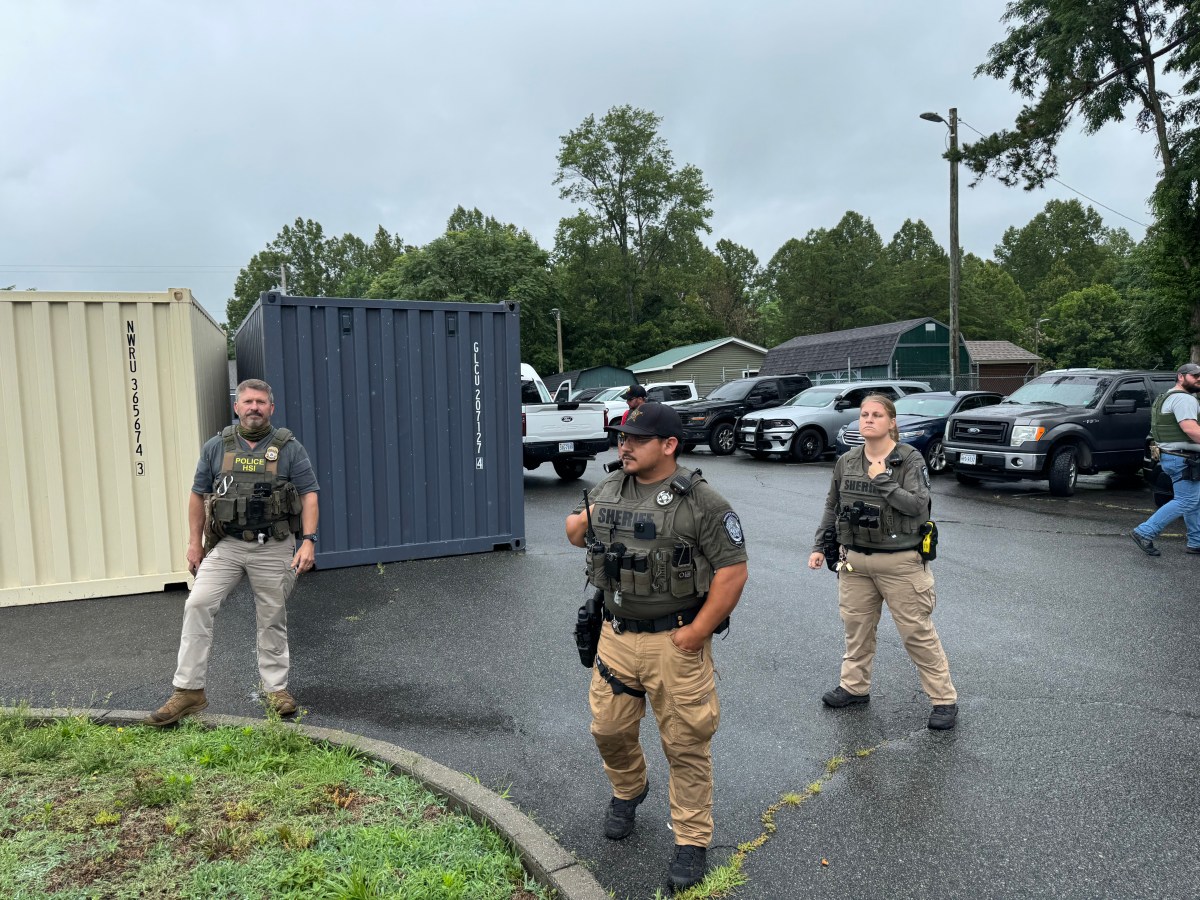
As Virginia was about to pull its local law enforcement from participating in federal immigration operations, Greene County Sheriff’s deputies were lining roads around Ruckersville alongside U.S. Immigration and Customs Enforcement agents.
On June 23, the Greene County Sheriff’s Office joined ICE in their largest joint immigration enforcement operation to date, stopping dozens of vehicles and arresting 49 individuals, according to a statement provided days after the event by an ICE spokesperson.
Seven days later, on July 1, a new state law went into effect that bans exactly that kind of local cooperation with ICE, attorneys who spoke with Charlottesville Tomorrow said.
The law, House Bill 1441, sharply limits the role local police and sheriff’s offices can play in ICE operations. In almost all cases, local officers are now barred from assisting the agency unless federal agents present a warrant signed by a judge or magistrate for a specific individual.
“Virginia law enforcement cannot provide a lot of informal assistance to ICE’s civil immigration enforcement unless they have a judicial warrant,” said Rohma Javed, the director of the Immigrant Justice Program at the Legal Aid Justice Center, and one of several immigration lawyers who worked with legislators to write the new law. “A judicial warrant requires them to go before a federal judge, present facts, and get that signed and approved by a judge. They would need that before they are able to collaborate in many ways with local law enforcement.”
The law also limits when local law enforcement agencies can enter into formal partnerships with ICE.
These new restrictions could dramatically change the way Greene County works with the agency.
Over the past year, Greene County has embraced one of the closest working relationships with ICE of any local law enforcement agency in Virginia. Since signing a formal contract with ICE, called a 287(g) agreement, in May 2025, the Sheriff’s Office has repeatedly assisted federal immigration enforcement efforts, including large-scale operations that seemed to rely on local deputies to help identify and detain people suspected of being in the country illegally.
But the new law doesn’t mean Greene County’s cooperation with ICE will immediately end. Laws similar to this one passed in other states have faced a multitude of court challenges. And the Greene County Sheriff himself has been vague when asked whether he will continue cooperating with ICE.
“I’m a Constitutional officer,” Sheriff Steven Smith told Charlottesville Tomorrow in February, after a reporter asked if Smith intended to end his cooperation once the new law took effect.
“I was elected by the citizens to keep the county safe, and that’s what I’m doing. I’m arresting people that have warrants. They can’t stop me from doing that.”
What’s more, on the day of the joint operation in June, a man who identified himself as Sheriff Smith was captured in a video taken by Charlottesville-based attorney Andrew Wilder Young saying: “I don’t care what the governor says.”
According to Young, Smith made the comment after Young had said that “this isn’t allowed in the state of Virginia, to be cooperating with ICE.”
Smith did not immediately respond to Charlottesville Tomorrow’s follow-up questions about what he meant by those remarks, how the Sheriff’s Office plans to comply with the new law or whether the office intends to continue its 287(g) agreement with ICE.
Greene County Sheriff says partnerships with ICE and other agencies are essential to safety
During the June 23 operation, Sheriff’s deputies joined ICE in an hours’ long effort to stop motorists. The operation began by 6:30 a.m., witnesses told Charlottesville Tomorrow. Around two dozen marked Sheriff’s office patrol vehicles and unmarked SUVs moved through streets and highways in and around Ruckersville, mainly stopping what witnesses described as “work trucks” and arresting individuals inside.
The operation came at the beginning of a sharp increase in immigration arrests around the country, the New York Times reported. Between June 26 and June 30, ICE arrested more than 10,000 people.
The way the arrests were carried out in Greene County also reflected broader national trends. Data from the Deportation Data Project, a group of academics and lawyers who obtain federal records through Freedom of Information Act requests and litigation, shows arrests are increasingly taking place in communities instead of during ICE check-ins or at jails and prisons. The group also found that the number of noncitizens arrested without criminal convictions increased nearly ninefold compared with the last six months of 2024.
ICE has not released the names of the individuals arrested in Greene County, nor has the agency answered Charlottesville Tomorrow’s questions about whether any of them had warrants, criminal convictions or charges.

In the days following the operation, Greene County’s cooperation with ICE drew criticism from community members and advocacy groups.
Around 20 people gathered the following day for a protest in the county, holding signs condemning the ICE action and the county’s involvement, according to a report from 29News. The ACLU of Virginia released a statement accusing the Greene County Sheriff’s Office of “directly coordinating with ICE to terrorize and racially profile our communities.”
In response, Sheriff Smith made a post to the Greene County Sheriff’s Facebook page on June 26 that seemed to defend the operation.
“I understand that some people may not agree with every law we are tasked with enforcing. However, our responsibility is not to decide which laws to enforce — it is to enforce the laws and serve our community professionally and fairly,” Smith wrote. “To accomplish our mission, we work closely with our law enforcement partners, including ICE, the FBI, the DEA, ATF, neighboring sheriff’s offices, and local police departments. These partnerships are essential to protecting our citizens and maintaining safe communities.”
Officials provided no information about the 49 people arrested. Nationally the number of people arrested for immigration violations with no criminal convictions has gone up
Smith has long spoken positively about his office’s partnership with ICE.
In February, he described the federal agents his deputies work with as “some of the most compassionate people that I’ve been around.”
“They are really good at what they do,” he told Charlottesville Tomorrow. “They know how to talk to people. They’re very calming, and just a great bunch of guys.”
At the time, ICE was also facing scrutiny elsewhere in the country. Smith spoke with Charlottesville Tomorrow about a month after ICE agents shot and killed two U.S. citizen protestors, and shot and injured an immigrant in January’s Operation Metro Surge in Minnesota. In those cases, the state is suing the federal government to cooperate in investigating the violence, according to ProPublica.
Smith, however, described a very different kind of experience with the agents he worked alongside in Greene County. He said that during one stop, ICE agents let someone go when they noticed he was accompanied by a child.
“They caught the guy,” Smith said. “He needed to go back, to be deported. He had a kid with him. The ICE agent said, ‘No, leave him alone, he’s got a kid. Let him go.’ That’s the kind of compassion that they have.”
Smith shared that story before Greene County’s two large-scale joint operations, including the June 23 operation and an earlier one on May 14. During that time, local advocacy groups say ICE and the Greene County Sheriff’s Office were conducting regular smaller immigration enforcement actions all in the same area, by U.S. Route 29.
“We’re not going after law-abiding citizens. It’s not like in the media, where we go and bust people’s doors down,” Smith told Charlottesville Tomorrow in February. “We’re going after criminals and people that came over here, and a lot of people got licensed to drive trucks with no knowledge, no experience, can’t even speak English, can’t read our signs.”
An ICE spokesperson also defended the partnerships in response to Charlottesville Tomorrow’s questions about the June 23 operation. The spokesperson sent a prepared statement confirming that ICE arrested 49 people in a joint operation “in conjunction with their 287(g) partners” in the Ruckersville area.
“Partnerships with law enforcement are critical to having the resources we need to arrest illegal aliens across the country,” the spokesperson said in an email. “When politicians bar local law enforcement from working with DHS, our law enforcement officers have to have a more visible presence so that we can find and apprehend the criminals let out of jails and back into communities.”
The statement did not answer many of Charlottesville Tomorrow’s questions, including how many vehicles were stopped or how many people were questioned. They did not explain how law enforcement identified the people who were arrested, how many had outstanding warrants or whether any had previous criminal convictions.
Javier Raudales, the director of Charlottesville-based nonprofit immigrant support organization Sin Barreras, disagreed with the characterization that the Sheriff’s Office and ICE are targeting criminals.
Raudales told Charlottesville Tomorrow that the group had received around 10 phone calls in the first couple of days following the June 23 raid from individuals whose loved ones were caught up in the raid.
“We’re hearing the stories of the people who are getting arrested, and it’s members of our community, it’s neighbors who really are just trying to live life and take care of their family,” Raudales told Charlottesville Tomorrow. “And we’re also concerned about how it affects those that are getting left behind here. They’re still trying to pick up the pieces.”
Other Greene County residents agree with Raudales. Several criticized the Sheriff’s cooperation with ICE during a Jun. 9 Board of Supervisors meeting following the May 14 joint operation. In that meeting, an ICE spokesperson confirmed that the agency conducted “administrative arrests” of 26 people.
An administrative warrant, issued by a government agency, is typically used for civil enforcement of immigration, in cases where the agency believes an individual overstayed their visa, violated the terms of their immigration, or committed a crime. However, this kind of warrant does not require probable cause the way a judicial warrant does. Judicial warrants are issued by a judge or magistrate independent of the government agency, and have a higher legal bar to allow agents to search or seize people or property.
That distinction has become more important as immigration enforcement has changed. More people are being arrested in what the Deportation Data Project is classifying as “collateral” arrests, according to an April report from Stateline that analyzes a little more than six months of ICE arrests. The report describes cases in which agents arrested people “based on appearance or proximity to someone wanted on a warrant.” About 70% of these arrests were people who had no criminal conviction.
“If deputies are conducting traffic stops that lead to immigration enforcement, what criteria are being used? How are these individuals being identified?” Kelly Marquez asked Board members during the public comment section of the June meeting. “Are they being targeted because they are a suspect of serious criminal activity or because they are believed to be undocumented or because they look [like] Latinos?”
Melanie Johnson of Barboursville shared that her neighbor and his elderly father were arrested by Sheriff’s deputies after a traffic stop, turned over to ICE and taken to Virginia’s ICA Farmville detention center. Her neighbor had lived in the country for 16 years, owned a home and a successful business and has two children who are U.S. citizens, Johsnon added.
“He has no warrant, no conviction, poses no threat, but he was targeted for the color of his skin and the type of vehicle he was driving,” Johnson said. “A 15-year-old girl cries herself to sleep every night terrified that she will never see her father again. A 21-year-old son is trying to hold his family together while knowing his father may be deported because they can’t afford the $10,000 needed for an immigration attorney.”
Johnson said that the Sheriff’s cooperation with ICE creates a “climate of fear in Greene County — fear that keeps hardworking neighbors from driving to and from work, from reporting crimes, from taking their kids to school, from supporting local businesses and from living their daily lives without worrying that one wrong turn could destroy everything they’ve worked so hard to build.”
Virginia put guardrails on local law enforcement’s work with ICE
That sentiment is partly what drove lawmakers to pass House Bill 1441.
“It’s about relieving the fear that exists in some new American and immigrant communities, amongst undocumented — as well as documented and naturalized and U.S.-born American citizen population,” Del. Alfonso Lopez (D-Arlington), who introduced the bill, told VPM news in March.
“Far too often, we’re seeing federal immigration enforcement continue to act recklessly as they target not only immigrants who have committed no criminal act, but also naturalized and U.S. American born citizens.”
The new law is sprawling, touching nearly every aspect of how local law enforcement agencies work with ICE.
Besides requiring a judicial warrant before any local cooperation can occur, House Bill 1441 fundamentally rewrites the agreements that allow local law enforcement agencies to partner with ICE.
The law does not outright ban those partnerships, called 287(g) agreements. Instead, it allows them to continue only if ICE agrees to a series of conditions written into state law.
One of the new law’s terms requires ICE agents to wear proper identification on their uniforms and vehicles while operating in Virginia. ICE must also provide local law enforcement agencies with the names and ranks of all agents who will participate in an immigration enforcement operation at least seven days before it begins.
ICE must also agree to cease conducting “any immigration enforcement activity on the property of any school, faith based organization, or courthouse within the commonwealth.”
If ICE declines to follow these and a few other rules, Virginia agencies are prohibited from entering into or maintaining the partnership.
The law gives any local law enforcement agency with an existing agreement until Sept. 1 to sign a new agreement that follows these restrictions, or the partnership will be void.
“The new law reflects the General Assembly’s decision to establish those very clear limits on when local officers might participate in civil ICE enforcement,” said Javed, the Legal Aid Justice Center program director who helped lawmakers write the bill.
The DOJ is suing to block the new Virginia law. The agency has lost similar cases in other states
House Bill 1441 has already faced court challenges.
The U.S. Department of Justice sued Virginia on June 11, arguing that House Bill 1441 is unconstitutional because it attempts to regulate how federal immigration agents operate and interferes with agreements between ICE and local law enforcement agencies. The lawsuit also challenges a separate new law that restricts federal officers from wearing masks while conducting their duties.
A judge has yet to rule on whether House Bill 1441 violates the Constitution.
Alex Kornya, litigation director at the Legal Aid Justice Center, told Charlottesville Tomorrow the lawsuit is overall “very similar” to Justice Department lawsuits in other states challenging laws that limit or regulate cooperation between state and local law enforcement agencies and federal immigration authorities. Some of those cases have already been dismissed.
For example, in December 2025, a federal district court dismissed the Justice Department’s challenge to an Illinois law limiting cooperation between local law enforcement and federal immigration authorities. As with other similar cases, the Justice Department has appealed that decision.
“So other courts so far have rejected the very arguments that the DOJ is making now to strike down the 287(g) ban,” Kornya said. “The lawsuit doesn’t raise any legitimate or new arguments that haven’t been addressed by other courts and rejected by other courts.
“I think,” he added, “that when it comes to the question of, can a state control its own law enforcement and restrain the powers and authority of its own law enforcement, I would say the legal equities are on the side of the state here.”