

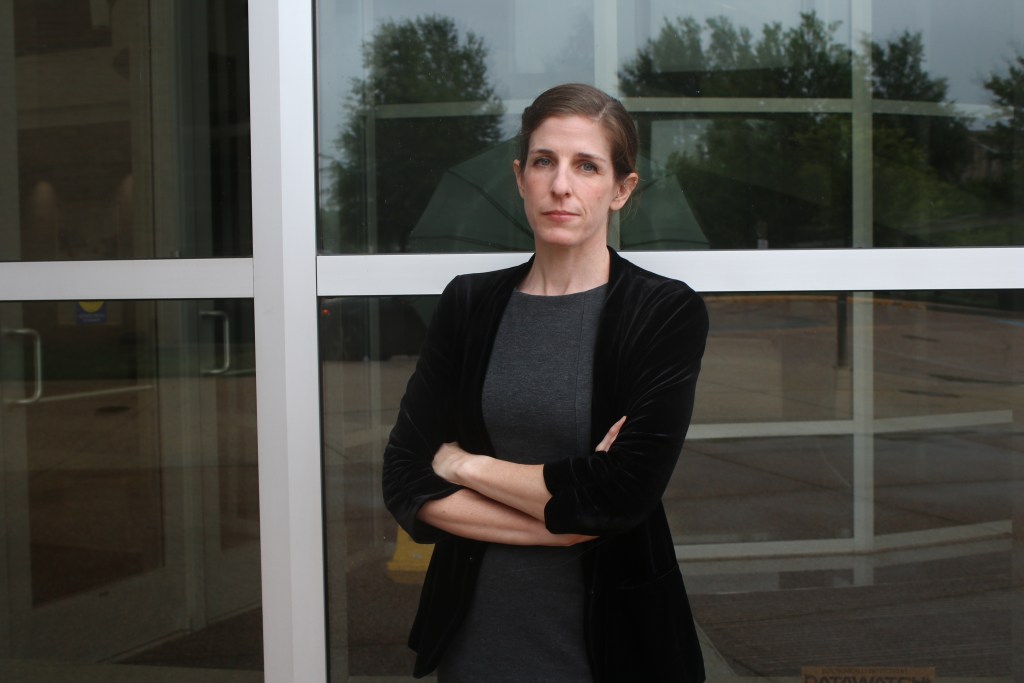
Former Virginia immigration judge Anam Petit was in a courtroom at the Annandale Immigration Court in September 2025, in between hearings and about to issue a decision on a case, when she got an email.
It was from the acting director of the Executive Office for Immigration Review, the agency that oversees immigration courts, and said that she had been terminated, effective immediately. There was no further explanation.
She stepped out of the courtroom for a moment to text her husband the news, but didn’t have time to wait for a response.
“There were folks in the courtroom waiting for me to issue my decision,” she told Charlottesville Tomorrow. “One of the hardest things I’ve ever had to do was to give that oral decision, which is a very complex, difficult part of being an immigration judge, while my mind is trying to go in a million different directions and I’m trying to bring it back to this case. And then I packed up my office, because I had to give my government equipment back by the end of the day, and that was my last day as an immigration judge.”
Across the country, cases like these have become increasingly common, immigration lawyers and former judges told Charlottesville Tomorrow. It’s emblematic of a broader politicization of the immigration courts by the second Trump administration that they say has had dire consequences for judicial independence and due process, including in central Virginia.
Mass firings reshape the nation’s immigration courts
Charlottesville Tomorrow spoke to four former immigration judges for this story, three of whom worked in Virginia courts and two of whom agreed to let Charlottesville Tomorrow use their names.
It used to be rare for immigration judges to be fired, and they were generally only fired following serious complaints or issues, Petit told Charlottesville Tomorrow. “You would have never heard of an immigration judge being fired without cause,” she said.
But since January 2025, the Trump administration has fired more than 113 out of around 700 immigration judges without cause or explanation, as reported by The Guardian, while others were reassigned or said they felt compelled to take buyouts or retire early to avoid being fired. The administration recently filled many of those empty roles in May 2026, swearing in 77 new permanent and five new temporary immigration judges, according to Reuters.
One former Virginia immigration judge told Charlottesville Tomorrow that they accepted a buyout because they feared they would be fired.

Another former Virginia immigration judge told Charlottesville Tomorrow that they’d dreamed of being an immigration judge for their entire career, but left under the second Trump administration because they also feared that they would be fired if they didn’t leave on their own terms. Both judges spoke to Charlottesville Tomorrow on condition of anonymity for fear of retaliation.
According to an April 2026 investigation by The New York Times (subscription required), White House and DOJ officials have been closely monitoring judges’ rulings, threatening disciplinary action or firing those who grant too many asylum or bond requests. More than two dozen immigration judges who served under the second Trump administration told The New York Times that they felt “a consistent sense of pressure to deport immigrants or risk losing their jobs.”
NPR analyzed the professional backgrounds of 70 immigration judges across the country who received termination notices between February 2025 and October 2025. The investigation found that judges with immigration defense experience accounted for the largest portion, or about 44%, of the firings. After the firings, judges with immigration defense experience made up 26% of judges remaining on the bench. The fired judges have since been replaced with less experienced temporary military judges or political appointees, The Guardian reported. The DOJ told NPR it does not target judges for termination based on their prior experience and that the terminations were not politically targeted.
A DOJ spokesperson told Charlottesville Tomorrow via email that, while they wouldn’t comment on personnel matters, the “DOJ is restoring integrity to our immigration system,” adding that the Biden administration was “forcing immigration courts to implement a de facto amnesty for hundreds of thousands” of non-citizens.
DOJ leadership, including acting Attorney General Todd Blanche, have told outlets like the Associated Press that judges under the Biden administration were too lenient in granting asylum or other statuses to applicants, arguing that the Trump administration’s mass firings of immigration judges is part of a much-needed overhaul to help fix an inefficient system and cut down on the current backlog of almost 4 million cases. In an April 2026 press release, the White House described the firings as part of an overhaul of a “broken system” that included “replacing activist judges.”
The number of individuals granted asylum spiked during the Biden administration, as did the number of denials. That’s because the number of asylum petitions filed in immigration court rose to “record highs” during the later part of his administration, according to data from the Congressional Research Service. The number of applications have remained at roughly the same level during the Trump administration.
Immigration judges oversee civil immigration cases, deciding whether people can remain in the United States or be removed. They hear asylum claims, removal proceedings and other cases involving immigration status. People typically appear before an immigration judge after the federal government initiates removal proceedings against them or when they seek forms of relief that require a judge’s approval, such as asylum, cancellation of removal or certain waivers.
Petit was fired from Virginia’s Annandale Immigration court, the primary court handling cases for Northern and central Virginia, including Charlottesville. Her asylum grant rate of 8.4% was above the current national average of 7.3%. Most of the Annandale immigration judges who were fired or retired under the second Trump administration had higher-than-average grant rates. The vast majority of Annandale’s remaining immigration judges have asylum grant rates below the 7.3% national average. Under the Biden administration, asylum grant rates averaged about 45%, rising from around 30% during the first Trump administration.
“I definitely think that the terminations are political,” Petit told Charlottesville Tomorrow. Petit and other former immigration judges who spoke to Charlottesville Tomorrow said that, from what they’d seen, the administration disproportionately targeted women and judges of color for termination. While the DOJ does not disclose personnel data, some former immigration judges have filed lawsuits alleging the same. Among them are former judges Florence Chamberlin, Irma Pérez, Carla Espinoza and Tania Nemer, who allege they were unlawfully fired because of their sex, race, national origin or political affiliation.
Petit was sworn in as an immigration judge in September 2023 after working as an immigration attorney and adjunct professor at Georgetown University Law Center. Despite receiving high performance evaluations, Petit said she was fired one day shy of completing her two-year probationary period, a mandatory trial period for all new immigration judges. Now, she’s returning to work as an immigration lawyer.

“Everyone I know in my class who got fired in those days had the exact same experience I did, which is, you got an email, you didn’t get a reason for your termination, you had positive probationary reviews, and then you’re terminated,” she told Charlottesville Tomorrow. “I had a conversation with my assistant chief immigration judge after I was fired, and he told me that he didn’t know about the decision, he wasn’t a part of it and he wrote me a glowing probationary review.”
“The people being fired, they have wonderful reviews, they’re doing amazing work,” Jeremiah Johnson, a former San Francisco immigration judge and vice president of the National Association of Immigration Judges, agreed with Petit. “Their supervisors in their courts are taken by shock that they’re being fired. This is not performance-based.”
Johnson was fired by email in November 2025. He was one of at least 18 San Francisco immigration judges to be fired since 2025, leading to the closure of the San Francisco immigration court, one of the courts most likely to grant asylum applications in the U.S. Like Petit, he said there was no explanation for his firing.
“I received an email in the afternoon that said, pursuant to Article II of the Constitution, the Attorney General has decided to remove you from your position as an immigration judge, effective today,” Johnson told Charlottesville Tomorrow. “Within 30 seconds, I couldn’t even print out the letter. I was locked out of the computer system, packed up, escorted out of the building.”
“Judges are being tapped on the shoulder mid-hearing, taken out of their hearing, when they receive that email,” he added. “Imagine that you’re before a judge, you’ve waited years to have your case, and the judge, mid-hearing, says, the Attorney General has just removed me from my position. What confidence does that give you in the system?”
Political pressure threatens due process, former immigration judges say
Immigration judges are supposed to have independent judicial decision-making authority, Johnson said. But “by firing judges with no stated cause or reason, you send a chilling effect upon judicial independence.”
The judges who are left, Johnson added, are operating “under constant threat or fear” of being fired. Because of the mass firings, many feel an implicit pressure to rule in-line with the Trump administration.
“As it stands, the system itself is not independent,” Johnson told Charlottesville Tomorrow.
Christopher Day, a U.S. Army Reserve lawyer who was assigned to serve as a temporary immigration judge in Virginia began hearing cases in late October. He was fired by early December after granting asylum or other relief in six out of 11 cases he heard, which is out of step with the Trump administration’s priorities, as reported by the Associated Press.
Petit also described feelings of pressure and intimidation when immigration judges are seeing so many colleagues terminated. “And despite knowing many judges who are still trying to do the right thing and uphold due process, it’s just getting harder and harder for them emotionally and mentally to do the right thing.” she said.

At the end of the day, Petit said, the issue isn’t partisan or political — it’s constitutional. When immigration judges lose their independence, she said, it risks the due process rights that the Constitution guarantees everyone, regardless of citizenship.
“The consequences are dire. We are seeing a complete erosion of due process at the courts,” she said. “There is a loss of public trust. Both immigrants and many of the attorneys who represent them have completely lost faith in the immigration court system to be just and fair and rooted in the due process that these immigrants are entitled to.”
“If you care about judicial autonomy and you look at the immigration system, you should be extremely concerned, regardless of your politics,” she added. “Not just citizens, not just residents, but all people are entitled to due process. And the question is, do we still think that’s true? Because if it’s not true for my neighbor who was born on a different side of a border than I was, pretty soon it’s not going to be true for me or for you.”
Elizabeth Schmelzel, who is a Charlottesville-based senior immigration attorney with the Legal Aid Justice Center and a University of Virginia School of Law lecturer, agreed.
“The politicization of the immigration court is ghastly,” she said. “You cannot believe that in the United States of America, in 2026, judges are being yanked off the bench in this summary way with no reason in a one-line email, because frankly, they aren’t complying with the goals of certain people.”
“My colleague was at a hearing several months ago for a bond case, and in the middle of the hearing, the judge received an email saying, ‘you are not allowed to hear detained cases anymore,'” Schmelzel said. “I had appeared in front of that particular judge more than any other judge in my career. She’s not biased towards us at all, I’ve lost many cases with her, I’ve won some as well. But she was removed, as was our other detained judge, because they were granting too many bonds in the eyes of the administration.”
Until last year, temporary immigration judges generally had to be former immigration judges, administrative law judges or DOJ attorneys with at least 10 years of immigration law experience. But after slashing those qualifications in August, 2025 so that any licensed attorney may now serve as a temporary immigration judge, the Trump administration is replacing fired immigration judges with temporary judges who often have no immigration law experience.
This has contributed to a significant loss of institutional knowledge across immigration courts, Johnson told Charlottesville Tomorrow.
“With the firing of experienced immigration judges, you don’t have that mentorship, that depth of knowledge that new judges can rely on,” he said. “I learned from judges who had that institutional knowledge, and then I could pass that on to other judges. That’s lacking now.”
On top of everything, the immigration judges that are left, including the less experienced, temporary judges, are now expected to fulfill a much heavier caseload at a much faster rate than in the past.
“When I took the bench, it was one hearing in the morning, one hearing in the afternoon,” Johnson said. “When I was fired, I was scheduled for six individual hearing cases a day.”
“Individual judges no longer have the choice to take more time to navigate complex cases,” he added. “It’s a structural problem — the chilling effects of the firings, but also not being able to handle your own docket.”
Combined, these factors have left immigration lawyers feeling exhausted and demoralized.
“It feels impossible for immigrants to get their due process,” Petit, who is once again a practicing immigration lawyer in Virginia, told Charlottesville Tomorrow. “From a mental health perspective, I feel more of an emotional toll doing these cases.”
“This is the worst it has ever been,” Schmelzel agreed. “It is indescribable. When people ask me how my day was, oftentimes I don’t even know what to say.”
High turnover of judges leads to ‘confusion and chaos’
Schmelzel is seeing the effect on her own cases in Charlottesville, she said.
For instance, it’s much harder to win asylum cases, she told Charlottesville Tomorrow. Since the start of the second Trump administration, the number of asylum seekers approved for protection has fallen dramatically, from more than 50% under some periods of the Biden administration to historic lows of just 7%, according to The White House.
The Board of Immigration Appeals, the highest administrative body for interpreting and applying immigration laws, also began ruling disproportionately in favor of the government after the Trump administration cut its membership by nearly half and filled the remaining slate of 15 judges with Trump appointees, as reported by NPR. Since then, the Board has ruled in favor of the government in 97% of publicly posted cases throughout 2025, increasing drastically from 64% under Biden in 2024, according to NPR.

Since it was reconstituted, the Board has enacted multiple rulings limiting the rights of non-citizens, Schmelzel told Charlottesville Tomorrow. For instance, In the past, immigration judges had the authority to grant release from detention on bond if they determined that detainees without disqualifying criminal records were not a danger to the community or a flight risk. But in September 2025, the Board reversed decades of precedent, essentially guaranteeing mandatory detention for undocumented immigrants by proclaiming that anyone who crossed the border unlawfully is ineligible to be released on bond. The new rule makes people more likely to self-deport before exercising their legal rights rather than risk staying in detention indefinitely, immigration lawyers told Charlottesville Tomorrow.
“The biggest change, and one of the hardest parts of immigration work right now is just how many people are detained,” Petit told Charlottesville Tomorrow. “Detained cases just take on a whole new level of resources and mental health and emotional toll to the respondents, to their family members and to the attorneys.”
Recent Board decisions have also severely restricted the rights of children in immigration court, Schmelzel added. In November 2025, the Board issued a decision limiting the ability of immigration judges to pause removal cases for minors awaiting Special Immigrant Juvenile status petitions to be processed or finalized.
“This kid is probably going to get a visa that leads them to a green card, they don’t really need to be in court,” Schmelzel said. “That is no longer considered good cause for pausing or terminating immigration court proceedings, which is a very significant change.”
“So, again, this idea that it’s all about efficiency isn’t really borne out by the data, because it’s more efficient to close that process and let somebody else take that slot in immigration court,” she added. Instead of ensuring efficiency, she said, the change makes it easier to deport more individuals, in this case children, who might have otherwise had a good case to stay in the country.
Petit agreed.
“It’s very inefficient to fire immigration judges if your goal is efficiency,” she said. “Judges are there one day and gone the next, and that leads to confusion and chaos.”
“The separation of powers is crumbling,” Schmelzel added. “As an immigration practitioner, that is the thing that gives me this existential fear for my country. What is happening now is a deviation from even the worst times.”