


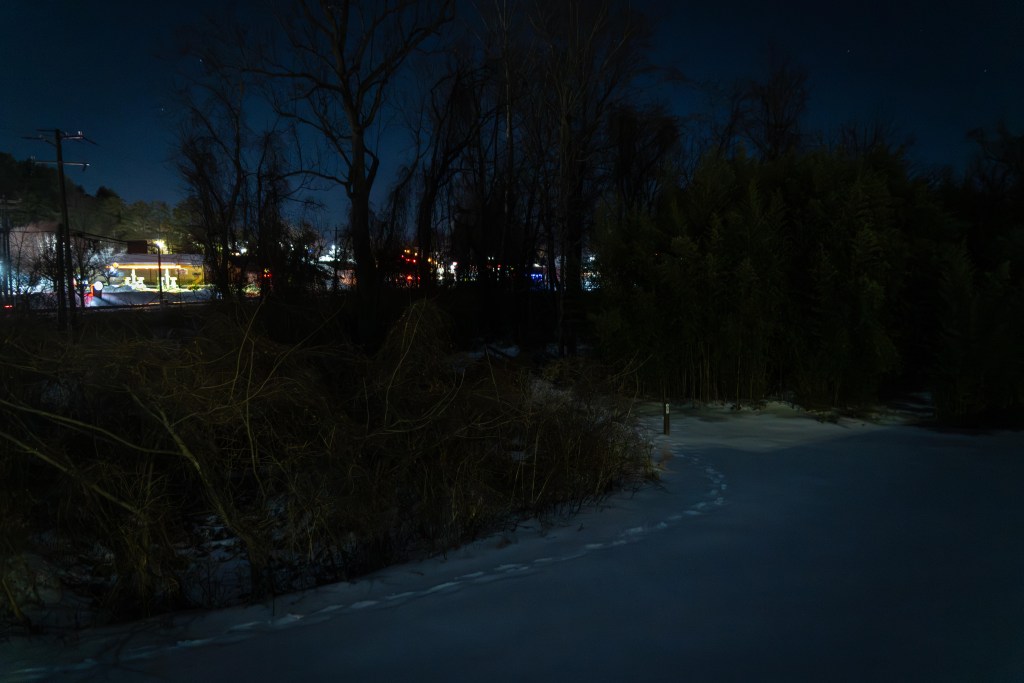
Ice crunched under Shayla Washington’s boots as she walked through the parking lot of the Starbucks on Fifth Street a little before 9 p.m. the night of Wednesday, Jan. 28. She trained her flashlight on a Rivanna Trail sign, and walked as far as she could toward the trail entrance, but a sheet of ice prevented her from even getting close.
“Outreach!” she called into the darkness, her breath a cloud in the dark air. She listened to hear if anyone called back, but all she heard were cars and trucks in the distance, and someone ordering a latte at the nearby Starbucks drive-thru.
“I really hope nobody is out here,” Washington said to a Charlottesville Tomorrow reporter. It was 11 degrees outside, and the temperature was dropping. In better weather, she might have found a small encampment of four or five tents and some unhoused community members. That’s who she was looking for.
Every year, on the fourth Wednesday in January, people across the country go out to count and survey the number of people experiencing homelessness in their communities.
The exercise, called the Point-In-Time count, is mandated by the U.S. Office of Housing and Urban Development and has been since 2005. The agency uses the data collected during the count to help determine funding for homeless service programs nationwide — including ones in the Charlottesville area.
And while the PIT count can be helpful in some ways, service providers and policy experts say it is a flawed procedure that underestimates how many people in the community are experiencing homelessness, or who those folks are.
“It’s just a point in time,” said Washington, who serves as executive director of the Blue Ridge Area Coalition for the Homeless, a nonprofit that helps other local homeless service providers coordinate their efforts and apply for funding. BRACH leads the area’s PIT count each year.
“It doesn’t tell us how this looks in March, or September. The only consistent thing is that it’s on the fourth Wednesday in January, and then there are a lot of different variables that can happen,” she said, gesturing toward ice-covered surfaces around her. “That’s the hard part about this count.”
Preliminary data shows that at least 192 people in the area were experiencing homelessness that night, Washington said: 101 in emergency shelters, 87 in emergency hotel stays, and 4 unsheltered. Washington expects that number to rise as she collects additional data from other programs, including the family-focused emergency hoteling ones run by the Charlottesville and Albemarle County social services departments.
Last year, the PIT count tallied 220 people total, according to data Washington shared with Charlottesville Tomorrow.
But that is almost certainly an undercount, and the number doesn’t tell the whole story.
Volunteers unable to check on many sites due to hazardous conditions
This year’s count took place on Jan. 28, a few days after a nasty winter storm hit much of the East Coast. The storm blanketed central Virginia in a thin layer of snow, then inches of sleet that quickly turned to immovable ice in sub-freezing temperatures.
As the storm hit and its effects lingered for days after, service providers and volunteers moved dozens of unhoused community members out of the dangerous weather. Some folks went to hotel rooms paid for with a combination of funds from BRACH, The Haven, the City of Charlottesville and local mutual aid groups.
Others went to one of the area’s two emergency shelters, People and Congregations Engaged in Ministry (PACEM) and The Salvation Army.
That means folks who might normally be living in encampments along trails and in parks, or sleeping near the Downtown Transit Station, were staying in shelters and hotel rooms the night of the PIT count.
But Washington and others needed to see if anyone was still out there.
HUD requires a count of people staying in emergency shelters, transitional housing, and safe havens, every year. The agency also requires a count of unsheltered people living outside, or in places not meant for human habitation — such as cars, tents and sheds — in odd-numbered years only. But BRACH counts both every year, because it is a chance to get out there and maybe find some folks service providers weren’t already aware of, Washington said.
Getting to potentially unsheltered folks was the biggest challenge of this year’s count.
The weather made it challenging — and in many cases, impossible — for Washington and volunteers to check many of the 21 sites they were hoping to check around the city of Charlottesville and Albemarle County’s urban ring.
Volunteer Emily Johnson couldn’t reach an encampment near Free Bridge along the Rivanna River, a few miles from where Washington was looking. Johnson had been to the camp before and knows some of the people living there. But Wednesday night, the path was solid ice and she couldn’t get her footing.
“It was like you were going to slip and slide into the river,” she told Charlottesville Tomorrow. “There was no way to get out and see if somebody was out there because it was so hazardous.” Like Washington, Johnson was relieved to know that so many people were in shelters and hotel rooms rather than outside in the bitter cold.
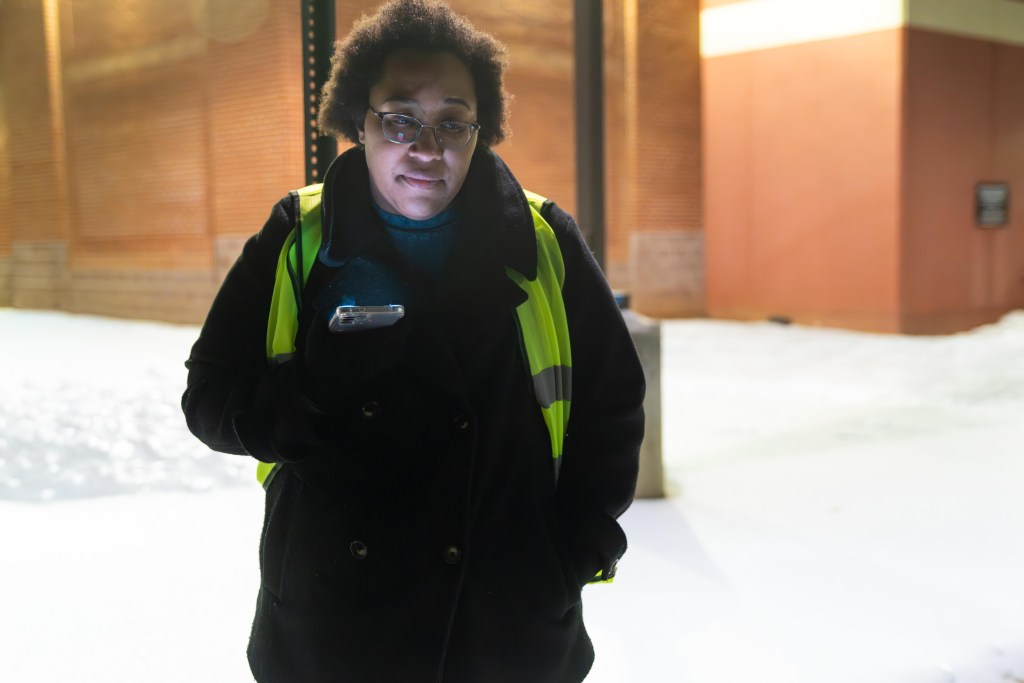
Washington couldn’t figure out how to safely access the Rivanna Trail near Fifth Street. Getting to the site would mean going down a hill covered in ice. If she could get down the hill, she would never be able to get back up. As she contemplated her options, her phone rang. It was Sid, a volunteer covering the Downtown Mall and E. Market St.
Sid, who asked to be referred to by her first name for privacy reasons, had met two people who were planning to spend the night outside. Could Washington book them hotel rooms?
Washington turned off her flashlight and walked toward the Starbucks to warm up and book the rooms on her phone. Both also needed transportation to the hotels, so Washington called a Lyft for one person, and then downloaded the Uber app to simultaneously book a second ride for the other person who needed shelter.
Across town, Sid waited with both men until their rides arrived and they were en route to their warm hotel rooms.
The Mall and downtown sidewalks were mostly clear of snow and ice, Sid told Charlottesville Tomorrow a few days after the count. She met a few people who were out panhandling, but they told her they had places to sleep that night, so she didn’t “count” them. She also saw a man sleeping in a storefront. Since he was asleep, she counted him, but wasn’t able to ask him to take the PIT count survey.
The unhoused folks she talked to weren’t interested in taking the survey anyway, Sid said. She suspected that was because of the personal nature of the questions.
“They’re geared toward trying to provide services, and trying to understand the community population — mental health, substance abuse and dependence, criminal history, things like that,” Sid said. “It’s like, ‘Hi, you’ve never met me! Do you want to tell me about the very worst parts of your life?’ People didn’t really want to talk.”
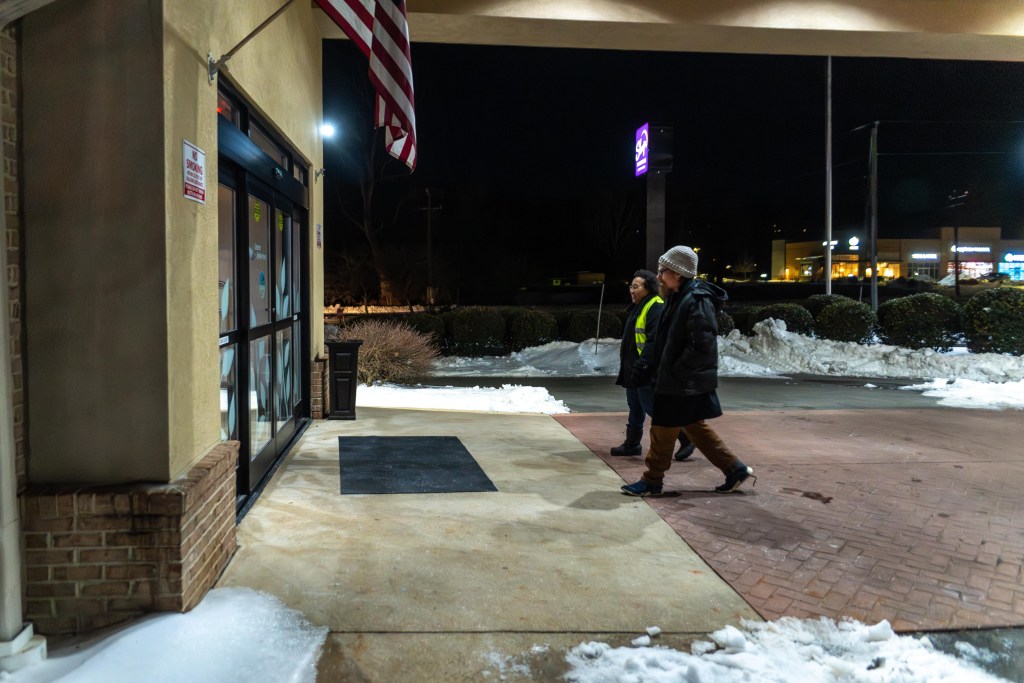
Over near the Rivanna Trail entrance, Washington got into her car and drove across Fifth Street to a hotel. She waited for about 10 minutes for one of the men Sid had talked with to arrive. She checked him into the hotel, then helped him carry his belongings — a duffel bag, a backpack, and a guitar — to his room.
“I’m stoked,” the man told Charlottesville Tomorrow in the hotel lobby. He did not want his name printed due to the stigmas associated with homelessness.
“I can’t believe it,” he added, shaking his head. He had been planning to stay outside that night, maybe in an alley downtown. “I can’t believe it.”
Federal government’s narrow definition of homelessness affects national statistics, experts and service providers say
By the end of the night, 87 unhoused community members were staying in hotels. By Friday, just two days later, that number had grown to 98. It’s possible that those additional 11 people were not included in the PIT count.
That’s an example of how the weather will affect the PIT count data, Washington said. And that could affect funding.
With so many people in emergency shelters and emergency hotel stays, the “sheltered” count this year is likely to be much higher than in previous years, Washington said. On the other hand, the “unsheltered” count is likely to be much lower.
BRACH will have an opportunity to explain what happened when it submits its PIT count data to HUD in the spring.
Still, the skewed numbers could lead HUD, or anyone looking at the data without essential context, to believe that unsheltered homelessness is no longer a problem, or isn’t as big of a problem as it was, in the Charlottesville area, and therefore doesn’t need federal support.
But that’s definitely not the case, Washington said, emphasizing the need for consistent federal funding to assist the Charlottesville area’s unsheltered people.
“Clearly we need funding help with sheltering people, ideally permanently” she said, gesturing to the hotel.
The variability in weather — and the way it affects the data — isn’t the only flaw in the PIT count, say experts and service providers alike.
One of the biggest problems is that the count is guided by, and reinforces, a narrow definition of homelessness: people staying in emergency shelters, and people sleeping in places not fit for human habitation.
“The methods used by HUD to conduct the PIT counts produce a significant undercount of the homeless population at any given point in time,” according to a 2017 report by the National Law Center on Homelessness & Poverty.
“Regardless of their methodology or execution, point in time counts fail to account for the transitory nature of homelessness and thus present a misleading picture of the crisis. Annual data, which more accurately accounts for the movement of people in and out of homelessness over time, are significantly larger,” the report continues.
For instance, volunteers counted 220 people during the Jan. 22, 2025 PIT count. But service providers knew of 571 people who experienced homelessness of some kind, at some point, between spring 2024 and spring 2025.
HUD’s definition of homelessness is intentionally narrow, journalist Brian Goldstone explains in the epilogue of his 2025 book “There Is No Place For Us: Working and Homeless in America.” For the book, Goldstone, who also has a doctorate in anthropology, shadowed five working homeless families in Atlanta for years. He discussed that process in an interview with Street Sense Media, a news publication focused on the voices of people with lived experience of homelessness.
“In the 1980s, when homelessness was starting to explode in the United States, elected officials tried to deny that there was anything to be concerned about,” Goldstone writes. “A top HUD official in the Reagan administration went so far as to bluntly assert: ‘No one is living on the streets.'”
But people knew that wasn’t true — they could see people sleeping on the sidewalks in their own cities and towns. And when gaslighting the public didn’t work, elected officials tried another method, Goldstone writes: convincing the public that substance abuse and mental health — not a lack of housing — cause homelessness. Because substance abuse and mental health issues among people experiencing homelessness are often very visible, it’s something the general population started to believe.
What they weren’t seeing, Goldstone points out, were the individuals and especially families living in hotel rooms, in their cars, or doubled up in small apartments.
“By 2005, when the Point-in-Time count was established by HUD, a small but conspicuous fraction of the total homeless population had come to stand, in the public imagination, for homelessness itself,” Goldstone writes. “Everyone else was written out of the story. They literally did not count.”
The Trump administration is doubling down on this rhetoric. In July 2025, President Donald Trump issued an Executive Order blaming homelessness on substance abuse and mental health, setting the tone for his administration’s approach to the issue.

Another population often overlooked in the PIT count is youth living separately from any family members, according to the National Alliance to End Homelessness, a nonprofit organization dedicated to ending homelessness.
These unaccompanied youth should be counted, but many communities report zero, the NAEH says on its website, and those numbers are likely inaccurate. That’s because youth are often more afraid or unwilling to go to a shelter, and on top of that, communities have few resources and beds specifically designated for them.
It’s even harder to find and count unsheltered youth, the organization says. They congregate in different areas from older people experiencing homelessness, and are not usually engaged with traditional homelessness assistance programs.
“Without adequate coverage of homeless youth in point-in-time counts, there is a danger that they will continue to be underserved,” the organization says.
Weather, lack of volunteers limited search areas, likely led to undercounting
Every person that Charlottesville Tomorrow spoke with about their experience conducting the PIT count last week said the same thing: They worried they were missing someone.
They probably were.
Not because they weren’t trying, but because the PIT count asks them to count only a certain set of people, and because homelessness is not always immediately visible. The weather also made it challenging, and in some cases impossible, to physically get to anyone who might have been outside.
Another reason for missing someone during the PIT count is that locally, BRACH never has enough volunteers to cover its entire service area.
“There could be plenty of encampments we’re missing and aren’t aware of, because we’re not out there,” Washington said. “We don’t have enough coverage in terms of volunteers or staffing to do the true outreach we need to do.”
BRACH serves the City of Charlottesville as well as Albemarle, Fluvanna, Greene, Louisa and Nelson counties, but the organization only had 33 people — three staff and 30 volunteers — to cover that entire area. They focused efforts on known encampments and gathering places, mostly in the city and in Albemarle’s urban ring.
A grassroots homeless coalition in Louisa contributed to the count in their community, Washington said. They tallied six people experiencing homelessness — three unsheltered, and three in hotel rooms paid for by a third party — and those folks will be included in the PIT count data BRACH sends to HUD.
“Unfortunately,” Washington said, she does not anticipate getting any data for Fluvanna, Greene, or Nelson. Not because there aren’t people experiencing homelessness in those places, but because she didn’t have enough volunteers to go to those places.
Having more volunteers would make a difference, Washington said. With an expanded geographical reach, she’s confident they’d find more people, especially folks living in their cars in parking lots throughout the area.
Having more paid, full-time outreach staff — people whose job it is to locate and get to know people who are experiencing homelessness, and help connect them with services — would help, too. Currently, there is only one full-time outreach staff person between all of the homeless service programs in the area.

The city considered hiring two outreach staff of its own. Charlottesville City Manager City Manager Sam Sanders talked about it as recently as August 2025, as part of his Homeless Intervention Plan.
“We’re looking at adding homeless outreach workers, individuals dedicated to being out on the street with the people who are outside, helping to inform us by having direct contact with individuals who are going through the things that they’re going through, and better inform the work that we’re doing,” he said at the time.
The city appears to have left that idea behind.
When Charlottesville Tomorrow inquired about the status of those positions, city spokesperson Afton Schneider said that the city did not move ahead with them.
“We didn’t move forward with establishing those two specific positions, but have instead decided to expand on our current operations to include homeless intervention strategies,” Schneider said in an email. She added that the city is working on an alternative, and will share details at a later date.
Local service providers collaborate and share their own data
Because the PIT Count measure excludes so many people experiencing homelessness, local service providers have other methods of understanding the constantly evolving issue of homelessness in the community.
One is that their definition of homelessness is broader than HUD’s — it includes the families and young people that journalist Goldstone and the National Alliance to End Homelessness say the PIT count leaves out.
With that in mind, local service providers collaborate on something called the “by-name” list. It’s a list of all of the people service providers know are experiencing homelessness in the community. The list changes every time service providers learn of someone who has fallen into homelessness, or someone who has become housed.
In January, 362 people were on the by-name list, up from 280 the previous month, December 2025. It’s the highest number in the past year, according to BRACH’s website.
But even that list is likely an undercount, because the by-name list is only the people who have reached out for help from one of the agencies. There are likely more out there who haven’t contacted any agencies, Washington told Charlottesville City Council in June 2025.
This summer, BRACH will lead another effort to count and survey folks — one that’s separate from any federal requirements. Washington hopes more people will volunteer for this effort.
Additional volunteers wouldn’t just help with the count. It would likely build a better community-wide understanding of the folks experiencing homelessness, and therefore the issue of homelessness itself.
A better understanding is why Sid volunteered to participate in the PIT count last month.
Sid lived in Boston, Massachusetts, before moving to Charlottesville a few years ago. In Boston, she worked at a homeless shelter, and her first winter in Charlottesville, she was shocked that people were expected to sleep outside in the weather.
In Boston, there were all-night warming shelters for folks who couldn’t get shelter beds, she said.
“A capacity was built out for that. Whereas here, there’s no stopgap measure,” Sid said. It doesn’t sit right with her that when folks’ hotel stays were up last week, they’d be back outside.
“It’s ‘back to business,'” she said. “There was a moment where I wanted to be like, ‘what is it I can help with?,’ and then feeling really frustrated that so little could be offered.
“People shouldn’t actually freeze to death,” Sid added. “But that seems like a low bar for how people should be treated.”