

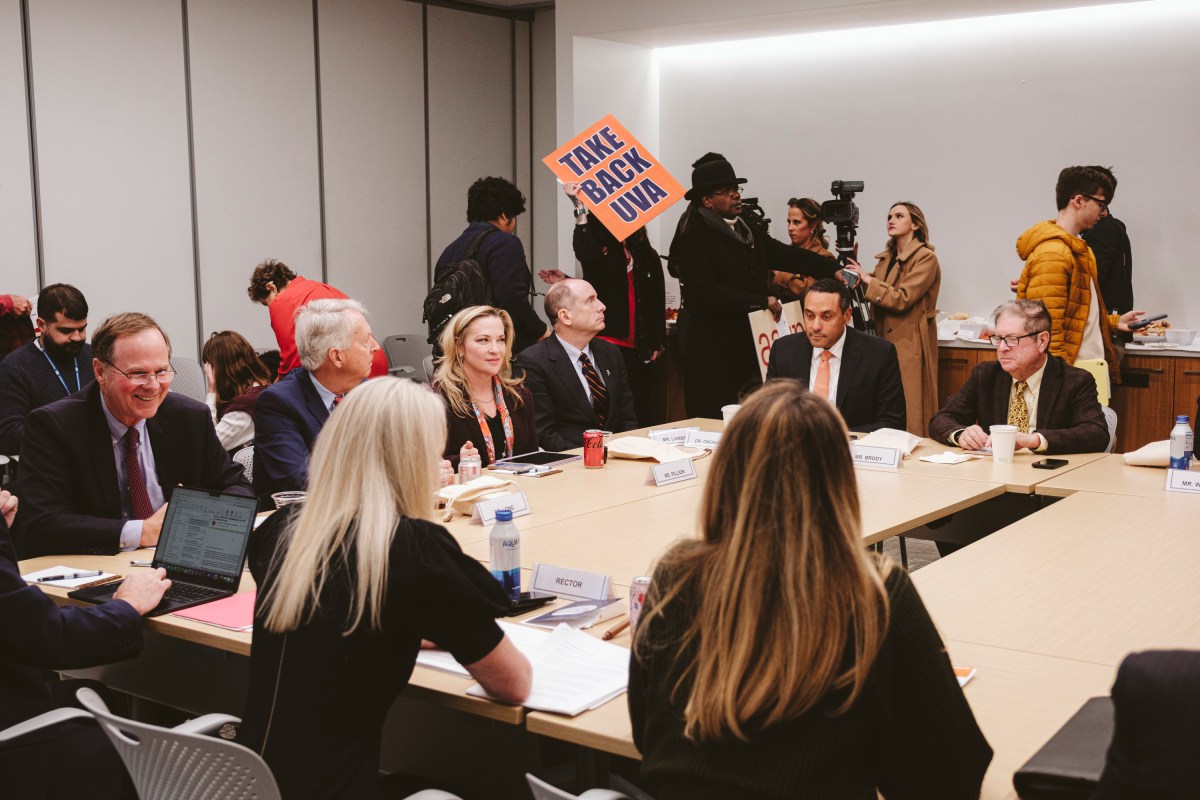
With Democrats now in full control of state government, Virginia lawmakers are proposing sweeping changes to the boards that govern public colleges and universities, saying that in the past few months Virginia Republicans and Republican-appointed board members have politicized higher education and destabilized campus leadership.
A primary point of contention has been former University of Virginia President Jim Ryan’s ouster from his role in late June under pressure from the Trump administration and the selection of Scott Beardsley as UVA’s 10th president in December. Beardsley began his tenure on Jan. 1 without the confidence of the university’s Faculty Senate — the primary, university-wide body that represents faculty interests at UVA — and under the shadow of a search process that some members of UVA’s community and Democratic officials have called “illegitimate,” “rushed” and “politically motivated.”
The Board of Visitors, the university’s main governing body whose members are appointed by the Governor and confirmed by the General Assembly, headed the search process for presidential candidates. The Board faced criticism from Virginia Democrats and multiple university groups after it accepted Ryan’s resignation with no apparent resistance and, according to Ryan, some members actively pressured him to leave.
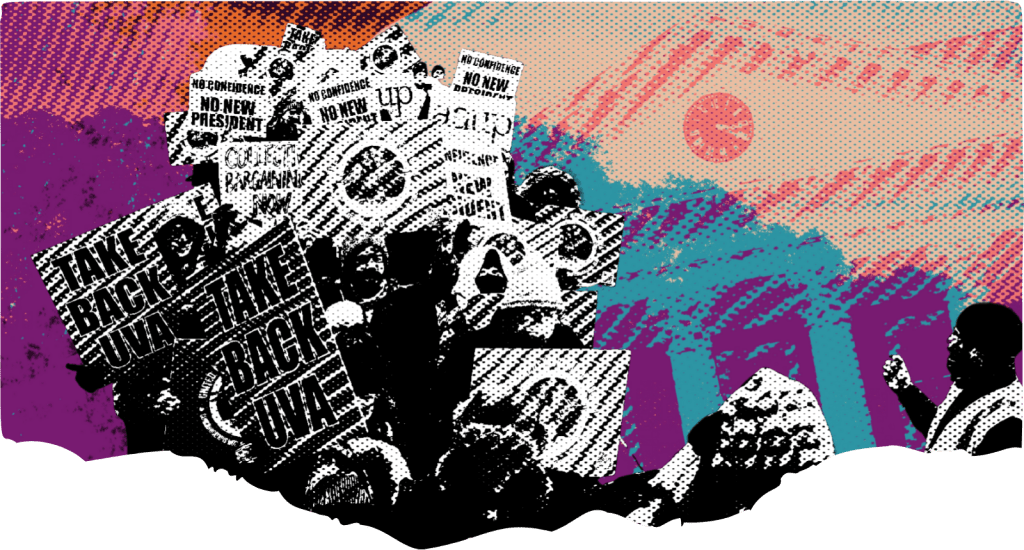
Ryan’s ouster became a political flashpoint, with various faculty, staff, student and alumni groups — including UVA’s Faculty Senate — criticizing the process that led to his departure, while other conservative groups have been vocally in favor of his exit. The Jefferson Council, a conservative organization formed by UVA alumni, donors, students and faculty in 2020, praised Ryan’s removal in a June 27 statement, calling it a “welcome step toward restoring intellectual diversity” and “depoliticizing” the university. The organization — which had previously spoken out against Ryan’s diversity, inclusion and equity initiatives at the university — had been calling for his removal as president since May.
Now, a number of Democratic state senators and delegates are proposing legislative changes to governing boards at Virginia’s public universities. The goal, they told Charlottesville Tomorrow, is to “de-politicize” university boards by giving them more tools to push back against political pressure.
And while board appointments have always been political in nature, the legislators say that they have become even more politicized in recent years, and Republicans and Democrats are struggling to find common ground as communication has deteriorated.
Virginia’s university boards have a long history of politicization
Accusations of politicization aimed at Virginia’s university boards are not new, former Chief Deputy Attorney General of Virginia Claire Gastañaga told Charlottesville Tomorrow. During her eight years in the Attorney General’s Office, Gastañaga was responsible for overseeing all legal services provided to Virginia’s public colleges and universities.
After Republican Gov. Jim Gilmore was accused by academic organizations and political opponents, including Democrats, of politicizing university governing boards, his successor Democrat Gov. Mark Warner established a “blue ribbon commission” that was supposed to focus on merit in recommending board appointments to the Governor, Gastañaga told Charlottesville Tomorrow. The commission was codified in 2005 as the Virginia Commission on Higher Education Board Appointments.
Nonetheless, since members of Virginia’s university boards are appointed by the sitting Governor, “they’ve always been political patronage appointments,” or positions that are generally reserved for the governor’s loyal supporters, Gastañaga said.
“The donor class has always been well represented on these boards when governors made appointments,” she said. “Either the donor class, or people who had been their long-standing aide, or that kind of thing.”
At least nine of UVA’s 12 recent Board members under former Gov. Youngkin donated directly to Youngkin or a Youngkin-affiliated political action committee, including former Rector Rachel Sheridan, who donated at least $25,000 to Youngkin’s Gubernatorial campaign in 2021. Her husband, Paul F. Sheridan Jr., donated $60,000 to Spirit of Virginia, a PAC associated with Youngkin, between 2023 and 2024.
Several of UVA’s Board members appointed by Youngkin’s predecessor — Democrat Gov. Ralph Northam — also donated either to Northam or an affiliated PAC. Thomas A. DePasquale, for instance, donated at least $164,069 to Northam’s gubernatorial and lieutenant governor campaign, as well as his 2018 inaugural committee.
The same is true of Gov. Abigail Spanberger’s recent appointments. Board member Mike Bisceglia donated the most to the governor out of her appointments, including $24,000 to her gubernatorial campaign and $12,500 to her inaugural committee.
Virginia higher education boards were more politicized than ever under Youngkin, Democrats say
While some level of politicization has always been expected from Virginia’s university boards, UVA’s Board has reached new extremes under Gov. Youngkin, Sen. Creigh Deeds told Charlottesville Tomorrow. Deeds, a Democrat, represents the 11th District, which includes UVA Grounds.
Virginia Republicans, however, have also accused Democrats of politicizing higher education boards.

Democrats on the Virginia Senate Privileges and Elections Committee, led by Senate Majority Leader Scott Surovell, blocked nearly two dozen of former Gov. Youngkin’s most high-profile university board appointments. The moves began in June 2025 with the rejection of eight nominees, including former Virginia Attorney General Ken Cuccinelli from UVA’s Board of Visitors. This was followed by an additional 14 rejections in August 2025, four of which targeted UVA.
Cuccinelli’s nomination drew particular opposition from democrats, who argued that his positions — which include a vocal opposition to same-sex marriage and a rejection of widely accepted scientific consensus on climate change — are too extreme for the role at Virginia’s flagship university. They asked Youngkin to steer clear from appointing anyone too polarizing or without a higher education background in the future.
While the committee confirmed the vast majority of Youngkin’s other routine appointments to state agencies and less controversial university seats, the targeted rejection of these 22 nominees left several major institutions, including George Mason University and UVA, with significant leadership vacancies heading into the 2026 administration change.
Republicans on the committee condemned their colleagues’ refusal to confirm Youngkin’s appointments, which they said included qualified and non-polarizing individuals, and Youngkin criticized the move as blatant and harmful partisanship.
But Senate Democrats argued that the governor was the one politicizing higher education boards by stocking them with controversial conservative figures with no background in higher education, like Cuccinelli, as reported by Inside Higher Ed.
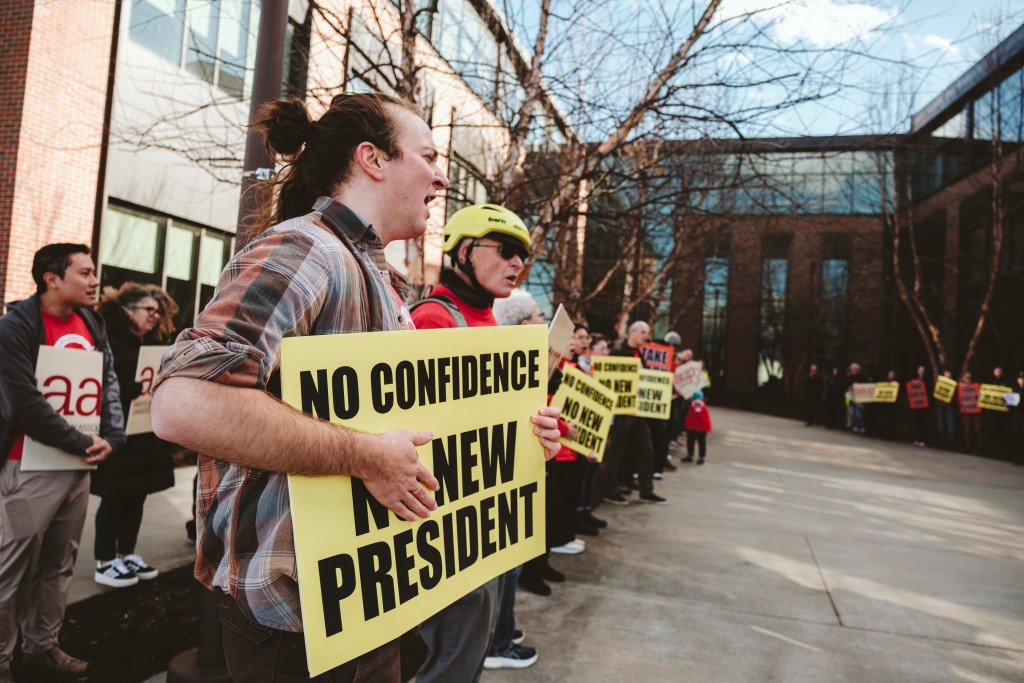
Youngkin “and his appointments have been driven by more partisanship than any ever before that I’ve seen,” Deeds said, adding that communication with UVA’s former Rector Sheridan was particularly challenging.
“I’ve been in the State Senate since 2001, and I’ve worked with members of the Board of Visitors that have been appointed by Democrats and Republicans,” Deeds told Charlottesville Tomorrow on Dec. 30. “I’ve had agreements and disagreements with them, but I’ve always been able to talk to them, there’s always been a channel of communication, and the channel has just been closed. They communicate with me now through lawyers.”
Deeds added that, while there have been controversies at UVA before, he’s never experienced a situation where he hasn’t been able to speak to a Board rector directly, especially during such a crucial time for the university.
“I’ve never had a situation where they couldn’t call me up and just we can sit down and talk — maybe disagree — but still talk,” Deeds said. “That’s not the way it’s supposed to work, we at least owe it to each other to have some dialogue.
“Our institutions of higher learning train our workforce, they create our ideas, they allow our economy to work,” he added. “Higher education is just too important to be torn asunder in a partisan world.”
In response to a request for comment directed to former Rector Sheridan and former Vice Rector Porter Wilkinson, UVA Spokesperson Bethanie Glover told Charlottesville Tomorrow that Sheridan spoke with Deeds on Jan. 12 at a meeting of the Education Subcommittee of the Senate Finance and Appropriations Committee, and told him that “she welcomes opportunities for continued dialogue with him and the other members of the committee on issues of shared concern by the university and the General Assembly.”

Youngkin and his press secretary did not respond to multiple requests for comment from Charlottesville Tomorrow.
Del. Katrina Callsen, a Democrat, agreed with Deeds, adding that the recent presidential search process that culminated in Beardsley’s appointment — which she described as rushed, lacking transparency and having “serious procedural issues” — revealed troubling issues around growing politicization in Virginia’s university boards.
“I think the last year has really illuminated for us some of the weaknesses in our board governance structure that really make us ripe for federal targeting, federal overreach and politicization of our state schools,” she said.
During a Dec. 19 visit to UVA, hours before Beardsley was appointed, Callsen said that the Board of Visitors was ignoring calls “from every corner of the commonwealth” to pause the search.
“The governor-elect asked for them to pause so that the board could be fully constituted. They ignored that. The General Assembly echoed those pleas. They also ignored that,” Callsen told Charlottesville Tomorrow. “They ignored big swaths of the faculty, staff and students that also called for more transparency in the process and to wait until they have a full board.”
While Glover told Charlottesville Tomorrow in an email that “Mr. Beardsley could not be any more apolitical and highly qualified,” Callsen told Charlottesville Tomorrow, “I don’t know why they couldn’t wait if he was truly deserving and ready to take the job.”
Ross A. Mugler, president and CEO of the Association of Governing Boards of Universities and Colleges (AGB), agreed with Callsen and Deeds that the past Board under Youngkin was unusually politicized, adding that he hadn’t seen so much interference in university governance from a governor’s office before.

AGB is a nonprofit that supports higher education boards with resources, research and training on best practices.
“I have been on a governing board for close to 20 years, and prior to the previous administration, I never saw interference from the Secretary of Education on board matters,” Mugler told Charlottesville Tomorrow of Aimee Rogstad Guidera, who served as Secretary of Education under Youngkin.
Virginia’s Secretary of Education is appointed by and operates directly under the Governor as a key member of the Governor’s Cabinet. In September, Guidera reached out directly to university Board rectors in Virginia — including at the University of Virginia — telling them to ignore the recent rejection of a number of Board members by the General Assembly, which under Virginia law has the power to confirm or reject gubernatorial appointments to university boards.
At the same time, when UVA’s Board of Visitors unanimously passed a resolution in March 2025 to dissolve UVA’s central diversity, equity and inclusion office and related programs, former UVA President Jim Ryan later revealed in a Nov. 14, 2025 letter that the resolution was originally drafted by Gov. Youngkin.
“This was the first time in my seven years that the Governor’s office had drafted a resolution on behalf of the Board,” Ryan’s letter states.
Meanwhile, private text messages between members of UVA’s Board of Visitors published by the Washington Post in January 2026 reveal that, in the early months of 2025, some board members exchanged messages about ending “chemical and surgical mutilation” for transgender youth at UVA Health as well as ending diversity, equity and inclusion (DEI) initiatives at the university. The texts revealed that Youngkin was pushing the board to end gender-affirming care in particular and “suggest a degree of involvement by the governor’s administration in university operations that is atypical in modern Virginia history,” the Post reported, citing multiple former board members.
In Virginia, university board members owe fiduciary duties of care, loyalty and obedience to their colleges and universities. In other words, they are required to act in the best interest of their institutions. This includes making informed, prudent decisions on its behalf (care), avoiding conflicts of interest (loyalty) and ensuring compliance with an institution’s laws and mission (obedience), according to Inside Higher Ed.
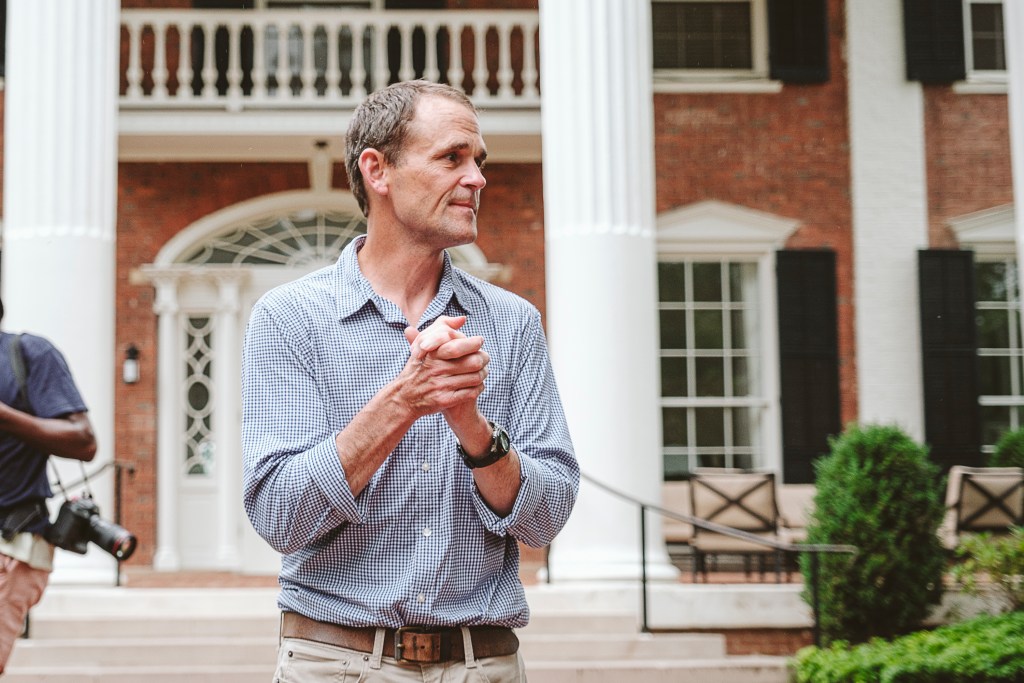
“Virginia has become a prominent example of a national shift toward appointing public college and university trustees based not on their civic or fiduciary qualifications, but on their ideological alignment with state and federal political leaders,” Mugler told Charlottesville Tomorrow on Jan. 14, adding that, prior to Spanberger’s restructuring of the Board, some Board members at UVA were attempting to “micromanage” their universities on an ideological level “rather than providing governance.”
“We have some basic principles in [university] governance — duty of loyalty, of obedience and duty of care — and I feel like UVA has been operating outside these prescribed guidelines for governance,” he said. “You have a board operating to undermine and compromise the president and the institution, not following the duties of care, obedience and loyalty, and not really focused on student success and alignment.”
This has led to “pressing current issues such as the erosion of institutional autonomy, challenges to academic freedom and unprecedented governmental overreach into the work of boards,” Mugler added.
To help address these issues, Mugler said it’s crucial that the existing nomination and selection process for higher education governing boards be reformed to ensure that members are selected based on experience and merit, and, once selected, that members are properly trained on their duties.
Proposed legislation would adjust terms of college and university board members
One of the changes Democratic legislators hope to make is to stagger and potentially extend terms of public college and university board members, Callsen told Charlottesville Tomorrow.
That way, a single governor isn’t appointing the entire governing body for every public university in the commonwealth, she said. Currently, board members serve consecutive four-year terms, so each governor can appoint all the members of a board by the time they leave office.
Callsen and Senate Majority Leader Surovell, a Democrat, introduced identical bills in the House of Delegates and in the Senate on Jan. 14 that would make changes to governing boards of public institutions.
In their bills, they specify that — instead of being allowed to serve two consecutive four-year terms — university board members will serve one six-year term, and must wait two years before being able to serve another six-year term.
Mugler of the Association of Governing Boards of Universities and Colleges told Charlottesville Tomorrow that he’s spoken to Surovell about instituting staggered terms for board members and believes this would be a positive step to help ensure the university stays focused on its long-term plans “regardless of who occupies the governor’s office.”
“Universities really operate on a multi-tier, multi-year level — strategic plans and capital projects and presidential tenures — and for a large, complex institution like UVA, stability on the board level is really critical to achieving those things,” he added. “Governance structures in the grip of a politically driven board that turn over quickly can really undermine that continuity and make it harder to attract and retain faculty, staff and strong leadership, especially in the president’s cabinet, in my opinion.”
Staggered terms, Mugler said, would help Board members “focus on stewardship, rather than short-term political cycles.”
Democrats propose independent counsel for Virginia universities
Deeds told Charlottesville Tomorrow that he is also considering legislation giving public universities the right to hire independent counsel.
Under Virginia law, the Office of the Attorney General is the default legal counsel for state agencies, including UVA.
Shortly after Ryan’s ouster in July, Sen. Surovell told Virginia Mercury that the Senate may reconsider a bill that would give boards the option to hire independent legal counsel and limit the Attorney General’s involvement to cases in which their services are specifically requested or for legal settlements involving more than $5 million.
The bill, which was introduced by Surovell in 2024, passed both the Senate and the House of Delegates during the 2024 session before it was ultimately vetoed by Gov. Youngkin.
Callsen and Surovell’s recent bill includes similar provisions. The bill allows the governing board of Virginia’s public higher-ed institutions “to hire or retain legal counsel for the provision of all legal services,” including a chief legal officer who would report solely to the board and the institution’s president.
Like Surovell’s previous bill, the bill specifies that the Attorney General may still be involved in legal cases when their services are requested by an institution, for legal settlements involving more than $5 million or in the case of an agreement with the Department of Education or the Department of Justice.
Currently, all of the lawyers who represent UVA and any other public college or university in Virginia must be appointed “special counsel” by the Attorney General in order to provide legal advice to the institution. This means that, even though the lawyers in the UVA Office of University Counsel are employees of UVA, the Attorney General can withdraw their appointments at any time.
Because the Attorney General is a political position aligned with a specific political agenda, this has the potential to create conflicts of interest that may prevent UVA’s in-house counsel from acting in the best interest of the university, contracts lawyer and UVA alumnus Chris Ford told Charlottesville Tomorrow.

“The university’s legal defense is subject to the Attorney General, but the Attorney General is politically inclined in the same way that the Department of Justice is, right? And so accordingly, they weren’t going to fight it,” Ford told Charlottesville Tomorrow in November while discussing UVA’s Oct. 22 deal with the DOJ, which critics say handed sweeping control to the Trump administration and undermined hard-won protections for students and faculty of color. “And so at least from my perspective, the whole thing was rigged from the beginning to have this outcome, from the forced ouster of President Ryan, to what has happened with this agreement, it was bound to happen because there was no resistance that was put up.”
“When the issues that surrounded the university were more political in nature — like the DEI issue, like the transgender affirmative care issues — the Attorney General basically aligned his positions with a political stance as opposed to defending the university,” Ford added in January. “And so because the general counsel of the university reports directly to the Attorney General, the general counsel was not able to defend the university.”
Former Attorney General Jason Miyares’ media contacts did not respond to multiple requests for comment from Charlottesville Tomorrow.
“Part of the reason that the university fell into some of the traps that it fell into in 2025 was precisely because it did not have independent counsel that could defend the university,” Ford said. “The university was left defenseless against the attacks from the Department of Justice.”

In fact, in a Nov. 14 letter by Jim Ryan detailing the series of events that led to his ouster, Ryan explained that in order to hire outside counsel to represent the university in the DOJ investigations, the university needed permission from the Attorney General.
“We asked for the three lawyers who had worked with us previously, but only two were approved — Jack White and Farnaz Thompson,” Ryan wrote in the letter. “Both are very good lawyers who are also conservative, and Farnaz worked on Project 2025.”
“Project 2025” is a long-term political strategy developed by the Heritage Foundation to advance a conservative agenda in the federal government.
“The third lawyer — the senior most lawyer of the three — Jonathan Blank, is a UVA alum and a moderate,” Ryan added. “Despite his seniority and the volume of work required, as well as his knowledge of UVA, I was told he was not allowed to participate.”
Miyares never offered any public explanation for why Blank wasn’t allowed to participate.
Deeds agreed that having the Attorney General serve as the default legal counsel for public universities creates too much room for the politicization of those universities’ boards.
“We’re going to pass legislation, or certainly consider legislation, that gives schools the ability to have their independent counsel,” he said.
While there may be some debate about how to pay for the independent counsel, the cost will probably come out of the Attorney General’s budget, Deeds told Charlottesville Tomorrow.
Gastañaga agreed that there is a potential for conflicts of interest under the current structure in which the Attorney General serves as the default legal counsel for public universities. But she believes the more serious problem is the apparent failure of the lawyer’s clients — the Board as a whole as well as certain individual members of the Board — to live up to their responsibilities, including their duties of loyalty and obedience to the university.
“The client — the Board in this case — decides the ‘what’ and the lawyer helps with the ‘how,'” Gastañaga told Charlottesville Tomorrow.
“Independent counsel would still be required to take their direction from the Board as the governing body of the University,” she said, adding that “the real problem here was that the president wasn’t backed by the Board.”
Two ways to tackle this issue legislatively, she said, would be to codify that board members have the legal and fiduciary obligation to act in the best interests of the university rather than the Governor or the Commonwealth; and to codify that universities may hire their own lawyers to represent them.
In addition to these legislative changes, she added that Attorney General Jay Jones, a Democrat, could take steps to achieve similar goals. First, Jones could publish an official opinion overturning an October 2023 opinion by Miyares stating that “the primary duty of the board of visitors of each Virginia institution of higher education is to the Commonwealth,” rather than the universities that the governing boards represent. Second, he could announce a general policy that all lawyers for Virginia universities will be jointly selected by the Attorney General’s office and the universities they would represent. And third, he could give anyone he appoints special counsel to a university an appointment letter citing his opinion that the lawyer’s ethical duty is ultimately to the university and not to the Attorney General’s office.
Miyares’s opinion, Gastañaga said, aligns university governance with the ideological leanings of the sitting governor rather than the goals of the university. Clarifying that the duties of the boards are to their universities would help toward their depoliticization without having to wait for legislation to be passed, she said.
Jones may be preparing to do exactly that. On Jan 17, his first day in office, Jones announced that he has directed his team to review Miyares’ opinion “and work in close collaboration with our public institutions of higher education to develop updated guidance that safeguards the integrity of our institutions and prevents the politicization of our best-in-class higher education system.”
Jones added that he is also directing his office “to conduct a national search to recruit the brightest legal talent to fill vacant counsel positions at the Commonwealth’s institutions of higher learning.”
University boards need voting faculty, staff and student members, legislators say
Deeds will also propose legislation to include student, faculty and staff representatives on higher-ed public institution boards as full voting members, he told Charlottesville Tomorrow.
Callsen and Surovell’s bills include the same provision. The goal, Callsen told Charlottesville Tomorrow, is to ensure that more of UVA’s community ultimately get a greater say in their university’s governance.
At UVA, student and faculty representatives sit in on meetings and advise the Board of Visitors, but do not ultimately get to vote on Board decisions.
Deeds said that it’s not only important for faculty and student representatives on boards to become full voting members, but also for staff representatives to also be on university boards with the same privileges.

“When you think about a school, you think about the faculty and the students, but the staff are there too, and they do a lot of the work,” Deeds told Charlottesville Tomorrow. “Most institutions cannot exist without a staff of people that take care of the facilities, take care of things and do a lot of the work.”
All three representative positions would be elected by their own peers, he said. In other words, faculty representatives would be elected by members of the faculty, student representatives would be elected by students and staff would be elected by other members of the staff, Deeds explained.
Currently, UVA’s student Board representative is selected by the Board. UVA’s faculty Board representative is also selected by the Board, but they typically rely on recommendations from the Faculty Senate, which elects candidates through its own process.
Deeds is not the only one working on legislation to increase representation on university boards.
Delegate Amy Laufer, a Democrat, plans to file a bill to make faculty and classified staff (salaried, non-faculty employees) voting members of their respective university boards, her office told Charlottesville Tomorrow. Meanwhile, Delegate Lily Franklin, a Democrat, plans to file a bill that seeks to make student representatives full voting members of their boards.
While Gastañaga told Charlottesville Tomorrow that conflicts of interest could arise from making faculty, student and staff representatives voting members of their boards, she added that they could potentially recuse themselves from specific votes in which they have a direct personal interest like salary decisions and tuition rates.
Contracts lawyer and UVA alumnus Ford added that he believes the need for students, staff and faculty to recuse themselves should only have to occur if they’re voting on a specific action that would affect them on an individual level, rather than an action that would affect the student body, faculty or staff on a wider level.
For example, “with a faculty member, if the vote were maybe the compensation for that person’s boss or head of department, then yeah, I would say that person probably ought to recuse themselves from the vote,” he said. “But if the vote was about curriculum, for example, or overall increases to the faculty, well then I think that person — although they would be affected — would not have to recuse themselves as a conflict issue. I don’t really see that as a problem.”
“In fact that’s precisely the point,” Ford added. “You want somebody in the room who can speak to and for — and vote to and for — those constituencies.”
Virginia college and university faculty, staff heading to state capital to support reform
Some Virginia politicians have yet to introduce their bills on proposed legislative changes to Virginia higher education governing boards, and it’s likely that the timelines on the consideration of these bills will vary. While some have introduced their bills in coordination with each other, like Callsen and Surovell, others are likely doing so separately, like Deeds, Laufer and Franklin.
In the meantime, several Virginia university union members, including UVA faculty and staff, went to the Capitol in Richmond on Jan. 16, two days after the start of the legislative session, to support the legislation to reform university boards as well as the right to collective bargaining.
“We think it’s really important for legislators and their staff to hear from people who are actually on the ground, doing the work of making our public higher education institutions function every day, and not just our fancy university lobbyists,” UVA librarian Cecilia Parks told Charlottesville Tomorrow.