

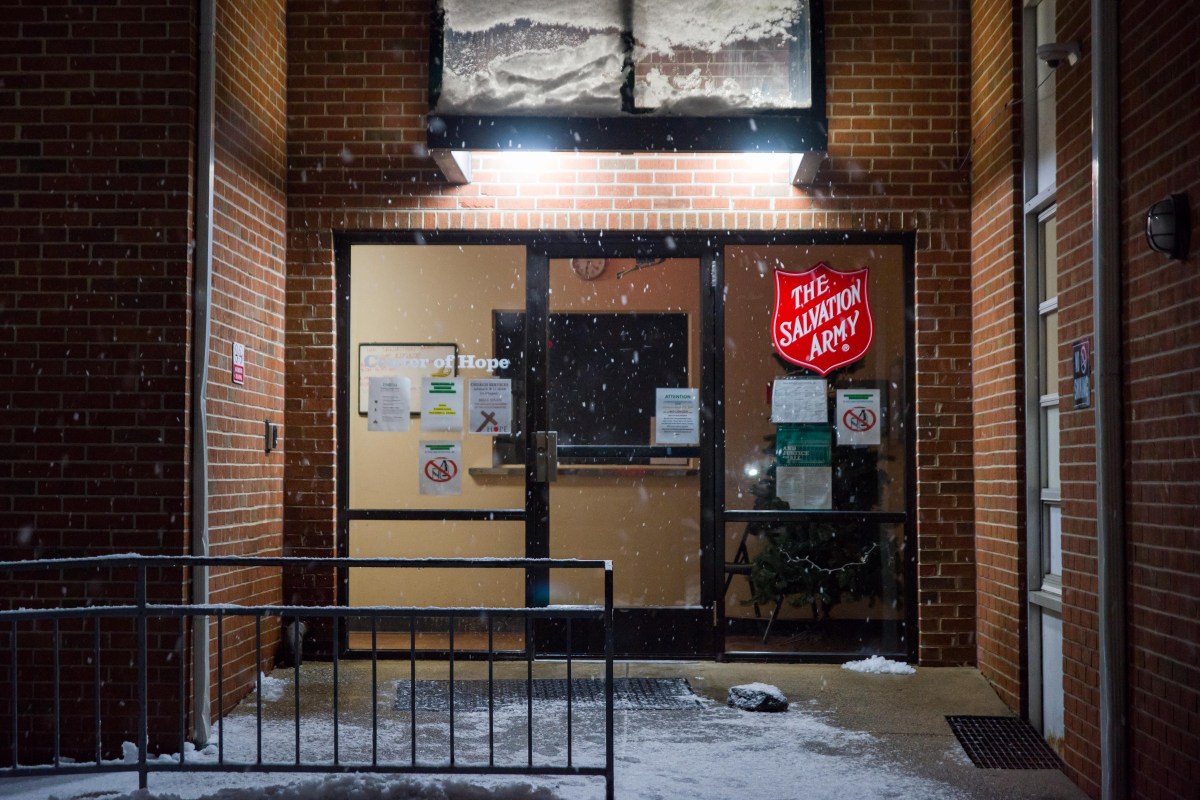
Issues of homelessness have been at the center of many emotional conversations in the City of Charlottesville over the past few years, from the emergence of a tent community at Market Street Park to local service providers shocking the City Council with the number of people experiencing homelessness in the community.
Most recently, residents of the Fifeville neighborhood have grappled with City Manager Sam Sanders’ idea of putting a new, low-barrier homeless shelter in their neighborhood.
While some residents have said they would welcome a shelter, others have reservations, mostly in regards to safety.
Low-barrier shelters typically have fewer entry restrictions than high-barrier ones, like the one The Salvation Army currently operates on Ridge Street. They often don’t require IDs, for example. They also don’t screen for drug or alcohol use, and allow people with violent criminal histories to stay.
When Fifeville residents learned of the proposal last fall, some came forward with concerns.
The building is in a residential neighborhood next to a popular park and a nonprofit organization that serves children. Would the shelter draw sex offenders? Would there be drug use on the site? Intoxicated individuals causing problems?
These are common concerns neighbors of proposed low-barrier shelters have, says Mary Frances Kenion, vice president of training and technical assistance for the National Alliance to End Homelessness.
Charlottesville Tomorrow reached out to Kenion to learn about how other communities have solved similar problems. Kenion shared the best practices city and shelter leaders can follow when considering opening a new low-barrier shelter. She also lent an expert voice to some of the concerns community members have brought up.
The National Alliance to End Homelessness is an advocacy organization dedicated to preventing and ending homelessness. Kenion has more than 15 years of experience helping nonprofits and local governments reimagine their homelessness response systems. She helped establish the Arlington County Homeless Services Center in North Arlington, Virginia. She also worked as a technical assistance provider for the U.S. Office of Housing and Urban Development (HUD) and did some of that work in Charlottesville.
Charlottesville Tomorrow: What are some of the things city leaders should be considering regarding opening a new low-barrier shelter?
Mary Frances Kenion: The first step is going to be making sure that there’s consensus around what low-barrier emergency shelter is and what it isn’t. There are often misconceptions about that.
When we say “low-barrier,” what we really mean is reducing some arbitrary requirements for people to gain access to the emergency shelter. That includes:
- screening people in instead of out;
- providing 24/7 year-round access to shelter;
- not having people call in or line up for a bed every night or leave early in the morning;
- no drug or alcohol testing to get in;
- no criminal background checks to get in;
- no income requirements to get in;
- not requiring people to be “ready” for housing to get in — everyone is ready for housing;
- allowing people, pets, and possessions;
- not separating families by having shelter rules that, for example, say only women and their kids are allowed in X shelter and boys over 12 are not allowed at all, etc.
[Editorial note: Every homeless shelter is unique and establishes its own rules, but most shelters fall into one of two categories: high-barrier and low-barrier. “High-barrier” shelters typically institute at least some of the rules Kenion describes.]

“Low-barrier emergency shelter” does not mean “anything goes.” There should be expectations put into place without compromising safety. For example, no guns or weapons allowed, no active drug or alcohol use allowed, etc.
There is this misconception that all people experiencing homelessness are addicted or alcoholics. Many of them are not. Many of them go to work and just don’t have a place to come home to every day because they can’t afford to pay the rent. Homelessness is very much a housing problem.
Part of ongoing conversations with the community could include normalizing that people do experience homelessness, and more people now than ever are experiencing homelessness for the first time due to a number of factors. One of those primary drivers is the increase in rent and the fact that wages are stagnant — that’s not unique to Charlottesville or any community in Virginia, that’s what we’re seeing nationwide. People just can’t afford to have a home of their own at this point.
So, the intent and purpose of a low-barrier shelter is to eliminate some of those prohibitive or really restrictive requirements that make it difficult for people to access the safety of an emergency shelter, and, ideally, go through a process by which they can focus on housing and get out of that emergency shelter.
How can a low-barrier shelter effectively accomplish that mission of helping someone who comes into the shelter get out of the shelter and into housing?
Any effective low-barrier emergency shelter is going to really focus on what we at the Alliance call five key pillars. [Note: read more about the five pillars on the NAEH website.]
One of those pillars is adopting a housing-first approach, meaning that everything within the shelter is focused on getting people out as quickly as possible into a home of their own.
In a true low-barrier shelter, all conversations are focused on housing and eliminating the barriers that people have in between them and housing, because for folks that have other issues — whether it’s economic mobility issues or addiction issues — it’s really hard to work on those types of things when you don’t have an address to give a potential employer, [or] when you might not be able to collect mail that’s needed to recertify benefits. People have got to have a place to call home in order to do all of those things.
I hate to be that person, but I’m going to say this because it’s true: many communities do need to expand their emergency shelter capacity just because there isn’t enough of it. But this is not a crisis that we can shelter our way out of. If there are investments in the low-barrier emergency shelter, there has to be investments in permanent housing pathways, too.
Quite frankly, you can have as many low-barrier emergency shelters as you want, but if there aren’t pathways to permanent housing — subsidized housing, unsubsidized housing, a roommate share situation, reunification with family or friends — then you’re going to run into some additional tension, because you don’t have any throughput with the shelter.
What about selecting a shelter location? Is there an “ideal” location for a low-barrier shelter?
In my experience, that doesn’t exist. If there’s not a community concern, there’s an environmental concern, there’s a transportation concern — there’s no perfect place for a low-barrier emergency shelter. But it is important to secure the buy-in of the community over time. That’s absolutely something that should be prioritized.
It’s appropriate and the right thing to do to acknowledge community concerns and to have conversations with people in the neighborhood when selecting a location.
There’s not a neighborhood that exists where I haven’t seen concerns raised. So having those ongoing conversations, talking about the tensions, talking about the mechanisms that are in place to keep not just community members safe, but people experiencing homelessness safe.
What are some of those safety mechanisms? During a recent neighborhood meeting, people who live in the neighborhood where the City is considering putting a shelter expressed myriad concerns, mostly about safety — especially for children who play in an adjacent public park and use a nearby trail to walk to school.
Again, community concerns are completely legitimate, because there are so many unknown variables.
I can give you an example based on my direct service experience. In Arlington County, Virginia, where I used to work, we were in the same boat as Charlottesville. We had one high-barrier shelter that was operated by an organization similar to The Salvation Army [note: The Salvation Army runs a high-barrier shelter in Charlottesville]. And we had a cold-weather shelter that was only in operation from November to March, depending on the temperatures [note: this is similar to the shelter in Charlottesville operated by People and Congregations Engaged in Ministry, or PACEM].
We had a consultant come in and say, “Hey, here’s how you can work on your system, so that it’s more efficient, so that it’s safer, and so that you’re focusing more on getting people out of homelessness.” One of the consultant’s recommendations was to open a new homeless services center. Over the course of several years, we did have to work with community members, and there was a condominium association that had concerns about this homeless services center going up nearby.
Throughout the conversations, we had to demonstrate that through our policies and our practices, that we would make sure that anything doesn’t go in a shelter. We assured them that, yes, we are scaling back some of the arbitrary rules, but not at the expense of anyone’s safety. Things like making sure that there are no weapons allowed, no drug use allowed on site, limiting the number of folks that were hanging out outside. Those are just a few examples.
There were additional expectations that we had of our guests, and we clearly communicated them to our guests when the facility opened.
Also, the nonprofit provider operating the new Homeless Services Center attended the regular condo association meetings to make sure that after the center opened, there weren’t additional safety concerns.
One of the concessions Arlington County made in the beginning was assigning a security officer to monitor the exterior of the building. But that phased out over time, because there weren’t any incidents. The folks that were entering our shelter, regardless of what their past experiences might have been, they were good neighbors. They followed the expectations. And if the expectations were not followed, there were consequences for that.
And the security came with a caveat: When we hired a security guard for this emergency shelter [in Arlington County], they went through the type of training that someone who works in a low- barrier emergency shelter would receive, to make sure that they understood how to apply the principles of trauma-informed care. They received mental health first aid training, de-escalation and intervention training. Additionally, the guard was not to be armed and was instructed to take a proactive, instead of punitive, approach to engaging with people experiencing homelessness.
Yes, some people experiencing homelessness do have mental health challenges, are in active addiction or substance abuse, even though that’s not the majority of folks. So someone does need to be properly trained and equipped on how to not cause any further harm in the role as a security guard.
As the City has publicly discussed various strategies to address homelessness in Charlottesville, some folks have said they are worried about a shelter, in any location, creating a concentration of unhoused people in their neighborhood. What safety risks, if any, are posed by that?
You have a group of people. Yes, they are concentrated. However, they’re concentrated with a lot of structure and with their basic needs being met. Having shelter and food, and being able to shower — it’s amazing how those can change someone’s disposition and their interactions within the community.
An important piece of the conversation that we don’t have enough is that there isn’t another model that exists where you have so much deep staff support. People that are not experiencing homelessness but who have addiction or alcoholism or mental health challenges are already in existing communities. They don’t have 24/7 staff support. They don’t have a structured environment.
We don’t often have these conversations about just your ordinary citizen that lives in the community. The number of people that have these challenges is not any greater in the population of people experiencing homelessness than it is the general population. We cannot crucify people for having the experience of homelessness or being on a low-income spectrum where they can’t afford a place to rent of their own.
Anything else you’d like people to know about low-barrier shelters, or issues of homelessness in general?
There are people that are already experiencing homelessness in our community right now. I think many communities don’t necessarily want tents or encampments in front of their business district or downtown or main street, so what do we do if we can’t provide shelter and we can’t get them to housing? What is the alternative?
I’ll end that question with this note: When a community has a chance to implement strategies that are grounded in evidence — meaning we know that these strategies work to end homelessness or to reduce homelessness very substantially — that means that your community is helping their neighbors, their potentially former friends or former colleagues or someone’s relative, get to a place where they can thrive and then reinvest into the community. There is an actual return on this type of investment that you can’t measure right away, but that it absolutely exists.