

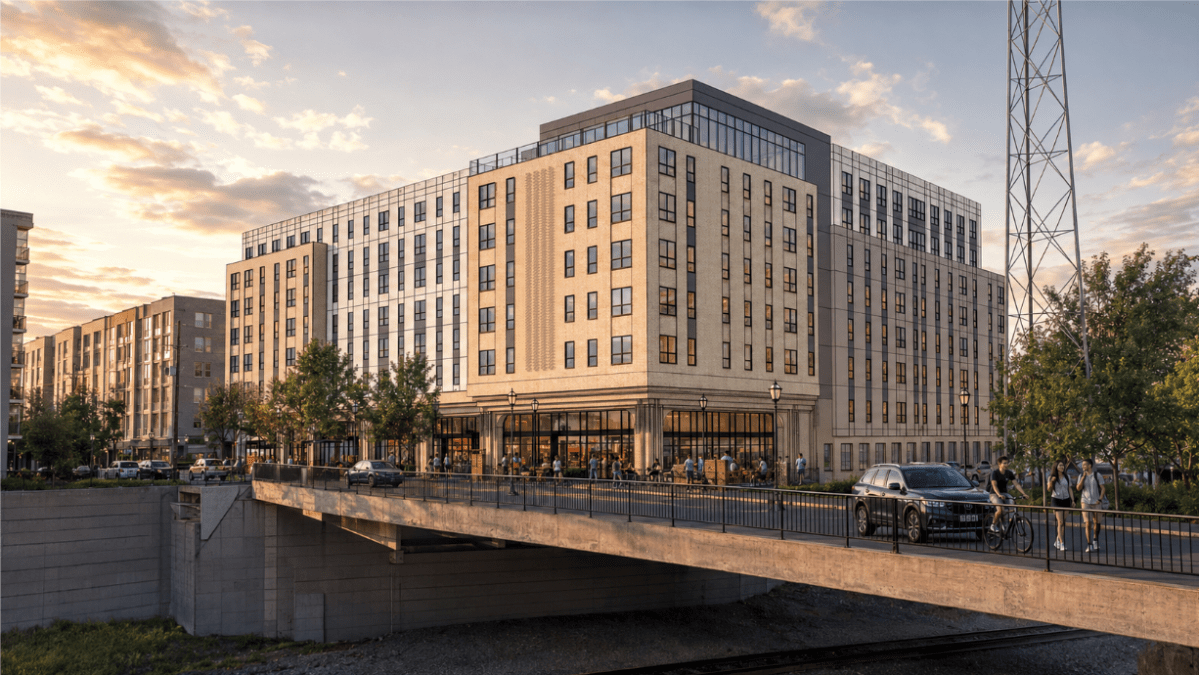
Charlottesville is probably getting more luxury student housing.
Tuesday evening, the city’s Board of Architectural Review (BAR) issued a certificate of appropriateness for an eight-story building of luxury student apartments located at 835, 843 and 847 West Main St., near the Drewary Brown Bridge.
The approval, which came with some conditions, is for the exterior of the building — the design and the materials. The developer, Texas-based LV Collective, will have to submit a separate landscaping plan for BAR approval in the future.
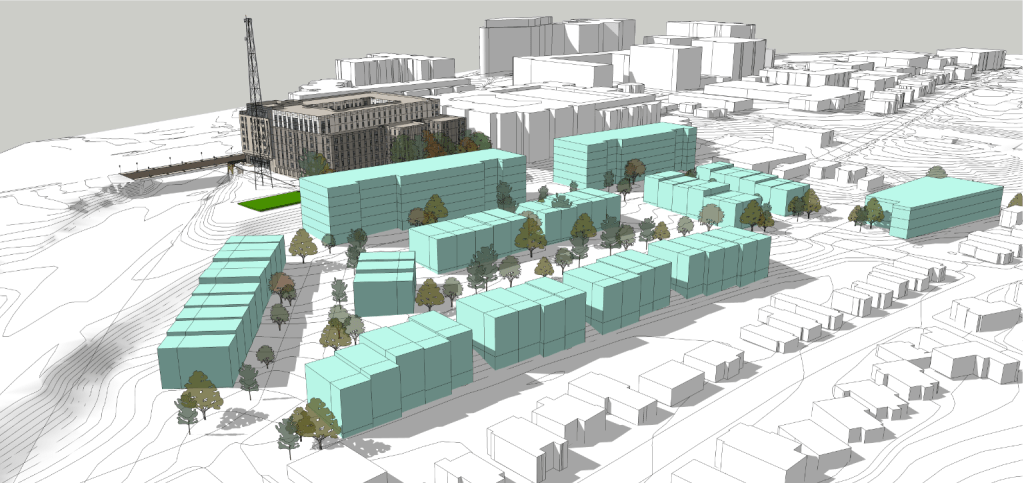
The BAR greenlit the project despite months of vocal opposition from community members, particularly residents of Westhaven, the city’s oldest public housing community, which stands to be literally overshadowed by the building.
It is the second luxury student housing development city officials have approved in two months, the other one being The Mark in the Fifeville neighborhood.
For the past nearly four years, Westhaven residents have planned the redevelopment of their own community. Among the things they’d planned for is a walkway connecting the neighborhood directly to West Main Street — something it doesn’t currently have. Residents hope it will be a “memory walk” that honors the history of Westhaven and the Black neighborhood the city demolished to build it, Cox’s Row.
Residents envisioned that pathway before hearing about LV Collective’s plans. Now, it would run through the West Main properties LV Collective is developing.
The plan LV Collective presented on Tuesday did not include a plan for a memory walk, though Brittani Sanders, vice president of entitlements and development strategy for the firm, said the company is committed to collaborating with the neighborhood on it.
“Touching on the memory walk, I want to publicly state that it is still LV Collective’s intent to follow the process that’s being discussed here today, and what was discussed at last meeting, in terms of having a productive community dialogue and following their lead in terms of how that memory walk is designed,” Sanders told the board.
While the BAR has urged the developer to work with the neighborhood on its plans, including the ones for the memory walk, the board cannot require it, Jeff Werner, Charlottesville’s Historic Preservation and Design Planner who serves as staff liaison to the BAR, told Charlottesville Tomorrow.
“That’s something between LV Collective and the community,” Werner said. Under the city’s zoning ordinance, which is a legal document, “the BAR doesn’t have the purview to require it or compel them to do it.”
The BAR’s purview starts and ends at a building’s exterior, according to the city’s ordinance. The board considers the building’s design, materials and height, as well as landscaping and emergency vehicle access, among other things.
And because there is not yet a plan for the memory walk, the BAR could not consider it. The board had to make its decision as if it doesn’t exist, even if they hoped it would, Werner explained.
It’s possible, however, that the design for a memory walk could come before the BAR at a later date.
“If they came up with some design that altered that site with their memory walk design, you could say that the BAR should review it,” Werner said.
At that point, Werner would look at the submitted plan and determine whether or not it’s within the BAR’s authority to review. If it is, he’ll write a staff report on the proposal and the BAR would consider it at one of its monthly meetings.
With the certificate of appropriateness issued Tuesday, the developer can now move on to creating a site plan. If anything in that process affects the building design, then the certificate could be voided, according to the staff report Werner wrote for the meeting.
Only two community members spoke Tuesday evening, a change from previous meetings, where dozens of folks showed up to hold signs and make public comments opposing the building.
Emily Dreyfus, a community organizer with the Legal Aid Justice Center who works closely with public housing advocates, asked the board to delay approval until they’ve seen a more substantial solar study, to better understand how much shade the building will cast on Westhaven at different times of day throughout the year. The current solar study looked at noontime for four months out of the year, and only for the future redevelopment.
Dreyfus asked for more information on different times of day, as well as what it would look like for the buildings currently there, because the LV Collective building is likely to be finished before the Westhaven redevelopment begins.
The board unanimously voted for the certificate of approval, knowing that a landscaping plan will come before them at a later date. It’s possible that the memory walk could be included in that plan, but that depends on LV Collective and the neighborhood.
The developer has 10 business days to appeal any condition of the board’s approval. Similarly, if an adjacent property owner feels aggrieved by the board’s decision, they can appeal to City Council.
As of noon on June 18, no one had appealed, though a few people had inquired about the appeal process, Werner said.