

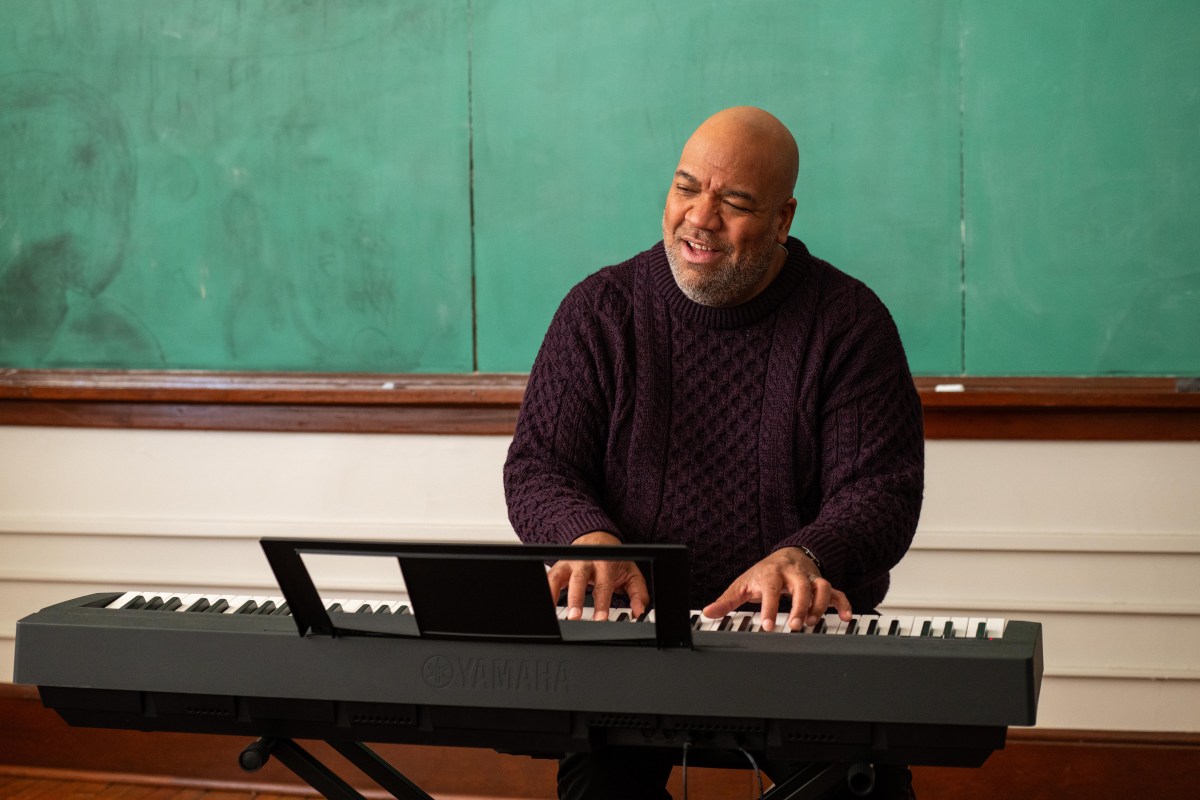
A few years ago, Ivan Orr was talking with his elderly mother when she paused in the middle of their conversation and started staring off into space.
“Yeah, you know, we used to go across the street to Peachie’s house for parties,” she said. “Yeah, Peachie Jackson. She taught at the school but she was retired before I got there.”
The school Orr’s mother mentioned was the Jefferson School, the city’s first — and for many decades, only — school for Black students.
Orr made a mental note of this family lore, but didn’t think much of it. Until he had to.
On Friday, Feb. 20, at the 100th anniversary of the opening of the Jefferson High School, Orr and a small ensemble will take the Jefferson School African American Heritage Center stage to perform an original piece of music written specifically for the occasion.
The composition, titled “Ancestral Frequencies (Pt. 1)” is an homage to four Black women who, between 1867 and 1942, shaped Black education and culture in Charlottesville: Isabella Rogers West Gibbons, Cora Brown Murray Duke Kenney, Teresa Jackson Walker Price and Peachie Carr Johnson Jackson.
Andrea Douglas, executive director of the Heritage Center, gave Orr, who is a musician, the assignment.
“It led me right back to Peachie,” he said, laughing.
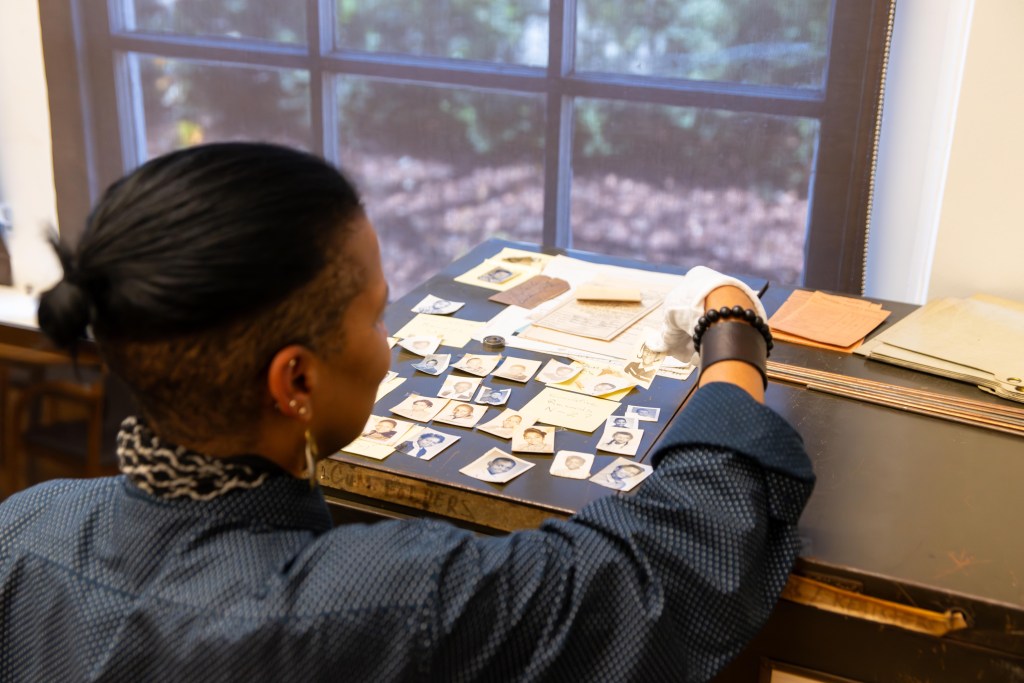
For the past year, Orr has delved into newspaper articles, library archives, oral histories and public school records in the Heritage Center’s archives to get to know these women, their lives and their personalities, to help him compose “Ancestral Frequencies.”
“All of these women are special,” Orr said, though each of them fought in their own way for educational opportunities for Black students during the Jim Crow era of legal segregation and disenfranchisement of people of color throughout the South. All of them either loved or played music, and all of them had ties to First Baptist Church on West Main St. “Ancestral Frequencies” celebrates those connections while also telling each woman’s unique story.

Isabella Rogers West Gibbons was born enslaved sometime around 1836. She was owned by a University of Virginia physics professor, and she cooked in the Pavilions in the Academical Village on central Grounds. She and her husband, William Gibbons, learned to read and write and secretly taught their children to do the same, according to research conducted for UVA’s Monument to Enslaved Laborers. After emancipation, Isabella earned a diploma from the New England Freedmen’s Aid Society’s Charlottesville Normal School in May 1867.
She became a teacher in the Charlottesville Freedmen’s School, which would become the Jefferson Graded School. But the school didn’t offer a high school-level education at the time. Black students who wanted to continue their studies after eighth grade had to go elsewhere for that. Starting in the 1870s, Isabella started advocating for a Black high school, but she died in 1890 and did not get to see her dream realized.
Isabella’s dream was realized during the lifetime of Cora Brown Murray Duke Kenney, who was born in 1876 to a shoemaker and a laundress. She was among the first women in Charlottesville, of any race, to register to vote after the ratification of the 19th Amendment in 1920, according to the Heritage Center’s research. Cora became principal of the Jefferson School not long after the high school opened in 1926, and she served in that role for more than four decades. Orr discovered through some Daily Progress newspaper articles that for years, Cora hosted musical recitals and performances in the Jefferson School auditorium — the very same room Orr and his ensemble will be performing in Friday evening.
Orr noticed that some of her recital announcements invited white community members as well. But once the Virginia General Assembly passed the Racial Integrity Act of 1924, which required all public meeting spaces to be segregated by race, that stopped. Cora died in 1970, just a few years after Charlottesville schools desegregated in 1965-66.
Peachie Carr Johnson Jackson is next in the timeline. She was born in Albemarle County in 1889 to a prominent Black family — they owned land that is now the Ivy Creek Natural Area & Historic River View Farm — and graduated from Virginia State University before pursuing graduate studies at the University of Pennsylvania. She later taught at the Jefferson School for 44 years. Her obituary, linked in a family genealogy on the Ivy Creek website, shows that she was a very civically minded person, holding membership in a wide variety of state, local, and national organizations. She served as president of the Virginia State Federation of Colored Women’s Clubs, a position that had her traveling extensively throughout the U.S. and North America. Later, she served as treasurer of the Golden Age Retired Teachers Club of Charlottesville. Peachie died in 1977.
The first installment of “Ancestral Frequencies” ends with Teresa Jackson Walker Price, born in 1925. Teresa graduated from Jefferson High School in 1942 and went on to become a teacher, following in the footsteps of her grandmother, Nannie Cox Jackson, a beloved teacher at the Jefferson School. By the time Teresa earned her teaching degree, the Jefferson School had reverted back to being an elementary school, and Jackson P. Burley High School had opened to serve the city’s Black students starting in 1951. Teresa taught business and typing at Burley for years. When the city considered demolishing the Jefferson School building in the late 1990s and early 2000s, she was one of the people who fought for it to become the community center it is today.
Teresa celebrated her 100th birthday in the Heritage Center’s auditorium last year. Orr provided some of the music.
“Ancestral Frequencies” is unlike anything Orr had composed before. He’s primarily a church music player who branches out into jazz, soul, and R&B.
One of the biggest challenges, Orr said, was that Douglas asked him to compose something that could be replicated by other musicians, particularly young musicians.
At times, Orr said he struggled to weave the many threads he’d come across in his research into a single, brief, accessible — and cohesive — piece of music. That is, until he realized that this is living memory work.
Once he recognized that, he started to understand the composition as folk music. To some, “folk music” might sound a certain way, like acoustic guitars, banjos and fiddles played to a certain rhythm. But folk music is less of a specific sound and more of a tradition, Orr said. Folk music is music that is passed down from generation to generation, with each one often adding to it.
It doesn’t have to be complex. It just has to tell a story.
The piece — which runs about 20 minutes total — has evolved as Orr has worked on it, too. At first, he envisioned it as something entirely instrumental, but in the last few weeks, he decided to add vocals. Jen Tal will be the vocalist for Friday’s performance, with Orr on keys, Vic Brown on bass and Carl Brown on drums.
The piece moves linearly, starting with Isabella before moving on to Cora, Peachie, and then Teresa. Each woman has three movements, and Orr considered what type of music they would have heard in their lifetimes — Black music traditions like gospel and church music, blues and jazz — while composing their movements.
For example, “Ancestral Frequencies” begins with a movement titled “Commencement.” It indicates not just the start of the piece, but how Isabella was on the forefront of the movement for Black education, and a Black high school, in Charlottesville. For this movement, Orr wrote his own version of “Pomp and Circumstance,” the ubiquitous graduation march music.
Isabella’s second movement is called “Jubilee,” which Orr wrote as a joyful celebration to sound like something the Fisk Jubilee Singers — a Black a cappella ensemble started in 1871 by students at Fisk University in Tennessee in order to raise money for their educations — might sing. He also thinks of this one as a song a teacher might sing to her students at the start of the school day, something in the vein of “Good Morning To You.”
The piece also includes “Alma Mater” written by Elizabeth Harris Williams, who graduated from the Jefferson School in 1934, when the school went up to eighth grade. Williams, who often played piano for school productions, wrote the piece while she was still a student.
Not wanting to give too much away about the performance itself, Orr hinted that it will incorporate some visuals and oral histories. The auditorium’s wood floors — which are original to the building — will be utilized in a surprising way as well, he said.
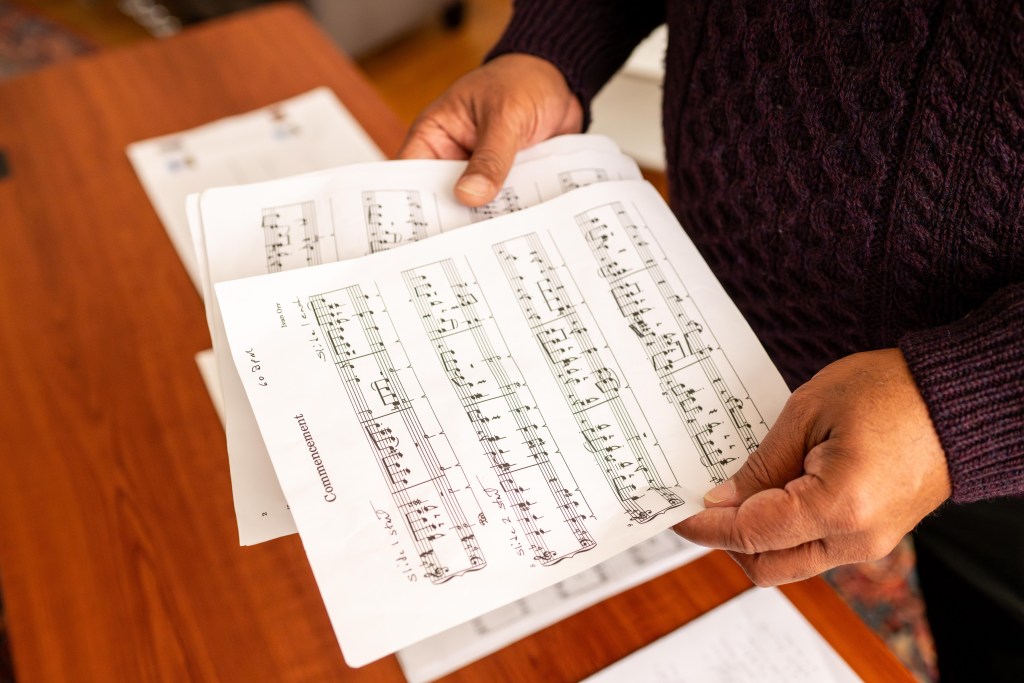
“It’ll give you information,” he said, laughing. “I’ll put it like that!”
“I believe you’ll walk away with little things, little earworms and other things, and it will reinforce what you have seen,” he added.
The personal connections that the audience will have to these women is what makes the work so special, Orr said. Some might know or have known these women personally. Some might be direct descendants. Others might have been taught by them, or have family members who were taught by them.
For Orr’s part, getting to know Peachie a bit better has so far been one of the great pleasures of working on “Ancestral Frequencies.”
Orr’s own parents were teachers, and when they first moved to Charlottesville, they rented a house in Vinegar Hill, across the street from the Jefferson School, where the Staples parking lot is now. The city razed the house, along with the rest of the majority Black, majority working-class Vinegar Hill neighborhood and business district, in the 1960s in the name of “urban renewal.”
Though Orr doesn’t have any of his own memories of Peachie — she passed away when Orr was seven years old — “Ancestral Frequencies” has helped him feel close to her. His mother and godmother told him stories about Peachie and her family.
And, there’s another personal connection for Orr. When his parents first moved to Charlottesville, they rented a house from Teresa Jackson Walker Price’s father. At the time, Orr’s father was teaching in Maryland, so he was only in Charlottesville on the weekends. Throughout the week, Teresa’s family would check in on Orr’s mother — also a teacher — to see if she needed anything.
Recently, Orr’s Heritage Center colleague Jordy Yager gave him a framed photo of Peachie hosting a retired teachers’ gathering at her home on 123 Fourth St. NW, right next to the Jefferson School. The photo hangs over Orr’s desk.
Peachie’s home is now On Our Own, a peer recovery center, and Orr had the chance to go inside the house while working on this project. The whole time, he thought about his mother’s story — “we used to go across the street to Peachie’s house for parties” rang in his ears. He was consumed by the idea of his parents attending a party in the house he was standing in, decades earlier.
“You just feel that energy line,” he said.
Orr expects a lot of folks to feel energy lines of their own during Friday’s performance, which is invitation-only. Many people in attendance probably have connections to these four women. Some might be direct descendants, while others might be descendants of their pupils. Many might know Walker Price, who is planning to attend.
The “Ancestral Frequencies” project will continue after the performance of part one, though Orr isn’t yet sure what form it will take. He and others at the Heritage Center are considering how the pieces will live on. The music is transcribed, but it could also be recorded or taught directly to other musicians. In any case, Orr is eager to get started on the next phase.
“I cannot tell you what it feels like to open one of those filing cabinets over there,” he said, smiling wide and pointing to a set of filing cabinets in the corner of his office at the Heritage Center. The cabinets contain hundreds of Jefferson School student and teacher records that Charlottesville City Public Schools recently gave to the Heritage Center for proper archiving.
He learned that Teresa still has the same smile as in her 1942 senior photo, and that Peachie sometimes signed her full name — Peachie Carr Johnson Jackson — in her impeccable handwriting, and other times signed a sassy “PCJ.”
“You’re reading across time,” Orr said. “That’s my goal with this music. It’s introducing you to this history, but it’s not as flat as it would be if I’m just standing in front of you, talking. I could do that, and that’s fine, it has its place. But this is something that we hope will stick.”
Editor’s note: This article was updated on Feb. 18, 2026, to correct Isabella Rogers West Gibbons’ name and to correct that Ivan Orr’s family rented a house from Teresa Jackson Walker Price’s father.