

Tensions are mounting over Valley Link’s proposed Joshua Falls-Yeat project, a $1 billion, 765-kilovolt transmission line which would cut through 115 miles of largely agricultural land and forests in central Virginia.
Residents are speaking out about the potential consequences if the project moves ahead, from having to abandon homes mid-construction to the financial impact of lost farmland. Some have said that they’re being forced to carry the burden without receiving any benefit, and others worry that the project will move ahead despite their objections.
While some local governments are moving to formally oppose the project, their power to influence its approval is limited as the project will ultimately be reviewed at the state level.
The developer, Valley Link — a partnership between Dominion Energy, Transource Energy and FirstEnergy Transmission — has characterized the high-voltage transmission line as necessary to address Virginia’s growing energy needs, citing the increase in data centers, an increased use of electric appliances and more frequent extreme weather conditions. A Dominion representative estimated that “more than half” the electricity from the transmission line would power data centers.
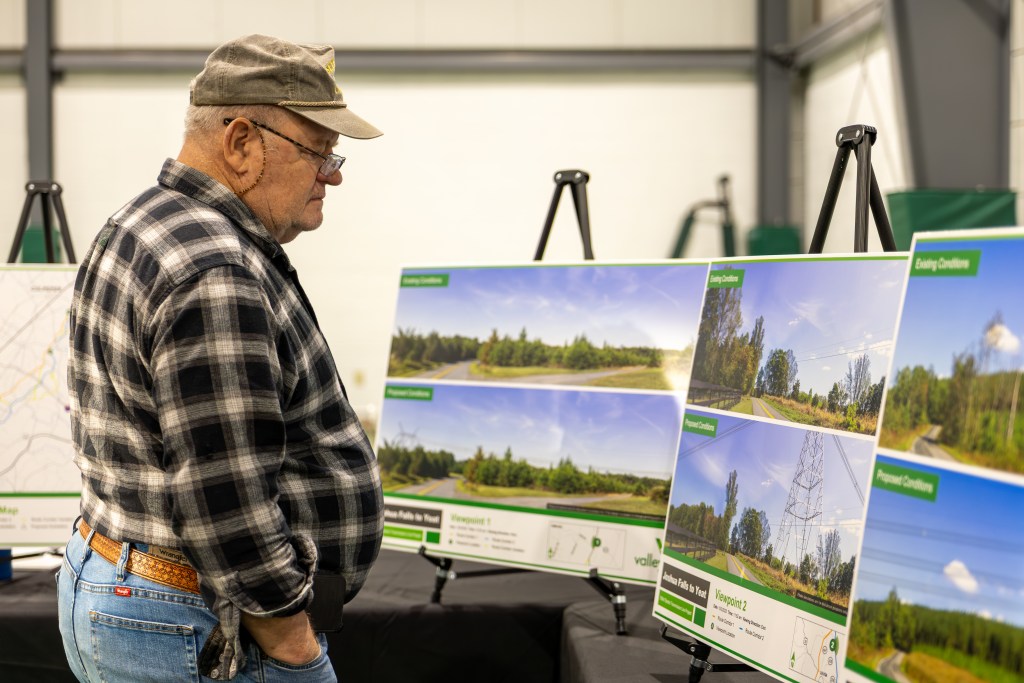
The proposed project would stretch from the existing Joshua Falls substation in Campbell County, near Lynchburg, to a new proposed substation in eastern Culpeper County and would require a 200-foot-wide corridor of cleared land along the entire 115-mile route.
Farmers worry about economy, environment and equity
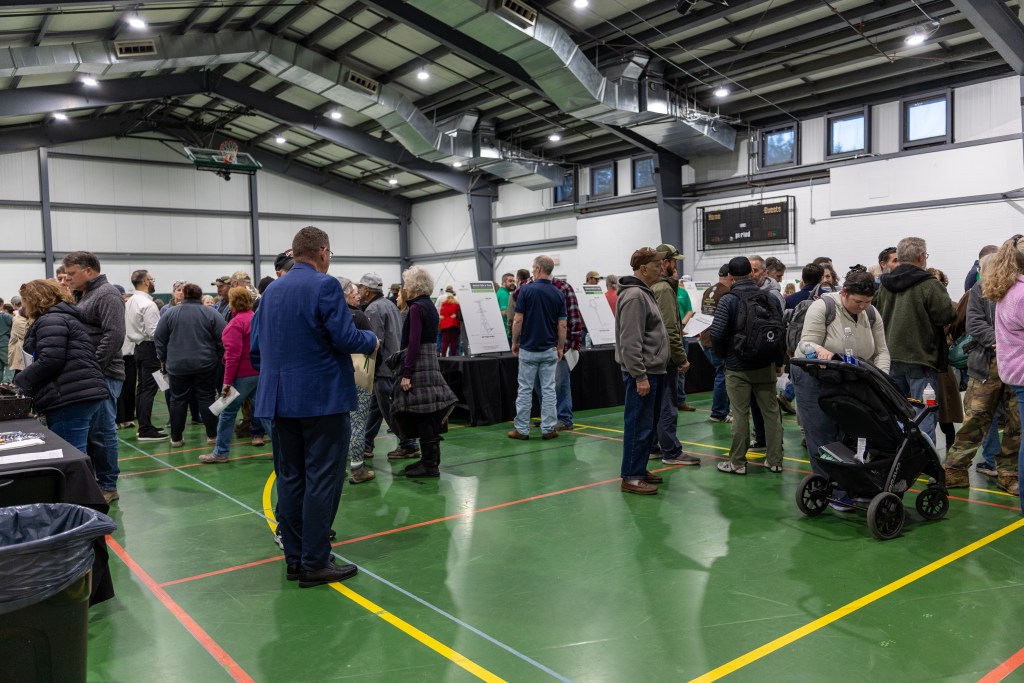
A series of open houses held by Valley Link throughout March have drawn huge crowds, with more than 500 attendees at both the Orange County meeting on March 9 and the Louisa County meeting on March 12, according to the venue owners and Craig Carper, Dominion Energy spokesperson and Valley Link representative.
Carper said that public participation — a required step for developers of large-scale utility projects to apply for final approval by the State Corporation Commission (SCC) — is a crucial part of determining the final route for the project and discovering potential problems that Valley Link may have missed in its initial research.
Carper said that Valley Link will host another round of open houses in May and June, where community members can ask questions about the finalized route, which is subject to change based on community input from the March meetings. After that, Valley Link will apply for approval by the SCC in September and hopes to have the transmission line fully built by 2029.
SCC Communications Director Greg Weatherford confirmed that approval processes like the one for the Valley Link project “take at a minimum months, probably considerably longer in a complex case,” once Valley Link submits its application in September. Weatherford said that the SCC takes a number of factors into consideration, including environmental and community impacts, in accordance with state law when deciding on applications.
“We are required to do this, but we don’t want a B for effort,” Carper said. “We want an A-plus, plus for effort. We’re committed, and not because we want extra credit, but we want this to be the best project that it can be.”
However, not all of the community members walked away from the open houses feeling like their voices had been heard. Renard Turner, a Louisa County organic farmer who raises goats, was at the March 12 open house with his wife and mother. Turner said the meeting with Valley Link representatives hadn’t lessened his concerns about herbicide application in areas where his goats could graze.
“I mean, they’re doing their job and getting people to respond, but I’m pretty sure the plan is to press forward regardless of what the majority says,” Turner said.
In both Orange and Louisa counties, nearly all of those in attendance were against the project. That aligns with reports from 29 News in Fluvanna County, ABC 13 in Appomattox County and the Farmville Herald in Buckingham County, all of which have reported strong public pushback against the project at recent meetings.
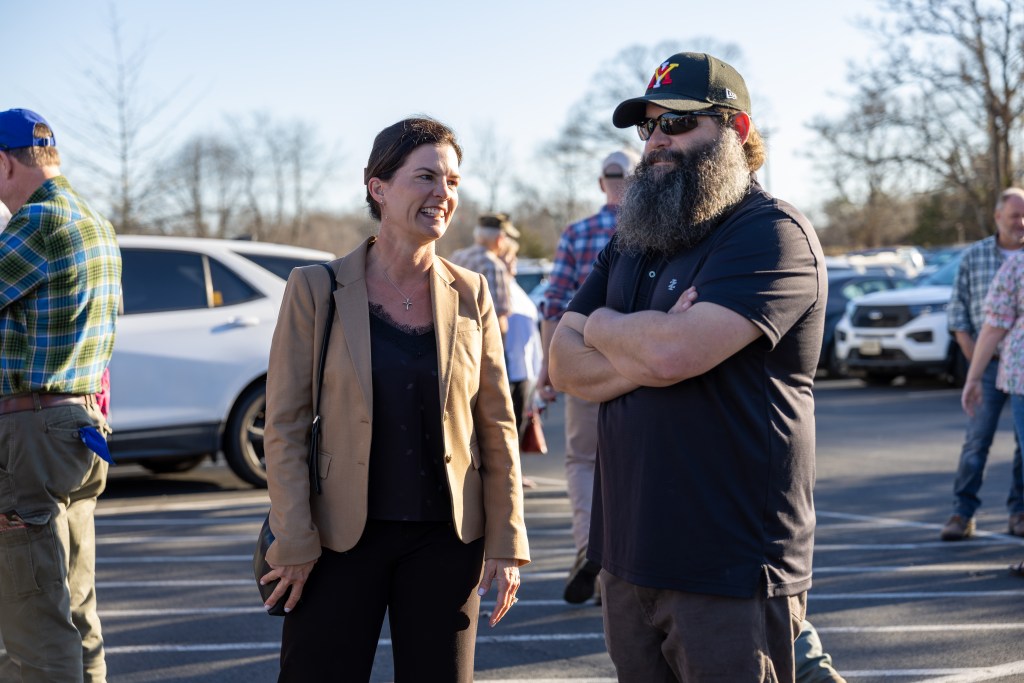
And, like Turner, many of the people who had come to oppose the project in both Louisa and Orange counties were farmers and residents with concerns about environmental and economic impacts on local agriculture.
Both Louisa and Orange counties boast strong agricultural economies, and more than 90% of agriculture businesses in both counties are family farms, according to data from the U.S. Department of Agriculture.
Crystal Coleman, who represents District 4 on the Orange County Board of Supervisors, was at the Orange County open house at Lafayette Station in Rhoadesville. Coleman said that while the proposed line wouldn’t impact her own farm, she was worried about the economic effects and the property rights of her constituents.
“When you destroy landscapes and show an inability to have a voice, then you’ll have people that no longer want to be participating as a citizen or as a business owner in this area,” Coleman said. “But my biggest concern is for the folks who are already here and have established their homesteads, their life, their livelihoods and now this is going to just cut right through and not give them an opportunity to say whether or not they want it.
Michael Carter Jr. is the owner of Carter Farms, a 115-year-old, 150-acre family farm that specializes in organic Africulture (which is also the name of his nonprofit), growing indigenous African vegetables with sustainable methods. He also teaches workshops at his farm and recently served as a member of Gov. Abigail Spanberger’s transition team.
Carter Farms already has a stretch of the Colonial Pipeline, which transports refined oil, running through the property, and one of the potential routes for the Valley Link project would place the transmission line just over the farm’s property line on a neighbor’s lot.
Carter said he was worried that the project would disproportionately impact Black and low-income communities, who could face more difficulty defending their property rights.
“We’ve seen these eminent domain projects take place before,” Carter said. “It doesn’t benefit us directly, but it does affect us tremendously, especially for our health, for our legacy and children, and making agriculture. Agriculture’s tough enough. And instead of being in the fields, we have to come out here now and just try to defend our property so people don’t take it.”

Carper said while eminent domain — the seizure of private property for public use by the government without the owner’s consent — can be used as a last resort, Dominion is able to voluntarily “resolve more than 90% of easement acquisitions through direct interaction with property owners.” In either case, landowners would be compensated according to what Valley Link refers to as “fair market value” based on third-party appraisals.
Valley Link representatives also said that the developers are taking equity into consideration when finalizing the route, including any new information learned from community members at the open houses. Dominion Energy Environmental Justice Consultant Katie McCormick said that her team takes care to follow the guidelines of the Virginia Environmental Justice Act, which was passed in 2020 to ensure the fair treatment of all people — regardless of race, income or faith — in the development of environmental laws.
When asked specifically about Carter Farms, McCormick said she personally wasn’t aware of the farm but would look into it.
Anna and Jason Anderson are part of a farming family in Louisa County and the owners of another “century farm,” which is a farm that has been owned by the same family for at least 100 consecutive years. They attended the March 12 open house after learning that one of the route options would cut through the middle of a parcel owned by Anna’s brother. The Andersons said they were worried that he could lose income from not being able to grow grain on that property due to construction of the line.
“It doesn’t seem like there’s a lot of data to support the sacrifice for our county, for the improvement of lives in other areas,” Anna said. “We’re giving up a lot here just for people in Northern Virginia, wherever, so that they can have the resources.”
According to Carper, Anna’s assessment is at least partly correct. When asked who will be using the energy generated through the transmission line, the Dominion spokesperson said that “the immediate benefits go sort of to the ends of the project.”
“So, both at the start in Campbell and at the end in Culpeper, this is going to immediately connect to lines that will allow moving energy between states,” Carper said. “Those will be connected to the western part of the PJM grid and the northern part of the PJM grid, so those are the very immediate beneficiaries, but this line is being built for generations.”
PJM Interconnection is the regional organization that manages the electrical grid in Virginia and a dozen other states in the Mid-Atlantic and Midwest, spanning from parts of Illinois to North Carolina. PJM acts as an independent system operator, coordinating wholesale electricity movement and managing the electric market within the region.
Carper called the line a “backbone project,” adding that it is being built such that later on, “people could connect via a substation and move power off of this line to benefit people directly” along the path of the line.
Asked if being able to pull large quantities of power could encourage the proliferation of data centers along the line’s path, Carper called it “the chicken and the egg question.”
“I mean, yes, it can, but it’s not designed for any one project or for any company,” Carper said. “There’s nothing defined that is saying, ‘We want this,’ and there’s no county that’s saying, ‘Hey, we need this so we can pull in the next five years.’ Does it make it easier to do that, should people want to? I think I have to say yes.”
Residents organize opposition, but local governments don’t have final say on project
Ultimately, the SCC, in its role as state regulator of public utilities, will make the decision on whether or not the project is approved, but that hasn’t stopped community members and some local governments from voicing their opinions or from trying to stop the project.
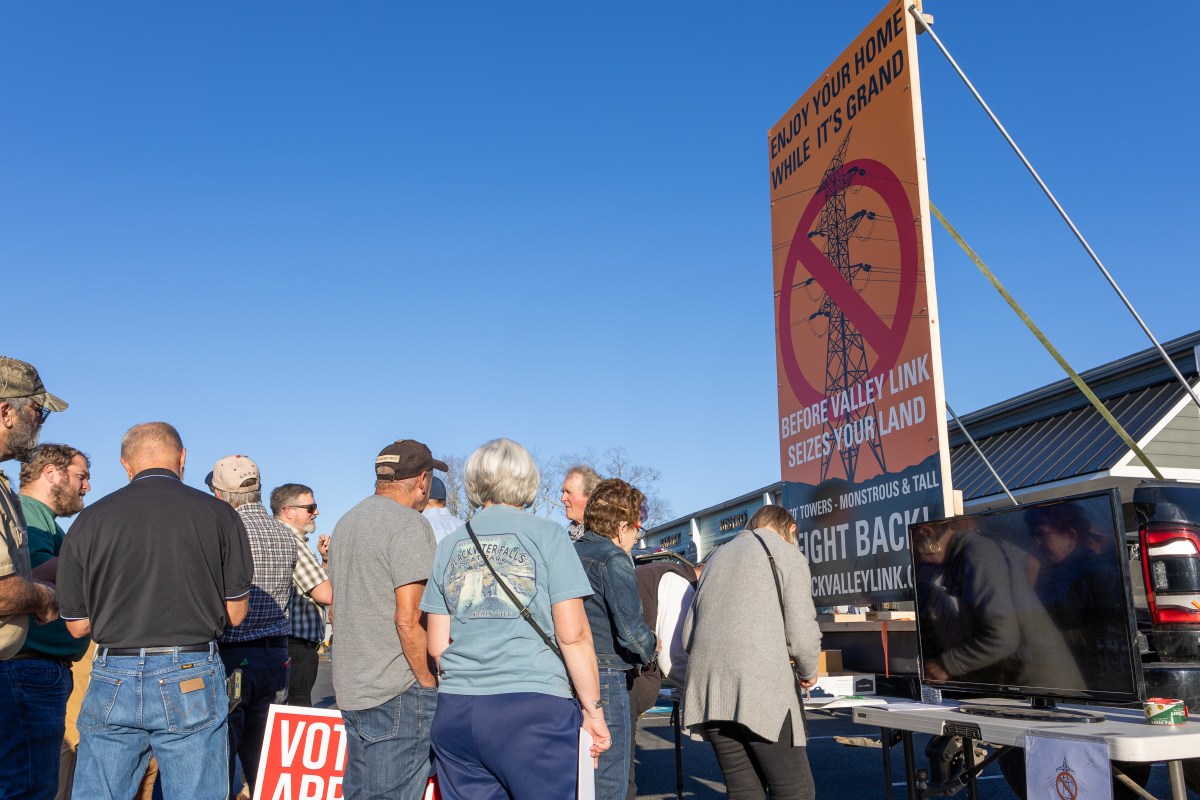
At the March 9 meeting in Orange County, Locust Grove resident Paul McDonald brought a full display — including a giant sign, informational materials and a television playing a loud humming noise that the lines are said to make — to the parking lot. He spoke with attendees as they waited in a long line to enter the venue, which had turned out to be too small to safely contain the number of people who showed up.
McDonald is leading a grassroots effort in opposition to the project called “Block Valley Link.” Talking to Charlottesville Tomorrow at the open house, he referred to himself as a “data center refugee” who left Loudon County after 50 years after the county introduced nearly 200 data centers, earning Loudon the nickname “Data Center Alley.”
“It got to be too much, and we came down here and bought this property because it was just like Loudon County used to be when I was a boy. And here we are,” McDonald said.
Nearly all of the potential route variations proposed by Valley Link run through McDonald’s property. He said that in his assessment, community organizing will be the key to stopping the same thing from happening in Orange County.
“We need to get people together,” McDonald said. “I’m gathering stories, and some of the stories are extremely sad. People’s entire lives have been upended, and there won’t be any conclusion for years. People have started building houses — they get the foundation done and they get a letter, and they look at the map and find it goes right over their house. They can’t do anything now. They can’t continue.”
McDonald wasn’t the only person organizing in Orange County or elsewhere. Helene Purcell, a Louisa County farm owner, was at the Orange County and Louisa County open houses, in addition to others. She and a group of neighbors have been circulating a petition in opposition to the project.
At the March 12 open house, Purcell said she was concerned about potential environmental impacts, as well as historic resources like Trevilian Station Battlefield.
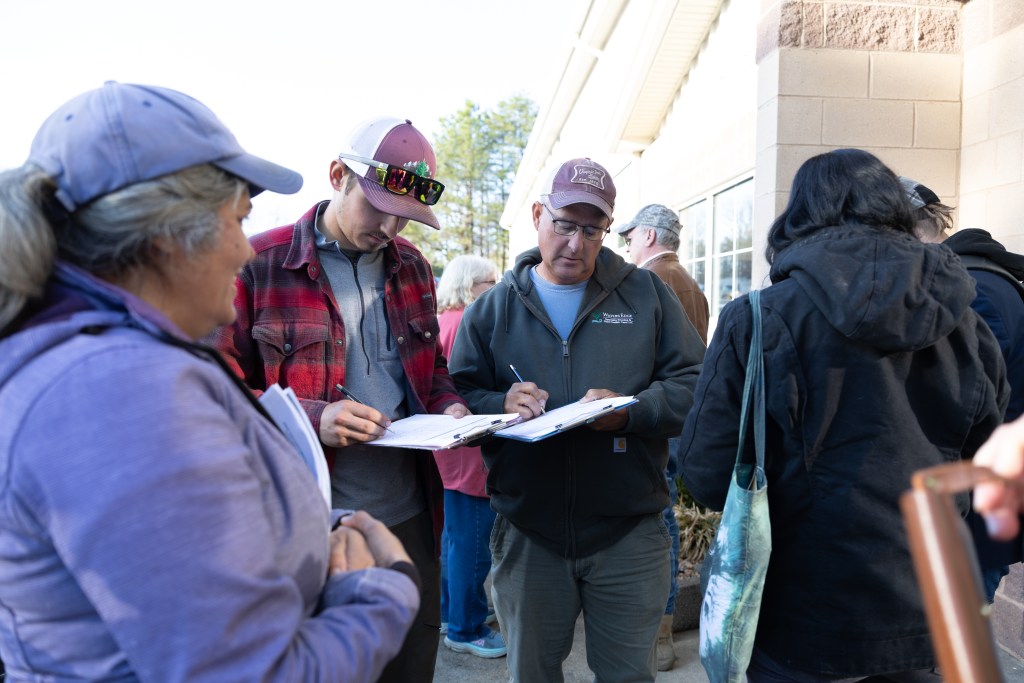
In a follow-up phone call on March 19, Purcell said that she has collected more than 1,200 signatures from residents in Orange, Louisa and Fluvanna counties so far, and plans to attend the open houses in Goochland and Campbell counties to gather more.
Meanwhile, local government officials in several of the nine counties along the proposed transmission line have been making moves to signal their desire to be more involved in the approval process, and in some cases, their opposition.
In Orange County, the Planning Commission voted unanimously on March 5 to request that the Board of Supervisors “consider, vote and approve that the Planning Commission pursue formal engagement with Valley Link and/or all relevant state agencies,” including the SCC.
On March 10, the Orange County Board of Supervisors essentially granted that request with a motion to “direct the Planning Commission, pursuant to Virginia Code 152.2202, to review the proposed Valley Link transmission project” in relation to the county’s Comprehensive Plan, and to determine whether the proposed project is consistent with the plan’s goals. The motion passed 4-0, with District 3 Supervisor Keith Marshall absent from the meeting due to a previous commitment.
During the same meeting, the Board of Supervisors unanimously passed several other motions related to the Valley Link project. These included directing the Planning Commission to review the Comprehensive Plan itself to identify areas where the plan could be strengthened to better guide large-scale utility projects.
Another motion dealt with potential action by a federal energy regulator that supervisors worried could change the entire course of the Joshua Falls-Yeat approval process. While the SCC approves utility projects for the state of Virginia, the Federal Energy Regulatory Commission (FERC) regulates interstate energy transmission, including electricity, natural gas and oil.
On Feb. 27, PJM — which approved the Valley Link project in 2025 — filed a proposal with FERC for an Expedited Interconnection Track. The proposal, if approved, would authorize PJM to fast-track up to 10 large-scale electric utility projects per year for two years, potentially bypassing SCC approval. To be eligible, projects would need to meet several criteria, including having the capacity to reliably produce at least 250 megawatts of power and achieving commercial operation within three years, according to PJM’s media hub Inside Lines.
Public interest in the proposal spiked in mid-March, when a Facebook post alerted community members that FERC’s public comment period for the Expedited Interconnection Track was set to end on March 20. The proposal has since garnered approximately 200 public comments in opposition from individuals and organizations including the Orange County School Board, according to FERC’s online docket search feature.
At the Orange County Board of Supervisors meeting on March 10, supervisors approved a motion to prepare and submit a comment to the FERC regarding the Expedited Interconnection Track.
According to Carper, however, Valley Link doesn’t anticipate taking part in the Expedited Interconnection Track for the Joshua Falls-Yeat Project.
“I don’t believe that’s an option for our transmission project,” Carper wrote via email. “We’re getting valuable input from our open houses and public engagement that will ultimately reduce the project’s impact on the communities we pass through. It’s a critical step and we have no intention of trying to rush through that before the fall.”
Both of the other motions passed by the Orange County Board of Supervisors on March 10 dealt with the Board’s upcoming meeting on March 24. Supervisors approved a motion to make the meeting, which will include a public comment period and a presentation by Valley Link representatives, a joint meeting between the Board of Supervisors and the Planning Commission.
The meeting will be held in the Hornets Sports Center at Orange County High School in order to accommodate the large crowd that officials are expecting based on attendance at the open house.
Take action
Attend an Orange County joint meeting on the Valley Link transmission line
The Orange County Board of Supervisors and Planning Commission will hold a joint meeting regarding the proposed Joshua Falls-Yeat transmission line project. The meeting will be on Tuesday, March 24 at 5 p.m. at the Orange County High School Hornets Sports Center (the fieldhouse) at 201 Selma Road, Orange.
The meeting will include a presentation from Valley Link representatives and a public comment period for community members. For more information, including public comment guidelines, view the Board of Supervisors’ news release.
The final motion was for the Board of Supervisors to submit a list of questions to Valley Link ahead of time, to be answered during the March 24 meeting. Residents can read the full list of questions that were subsequently sent to Valley Link on District 1 Supervisor Jason Capelle’s public Facebook page.
Several supervisors have already publicly expressed their opposition to the project.
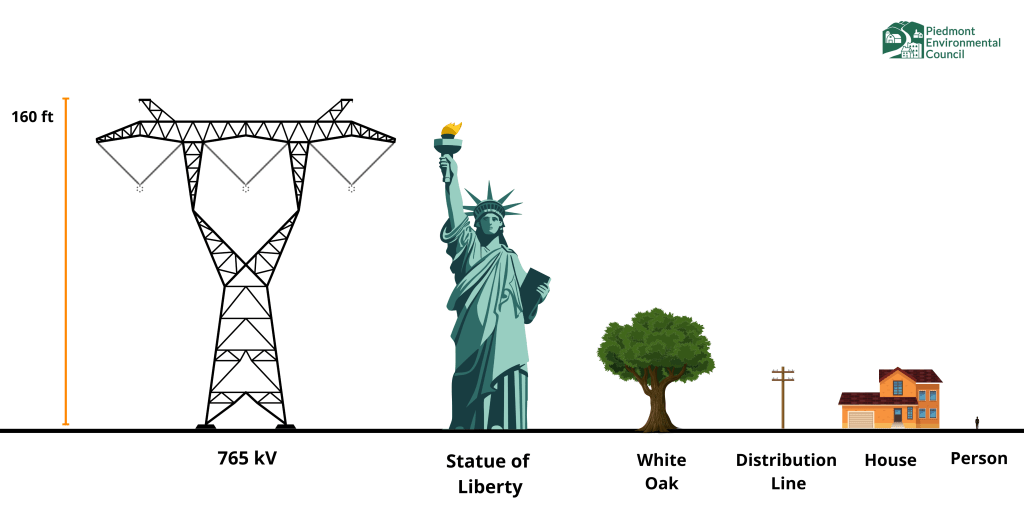
“I know there are other 765 lines out there, but it’s slated to tear apart farms, residences, properties all across our county, and have negative impacts to our citizens; our rural character; the historic and natural resources that we value so much. The viewshed of our entire county will be altered forever,” said District 5 Supervisor and Chair Bryan Nicol at the March 10 meeting.
While Orange County is moving to more formally engage with the Valley Link project, other localities are making similar moves. According to a report from the Fredericksburg Free Press, the Spotsylvania Board of Supervisors is preparing to send a letter to the SCC opposing the project, and even pulled approval of the letter from the supervisors’ March 10 agenda so that they could amend it with stronger language.
On Monday, March 16, Engage Louisa reported that the Louisa County Board of Supervisors was “poised to pass a resolution formally opposing Valley Link Transmission Company’s plan to build an ultra-high voltage, overhead power line through central Louisa County” during the Board’s meeting later that evening. Supervisors ultimately passed the motion unanimously, while pushing back against public comments that the Board’s approval of data centers had led to the line passing through Louisa.
Mineral District Supervisor and Chair Duane Adams also made remarks directed at the Culpeper County Board of Supervisors, which he suggested may be able to have a bigger impact on the project than other localities.
The proposed Yeat substation, located on the northern end of the transmission line, was originally planned to be built in Fauquier County near Morrisville, as can be seen in a PJM report from January 2025. The substation was subsequently moved to Richardsville in eastern Culpeper County in order to shorten the length of the route by approximately 40 miles and reduce the number of impacted localities from 16 counties to nine, according to Carper.
“Here’s a real key, and this is to my friends in Culpeper County on the Culpeper Board of Supervisors,” said Adams. “The new transmission line would extend the 765-kV supply from Joshua Falls to Yeat substation, which hasn’t yet been built in Culpeper. It has to be zoned. It has to be approved by the Board of Supervisors. There’s a way to stop this thing, but right now it’s on the plate of the Board in Culpeper. There’s no destination for this yet.”
During a phone call with Charlottesville Tomorrow, Carper confirmed that the new substation will require a Conditional Use Permit from Culpeper County, and said that he wasn’t sure what will happen if the permit is denied.
Carper also said that Valley Link has been in communication with Culpeper County officials about the project; however, county officials have not yet made any public statements about the proposed transmission line or the substation.
Charlottesville Tomorrow reached out to all members of the Culpeper County Board of Supervisors. On March 22, East Fairfax District Supervisor David Lee wrote in an email that he would be able to talk after reviewing information from Dominion and the Culpeper County Planning Commission. During a phone call on March 23, West Fairfax District Supervisor Gary Deal confirmed that county officials had met with Valley Link representatives, but declined to comment further until the developers submit a permit application for the substation.
None of the other supervisors responded to requests for comment before publication.