

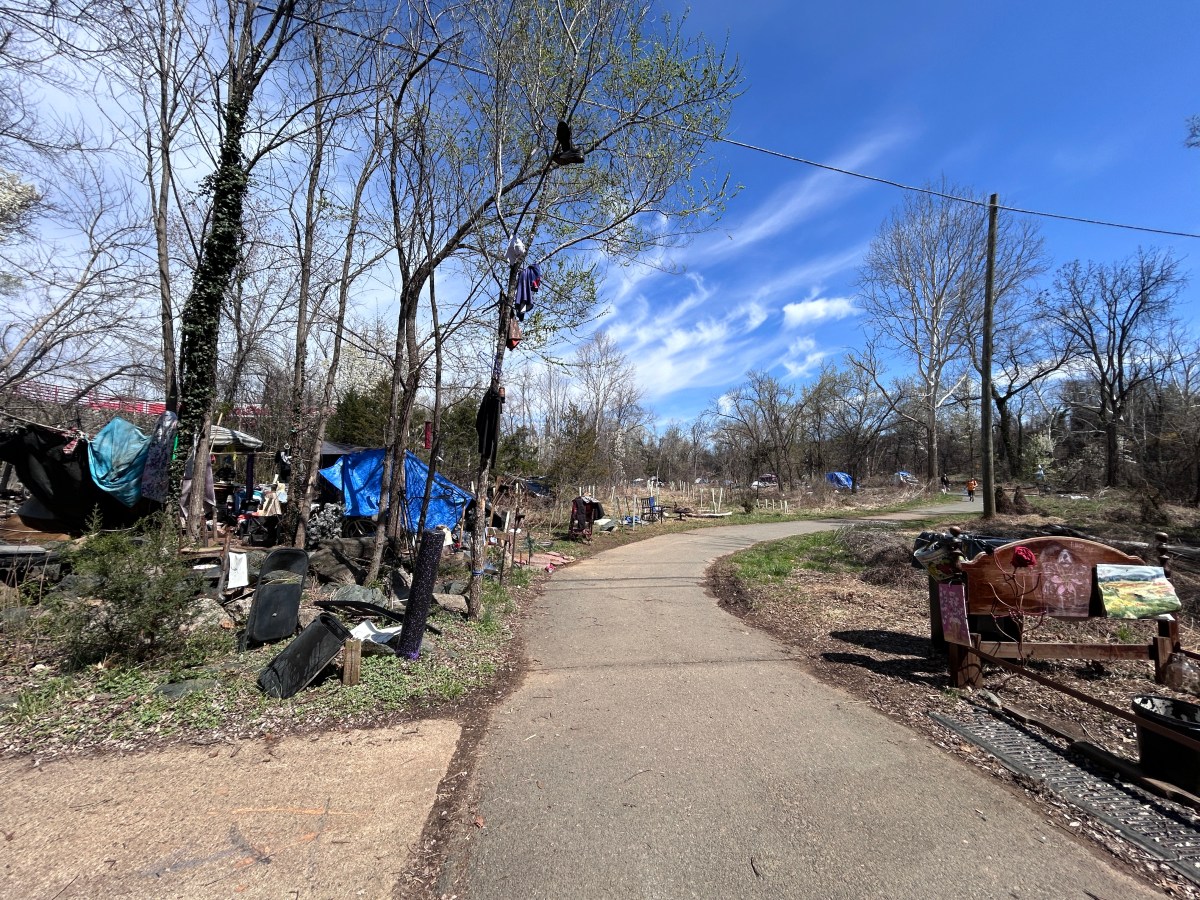
This week, the City of Charlottesville is leading a cleanup effort at a tent community that has formed along the Rivanna River, near Free Fridge on Pantops.
Citing public health and safety concerns for both the broader community and the people living in the encampment, as well as environmental concerns, city staff and a local landscaping company will clean up trash and install portable toilets and sharps disposal containers at the site Tuesday, March 24 and Wednesday, March 25.
None of the people living there will be forced to leave, city spokesperson Afton Schneider emphasized in an email to Charlottesville Tomorrow on March 17.
It is “absolutely not a displacement event,” she wrote. “It’s a cleanup effort.”
But people living in the encampment, which has been there in some form for at least a year, are wary.
“We’re been through this before,” Mary told Charlottesville Tomorrow. She is one of the approximately 40 people currently living in the encampment, which is located on the Charlottesville side of the river. She is also one of the hundreds of people in the community who will experience homelessness of some kind, at some point, this year.
Mary is not her real name — she wanted to maintain her privacy for personal safety concerns and the stigmas associated with homelessness. In summer 2025, Mary and her husband were living just a few yards away, under Free Bridge, when a flood came through and swept away all of their belongings.
Shortly after that, in late August 2025, Charlottesville City Police cleared the encampment, pointing to safety concerns over flooding. And while the area under Free Bridge remained clear for at least a few weeks, people simply moved their tents somewhere else along the trail, according to a 29News report from September 2025.
Then, on Sept. 2, Charlottesville Police Chief Michael Kochis asked City Council to consider an ordinance banning camping on city property. He cited “a marked increase in quality-of-life complaints in and around locations where unhoused community members are residing.” He said that without a clear legal ordinance, his officers could only respond to active crimes, but could not legally clear sites that were becoming hazardous to the public or the residents themselves.
Dozens of residents objected to the ordinance during that night’s Council meeting, calling it “cruel,” “inhumane,” “draconian” and “criminal,” among other things. Council tabled the ordinance indefinitely.
In the following months, some folks, including Mary, returned to the Free Bridge area. She doesn’t want to be there, she said — she’s been on the waitlist for housing assistance for eight years. But, she has managed to find a community at the encampment, and on the afternoon of March 19, she was doing another woman’s hair in the sunshine, the quiet sound of the river in the background.
Like Mary, Jane would rather not be staying in the encampment.
“We’re not out here because we choose to be out here,” Jane said. Jane also asked not to go by her real name in this report, out of concerns for her personal safety and security.
“We’re out here because we have to be out here. Some of us have no family, no support, no anything.” She landed at the encampment about a month ago, after being released from incarceration, she said. Since being there, she’s had her birth certificate, her ID, and most of her clothing stolen from her campsite. That, in conjunction with her record, has so far made it impossible for her to find a job and therefore housing. She was close to tears as she described her situation.
While there are some shelters locally, they have limited space, Jane said. This is not a new problem. Local homeless service providers said that in the 2022/2023 winter season, demand for shelter beds was double what they could accommodate. Additionally, not everyone is eligible to — or wants to — stay in a shelter. And if someone does stay in a shelter, she said, it’s hard for someone to carry all of their things around with them to soup kitchens when the overnight shelters close for the day.
Local service providers say that the number of people experiencing homelessness in the Charlottesville area has been increasing in recent years. In 2024, service providers were aware of at least 571 people who had experienced homelessness of some kind, at some point, throughout the year. Data for 2025 is not yet available.
While the encampment has been helpful for people like Mary and Jane, city officials have implied that not all community members are happy about its existence.
Community members have been contacting city officials about the encampment, according to a comment made by Charlottesville City Manager Sam Sanders during the March 16 City Council meeting.
“We’ve heard from a lot of people, had a lot of comments and different suggestions,” he said.
That’s also what happened when a tent encampment popped up in Market St. Park after Sanders lifted the park’s curfew in September 2023.
For the current encampment, water quality is one of the chief concerns, specifically regarding human excreta, City spokesperson Schneider said. The encampment is along the Rivanna River, which is a major tributary of the state’s largest river, the James. It’s a popular recreation spot for locals, who use it for kayaking, canoeing, tubing, and even swimming, depending on the spot.
When human urine and feces make their way into a river, a host of problems can occur, including threats to human health, according to American Rivers, a national nonprofit focused on clean water and river conservation.
“Untreated human sewage teems with salmonella, hepatitis, dysentery, cryptosporidium [a disease, caused by a parasite, that causes watery diarrhea], and many other infectious diseases,” the American Rivers website reads.
Locally, the Rivanna Conservation Alliance regularly tests e. coli bacterial levels at more than 20 stream and river sites throughout the area. The organization maintains a bacteria monitoring results dashboard on its website.
E. coli “is an indicator of fecal contamination in freshwater,” Lisa Wittenborn, executive director of the alliance, told Charlottesville Tomorrow in an email. “While most strains of e. coli are harmless, finding high concentrations in our waterways suggest that harmful pathogens may also be present.”
Typically, bacteria levels in the Rivanna are “very low,” low enough for the river to be safe for recreational use by state standards, Wittenborn said.
The RCA’s bacteria testing season just began, and there are a couple of places in the area where e. coli levels are above state recreational standards, according to the dashboard. That could be for a variety of reasons, Wittenborn said — not necessarily the encampment. For instance, e. coli levels in the Rivanna often rise after a period of heavy rainfall, but go back to normal after a couple of days.
“It is not possible to distinguish contributions to the bacteria load in the river from the encampments versus other sources in the watershed such as leaking sewer lines or animal waste,” she added. “However, we do not need water quality data to tell us that sanitation improvements are needed for the encampments, not only to protect the river, but to protect the health and dignity of unhoused people living in them.”
Wittenborn sees the portable toilet installation as a first step toward improving conditions for everyone at the site.

Water quality isn’t the only concern, Sanders mentioned from the City Council dais on March 16. He mentioned “some concerns about fires and various things people have been using in the area.” Sanders did not go into specifics about the latter.
Based on the March 11 city news release about the cleanup, which mentions “secure needle disposal containers,” used needles seems to be another.
A reporter reached out to the Charlottesville Police Department to ask about any additional public safety concerns, but the department did not immediately respond Tuesday morning.
Part of the cleanup will also be focused on education, Schneider said. Staff from the city’s Department of Human Services, Parks & Recreation, and the fire and police departments will be on-site to help educate community members about keeping the area safe and sanitary for themselves and other trail users.
The city has hired Signature Property Maintenance LLC, a local landscaping and excavation company, for the task. The company’s Facebook page shows photos of some recent jobs, including a culvert repair, a creek cleanup, leaf removal and an excavation for a water line installation.
The city will pay Signature $2,400 for the job, according to the city media release.
The company is “uniquely qualified to carry out this clean up,” Schneider said, because it “is familiar with the area and the scope of work ahead, and they have previous experience conducting clean ups of encampments.”
Signature has been told to take care with removing items from the site.
“Contractors will not remove any items unless it has first been reviewed and approved by [police] after direct communication with the owner of the item,” Schneider said.
Online responses to the city’s announcement have been mixed.
“If these additions actually are used and make the area feel safer then I’m all for it,” a Reddit user wrote in response to the city’s announcement posted to the site. “I don’t have any desire to walk along a biohazard nature trail, and I think that’s what most people have a problem with.”
Others were not happy about the plan, with one user saying that by installing the portable toilets the city was granting “tacit approval to this location as a homeless camp site.”
“I am not opposed to their being a homeless camp in general,” the user continued, “but I am opposed to there being one at this location.”
While the city is leading the cleanup, local service providers are aware of and even supportive of it, Shayla Washington, executive director of the Blue Ridge Area Coalition for the Homeless, told Charlottesville Tomorrow. The Blue Ridge Area Coalition for the Homeless is a local nonprofit that helps local homeless service providers coordinate their efforts and acquire funding.
Washington is part of a public spaces working group that includes organizations interested in the environmental concerns that have come up as the number of people living in the tent community along the river has increased.
“Some of the key points we had planned to address with City leadership will actually be managed in the upcoming cleanup efforts,” she said. “I’m pleased with the direction this is going, and I hope it is received equally as well by the people who are residing in those encampments.”
Sauda Mensah, outreach coordinator for the Blue Ridge Area Coalition for the Homeless, visits the encampment regularly. She has been letting folks know about the cleanup so that they won’t be surprised when city staff and the landscaping company show up on Tuesday. She has also been reiterating to them that it’s a cleanup and safety effort and that they won’t be displaced.
So far, people at the encampment have been receptive to the idea, Mensah said.
This week’s cleanup will be the first of many, according to the city media release. The city is developing a regular maintenance schedule for the area, in which staff will monitor conditions at the site on a monthly basis and conduct cleanups “at least quarterly” from now on.
As part of its homeless response plan, the city is also planning to open a permanent, year-round homeless shelter. In fall 2025, the city purchased a building that it plans to convert into said shelter, located at 2000 Holiday Dr., just off Rt. 29 N and the 250 Bypass. Local homeless service providers are working with city officials and staff on creating a shelter operating plan, but it won’t be open for a while. The building needs significant renovations and retrofitting before it can operate as a shelter. City Council will have a special meeting about the shelter this Wednesday, March 25, at 4 p.m.
Over at the encampment, Mary and Jane said they had been told about this week’s cleanup. While they’re skeptical that they won’t be asked to leave, they think that a tidier area could be a good thing.
“I pick up trash every day,” Jane said as Mary brushed her hair into a sleek, side-parted ponytail. But not everyone does, and the trash draws raccoons, rats, and other animals to the site, she said.
“And it’s not just the people who live here,” Mary added. “Some of your joggers and your regular people, they come down here and throw their soda cans and soda bottles, too.”
Both women have heard what the broader community is saying about the tent community online, particularly in local Facebook groups.
Most of the comments assume that everyone at the encampment is a “bad” person with a drug problem, Jane said.
“We are not all bad people,” she said. “We are not all out here because we choose to be and we’re on drugs. We do search for jobs, we do. But people look down on us. People come out here and want to stare and gawk and take pictures, but this is not a circus.”
That negativity and judgement is discouraging, Jane said, particularly since she herself has been clean for two and a half years. She wishes the broader community would stop “bashing” people living at the encampment and instead advocate for or directly help them, especially regarding mental health resources.
“A lot of us want to go into therapy. We need to go speak to someone about past trauma and stuff like that,” she said, but people are either turned away or end up waiting months for treatment. Some folks don’t survive that, she added, shaking her head.
“But you got some people who want to bash us and not help, not work together,” Jane added. “We’re not asking for money, we’re not asking for any handouts. We’re just asking for support, that’s all.
“This is not how we choose to be, but we have to have a place to lay our heads, too.”