
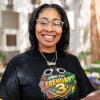

Before I was inmate number 1414048, I was Candace Williams.
And long before the system knew my name, I was a little girl whose mother was in and out of prison. I was raised by my grandparents. I told myself over and over again, “I’m not going to end up like my mom.” But cycles don’t just break because we want them to.
In 2008, at 22 years old, I was arrested in Charlottesville. I was already a mother of two beautiful girls and pregnant with my third child. I pleaded guilty for my role in felony murder, two robberies and abduction. It’s a story I’ve told many times over the last few years. Now I want to tell the next part of my story.
Eight months into my incarceration, I gave birth to my son. I was allowed to hold him for four hours. Four hours to memorize his face. Four hours to kiss his forehead. Four hours to be his mother. Then he was taken from me. I was strip-searched and placed back in a cell — alone — with milk still in my body and emptiness in my arms.
What should have been one of the most sacred moments of my life became one of the most traumatic. But even that didn’t wake me up. Not fully. It wasn’t until sentencing day in 2011 that I started to process our generational curse. The judge looked at me and said, “Ms. Williams, I sentenced your mother. Now I’m sentencing you. And most likely, I will sentence your children.”
The time he gave me — 65 years, 47 suspended and 18 active — didn’t shake me to my core. That statement did. Because in that moment, I heard generational trauma being predicted like it was inevitable. When I was first sentenced, I thought the judge was being unfair. But then I realized what he was implying: If I didn’t change the narrative, the narrative would change my children.
When I arrived at the Fluvanna Correctional Center for Women, I met individuals who changed my life. Women who were serving long sentences, women who had lost custody, women who had made mistakes. But they were still mothers. And they showed me something I had forgotten: Incarceration does not erase motherhood.
Last year, the Virginia Department of Corrections held almost 23,000 inmates on average per day. Fewer than 2,000 of those inmates are women, or as many as 3,000 in the last decade according to the VADOC. We are lost in the numbers. From our clothing to prison programming to re-entry, the system is designed for men.
At the time of their incarceration, 58% of women according to national U.S. Department of Justice statistics have custody of their children. Yet when we walk through those gates, we lose that. We feel deflated, disconnected, powerless. But we still have rights. We can write to our children’s schools, we can contact pediatricians, we can stay involved — if we’re willing to learn how.
I took the parenting class at Fluvanna Correctional Center twice in 2013. The third time I took it in 2014, I came back able to give my insights to other mothers who felt that there was no light at the end of the tunnel. I told them that I was able to build healthy relationships with my kids after taking the class.
Later, I created the Mending Hearts Parenting Support Group in the Cognitive Community, what we called the “re-entry hall” where individuals were moved before being released. It wasn’t just a class, it was a space where mothers could say, “I’m scared my child won’t know me,” “I don’t know how to talk to the caregiver,” or “I don’t know how to fix what I broke.”
We learned parenting styles. We practiced difficult conversations. We talked about accountability and healing. Over 200 mothers came through Mending Hearts before I came home. And I watched something beautiful happen. Mothers began to pour into other mothers. Women who once felt shame began to find purpose. Certificates from the program — I kept copies of all of them because I was so proud — helped some women regain visitation and even begin custody processes. And I realized something powerful: When you support a mother, you support a child. When you support a child, you shift a generation.
But there’s another group we don’t talk about enough: The grandmothers raising babies again and the sisters stepping in. We don’t talk about the fathers trying to figure it out and the caregivers carrying financial, emotional and mental weight without recognition.

When we are sentenced, our children are sentenced too. They walk into classrooms with a cloud over them. They hear whispers. They Google our names. And the narrative gets written without us.
So I began advocating for something bold: A “Hidden Victims Impact Statement.” Since my release, I’ve been speaking with lawmakers and advocacy groups in Virginia about the people who are taking care of the children of incarcerated loved ones. Just like victims have a voice in court, why shouldn’t our children and caregivers have one too? Why shouldn’t the court hear how incarceration impacts families mentally, emotionally and financially? Because if we don’t humanize the impact, we normalize the cycle.
In 2020, I was transferred to the Virginia Correctional Center for Women in Goochland to complete a 72-hour Peer Recovery Specialist training, to use my lived experience to mentor other people who’ve been through trauma from incarceration. I worked one-on-one with women preparing to re-enter society. Then COVID-19 hit and many programs shut down. The Peer Recovery training shut down, the parenting and educational programs shut down. And once again, incarcerated mothers were left without structured support.
That silence felt familiar, but I wasn’t the same woman anymore. The day that judge made that statement, I became a mother on a mission. I decided that my incarceration would not define my legacy — my transformation would. Every time I saw the warden come down the hall during the pandemic, I asked him when the programs would start again because people were getting released without the information and tools they needed for re-entry. When the lockdown ended, I started Mending Hearts in Goochland too.
Take action
Hear more from Candace Williams and learn about how people come home from prison.
Candace Williams will be part of a roundtable at the 14th Tom Tom Festival called “Cville’s Reentry Ecosystem: Strengths & Struggles.”
Wednesday April 22, 2026
11:30 a.m. to 12:30 p.m.
Vault Virginia Gallery
300 E Main St, Charlottesville, VA 22902
Find our more about the event.
On December 26, 2023, I went home. And freedom didn’t slow me down. It sharpened my purpose. Today, I advocate for incarcerated women by speaking and standing in my truth and sharing my lived experiences. I carry the voices of the women I left behind. I carry the lessons I learned inside the walls of the Fluvanna Correctional Center and Goochland.
I want to keep talking to the woman inside who feels like she’s already been written off. I want to talk to the mother who thinks she’s ruined everything, to the woman who hears that voice saying, “You’re just like your mama,” “Your kids are next.” I need you to hear me clearly. Cycles are real but so is change. Accountability is painful, but it is powerful. Motherhood does not stop because of a sentence and your story does not end here.
If you are willing to heal, to learn, to take responsibility, to lean into programs, to pour into each other — you can change the trajectory of your family. I am not inmate 1414048. I am Candace Williams. I am a mother. I am an advocate. I am proof that transformation is possible. When mothers are supported, families heal. When families heal, communities change. And when women inside prisons believe they still matter, the cycle breaks.
This First Person Charlottesville piece is adapted from a talk Candace Williams gave as part of a March 11, 2026 Tedx program Fluvanna Correctional Center for Women, hosted by the nonprofit organization Proximity for Justice and the Virginia Department of Corrections.