

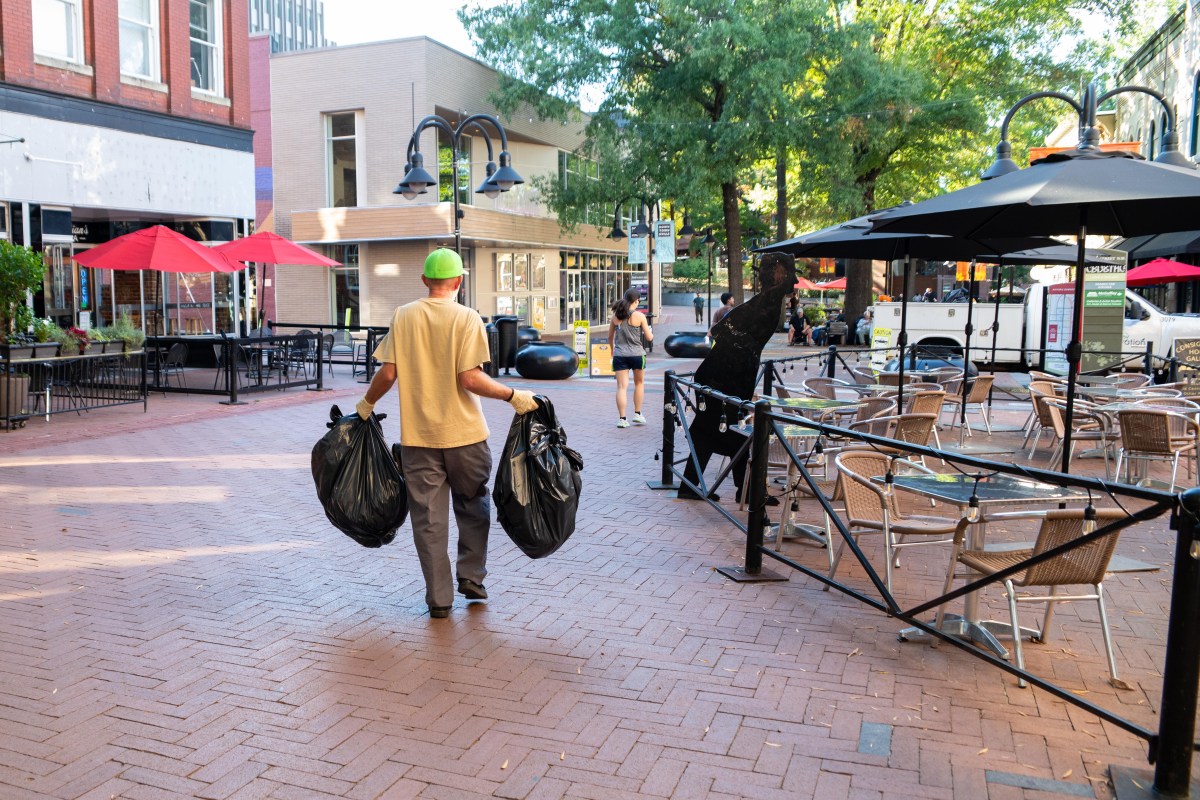
The Downtown Mall is the thing Senlin Means loves most about Charlottesville.
A second-generation downtown business owner, Means knows it well. Her parents owned a business on Market St. for years, and so she essentially grew up on the Mall, which was built just a year after she was born. She loved watching poets scribble in their notebooks and play chess at Mudhouse, giggling at how the punks and buttoned-up businessmen alike danced at Fridays After Five.
She later worked at Market Street Wine Shop for 12 years. Since 2023, she has been a co-owner of The Beautiful Idea, an antifascist bookstore, queer maker’s market and alternative community hub on the Mall.
“It is an amazingly unique, beautiful thing,” she said from a table at Lone Light Coffee on Fourth St. NE, reminiscing about some of the downtown businesses that have come and gone. Right now, she’s particularly delighted by the fact that the Mall has an escape room, an arcade and a crystal shop.
“The Mall is an incredible community,” she said.
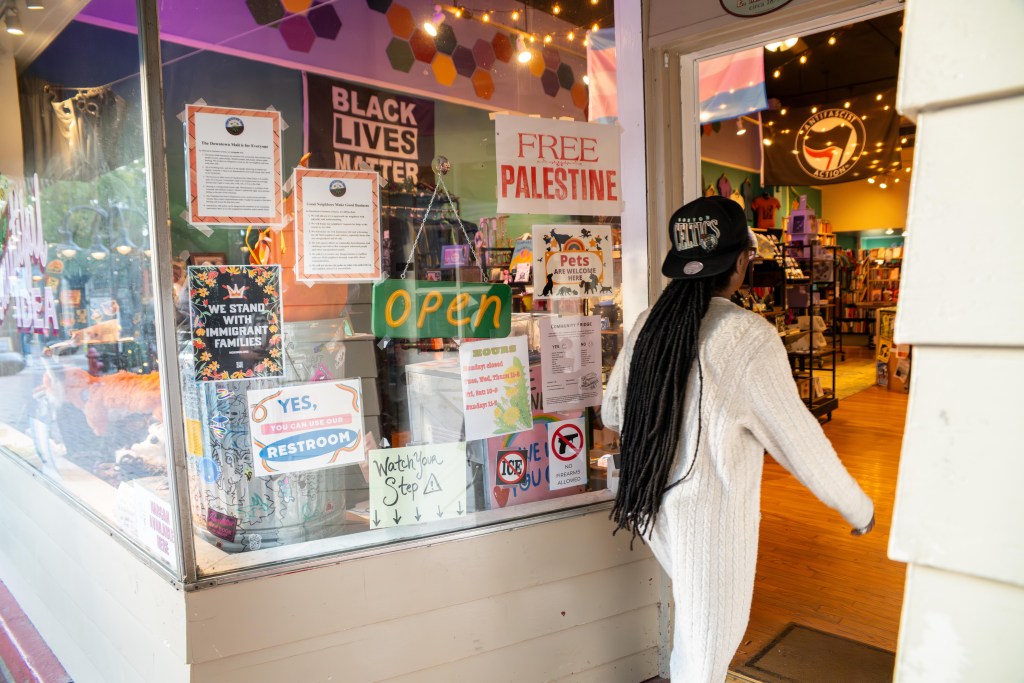
But conversations about how to improve the Downtown Mall have been happening since it opened, nearly 50 years ago, in 1975. With that anniversary coming up, those conversations have picked up speed for some, and not everyone agrees on how, or why, the Mall needs to be improved.
As recently as a Sept. 2 City Council meeting, city officials discussed a proposed ordinance to ban sleeping, camping or storing belongings in public areas — including on the Downtown Mall. During that meeting, a representative for numerous downtown businesses said foot traffic on the Mall has slowed, and attributed it to the presence of unhoused people. Other community members refuted that claim, saying slow business could be because of the economy or the irrelevance of the shops to local people and tourists.
While the council tabled the ordinance indefinitely, an upcoming initiative that has received mixed opinions from business owners and residents is a two-year pilot program for a Downtown Mall “clean team and ambassador” program scheduled to start in early 2026. The city is paying $600,000 of taxpayer dollars per year — $1.2 million total — for the pilot.
Kentucky-based company hired for ‘clean team and ambassador’ program on Downtown Mall
The main purpose of the program, Charlottesville’s director of economic development Chris Engel told Charlottesville Tomorrow, is to change the perception that people have of the Mall, and therefore the experience they have when they visit it, to help boost retail sales and therefore tax revenue for the city. It helps keep the burden of taxes from falling solely on the residential community, Engel added.
“We have to have a healthy, vibrant downtown in order for the tax generation to occur in a way that helps the city overall,” he said. “We definitely want to see this work.”
A Louisville, Kentucky-based private company, Block By Block, will be performing both maintenance and ambassador duties on and immediately surrounding the Mall, Engel said. They’ll be painting, power washing, picking up trash and dog waste, sweeping leaves and scrubbing away graffiti. They’ll also be available to give directions, help people with their shopping bags and walk people to their cars.

They’ll pick up in part where Charlottesville Parks & Recreation crews, who work on cleaning up the Mall early every morning, leave off, Engel said. Block By Block will likely be present on the Mall Wednesday through Sunday, starting in the afternoon and going until 9 p.m. or 10 p.m.
Block By Block holds, or has held, contracts with more than 100 cities throughout the U.S. and Canada, including Louisville; Salt Lake City; San Francisco; Nashville, Tennessee; Brooklyn, New York; Coral Gables, Florida; and Roanoke, Virginia.
Outsourcing the work is a problem for City Councilor Michael Payne, who voted against using taxpayer dollars for the program.
“Any time we outsource work, I’m very concerned that we’re undermining our unionized workers,” he said while discussing the program during a City Council meeting in June. “It’s almost guaranteed, when we outsource, they will not be unionized, they will have lower wages, and they will have worse, potentially no, benefits.”
Block by Block is expected to hire between seven and ten local people for the program, and is supposed to pay them a living wage per its contract with the city.
(Living wage is the hourly rate that an individual in a household must earn to support themselves and/or their family while working full-time, or 2,080 hours per year. It changes depending on household makeup. A living wage in the City of Charlottesville is $23.00 an hour for one adult with no children, for instance, but $49.77 for a married adult with three children, according to the MIT Living Wage Calculator.)
The City decided to outsource the work, rather than add money to the Parks & Recreation budget, for a few different reasons, Engel said.
One is that Block By Block offers ambassador services in addition to cleaning. The company developed its model specifically to serve business districts with its services, Engel said. The company also has a technology support system that helps them keep track of the work employees are doing and maintain relationships with business owners.
“They have a system that stood out as being entirely desirable, and it’s obviously worked in a lot of other places,” Engel said.
“It’s remarkable, in my opinion, that we haven’t done something of this nature before this,” Engel added. “Most of our peer cities have.”

The city has had an ambassador program before, from 2013 to 2016.
City Council authorized a Downtown Mall Ambassadors program to help tourists navigate the area and to be “eyes and ears” for the police, The Daily Progress reported at the time. When it started, the program cost about $72,000 for four ambassadors.
In 2014, City Council praised the program for helping make the Mall safer. But a few years later, the city added more full-time police officers, some of whom were assigned the Downtown Mall beat, and in 2016, then-City Manager Maurice Jones cut the much less expensive ambassador program, The Daily Progress reported.
Community members disagree on whether the program will succeed, and who will benefit
City Manager Sam Sanders brought the Block By Block proposal before the City Council in June 2025 as part of an $8.7 million “community improvements” package.
In addition to the $1.2 million for the two-year Block By Block pilot, the list included $3.5 million to replenish the health care fund reserve for city employees; $280,000 for a long-term public restroom solution on the Downtown Mall (a site has not been chosen yet, Sanders told the Council); and $425,000 for a two-year homelessness outreach pilot program.
The money will come from the Capital Improvement Program (CIP) contingency fund.
Council voted 4-1 to fund the package during its June 16 meeting. Councilor Michael Payne was the sole vote against it — specifically because he was opposed to the Block By Block program.
“My opposition is to the $1.2 million for the clean team program, which I think has good desires for creating it. I don’t think it will accomplish the goal,” he said from the dais.
Some community members, like Rhoda Wheeler, are looking forward to Block By Block’s presence on the Mall.
Wheeler moved her luxury consignment boutique, Agents In Style, from northern Virginia to the Downtown Mall in 2021. Having a shop on a pedestrian mall so close to music venues and theaters, and being part of the small business community, appealed to her.

“The Downtown Mall is comprised of mainly small, locally-owned businesses like mine, and I know we welcome the Block By Block program,” Wheeler wrote in an email to Charlottesville Tomorrow. “We all have our local customers who note the need for some ‘sprucing up’ on the bricks. The walkable blocks are a delight for many, and we certainly welcome upgrades in landscaping and tidiness.”
Having ambassadors available to give directions will help tourists and out-of-towners, shoppers whose business she relies on, she said.
Friends of Charlottesville Downtown, a coalition of downtown business owners, is also eager for the program to start.
“Friends of Charlottesville is ecstatic about the city’s commitment to provide a clean and safe Downtown Charlottesville,” Achenbach, executive director of Friends of Charlottesville Downtown, wrote in an email to Charlottesville Tomorrow. She lauded Block By Block’s expertise and hopes the program “will create a more vibrant atmosphere that benefits our small businesses and the Downtown community.”
Achenbach said she recently met with Block By Block and as a result is feeling even more optimistic about the company’s data-driven approach and training around cleanliness and hospitality.
Others are unhappy that the city is spending money on this program, and are suspicious of what the program will actually be used for.
“To me, it’s a way of Trojan-horsing in the harassment of homeless people,” said Means. “It doesn’t look good to do it with cops, so we’ll do it with ambassadors. It’s all about maintaining a facade of civility while not helping the people who need help. We do have a homeless problem, but who is it a problem for? The people actually living on the street.”
She thinks the $1.2 million would be better spent on a mental health outreach program at Region Ten, making a dent in the city’s low-cost housing supply, or even tents, food and water for unhoused community members.
Means also doesn’t see the need for a clean team — the Mall is “not that dirty,” and graffiti is a legitimate art form that is a sign of a thriving city, she said. She doesn’t see the need for an ambassador program, either, because everyone who has a smart phone has a GPS in their pocket.

Laura Sigarny called the program “dubious” in her public comment to the City Council on Oct. 20. She asked why the city is spending money on this, instead of on more resources for unhoused community members. She suggested that if the city wants a cleanup crew, she knows a lot of unhoused folks who could use, and would do, the work.
Clifford Hall, who has lived in Charlottesville since 1988 and has been homeless off and on since 2011, is skeptical of the city’s motivations for the Block By Block program, and of its price tag.
While sitting on the Mall one recent evening, Hall looked around him at the people walking around while colorful autumn leaves fell gently from the trees. As he watched a Parks & Recreation employee empty trash cans and toss the glossy black bags into the back of a pickup truck, he wondered aloud how the city defines “clean.”
“Oh! We’re the problem,” he said, emphasizing the word “we’re.”
He knows that recently, people have been blaming unhoused people for the downturn in foot traffic, and therefore business, on the Mall.
Business revenue is declining, in part due to less foot traffic on the Mall, Chamber of Commerce says
Business in the city is declining, according to the Charlottesville Regional Chamber of Commerce second quarter 2025 report, released in September. The report showed that Charlottesville’s sales tax revenue declined by 2% in the previous year, while it increased by 6% in Albemarle County.
Chamber President and CEO Andrea Copeland told 29News that the city’s drop in revenue can likely be attributed to declining foot traffic on the Downtown Mall.
But business in the city, and on the Mall in particular, has fluctuated for years, for many reasons.
In 2010, downtown business owners complained about “aggressive panhandling” hurting their businesses, C-VILLE Weekly reported. Some blamed The Haven day shelter, which opened in January of that year.
The city tried to pass an anti-panhandling ordinance in response, but a few community members sued the city over it, saying it unfairly targeted panhandlers. A few years later, in 2015, a judge sided with the plaintiffs. The city settled the suit and amended the ordinance so that it banned people from begging for money from people eating on restaurant patios.

In 2018, Charlottesville business owners attributed a dip in business to a variety of things, according to a report in The Daily Progress. Among them, the August 12, 2017 Unite the Right rally; the city’s parking meter pilot program; competition from Albemarle County shopping centers like Stonefield and 5th Street Station; and a possible boycott over the city’s decision to remove racist statues.
Then came the COVID-19 pandemic, during which businesses had to pivot to online sales and restaurants to take-out. People who worked in downtown offices — and frequented downtown businesses — started working from home.
Years later, staffing remains a challenge, and some Mall restaurants have cut back on hours and even days open, C-VILLE Weekly reported in 2024. And, as remote work has become the norm for many companies, downtown office closures have affected the level of activity on the Mall. Rapture owner Mike Rodi told C-VILLE that pre-pandemic, his restaurant had a waiting list for lunch, but that’s no longer the case.
This year, some city officials and business owners have faulted unhoused community members once again. In September, Charlottesville Police Chief Michael Kochis brought a camping ban ordinance before City Council. The ordinance proposed banning sleeping, camping and storing personal belongings in public areas. The reason, stated in a policy briefing summary on it, was “a marked increase in quality-of-life complaints in and around locations where unhoused community members are residing.”
Kochis mentioned complaints of blocked sidewalks and rights-of-way, sanitation concerns and accumulation of personal belongings on public property, saying they have negatively affected surrounding neighborhoods and businesses.
Dozens of community members lambasted city leadership over the proposed ordinance during the Sept. 2 council meeting, saying that the ordinance unfairly targeted unhoused community members who have nowhere else to go. They called the ordinance “cruel,” “inhumane,” “dystopian,” and “draconian,” among other things.
At that meeting, Friends of Charlottesville Downtown’s Achenbach was the only person who voiced support for the ordinance. Speaking on behalf of numerous downtown businesses, she said that the presence of unhoused people was negatively impacting businesses.
Community members immediately pushed back on that claim, saying that unhoused people are not the reason they don’t frequent the Mall. They said that many of the shops on the Mall are not relevant to local people, and are too expensive for many residents. Additionally, the lack of a regularly accessible public bathroom makes a Mall visit a challenge, they said.
The city started renting out a public restroom in York Place in 2022. It is supposed to be open when York Place is, roughly 10:30 a.m. to 8:30 p.m. daily, but Charlottesville Tomorrow staff have found it is not always open during those times.
The Transit center also has public facilities available during business hours, and for several years the city has paid to have a porta-john across from Market St. Park, near the Albemarle Charlottesville Historical Society, Engel said.
Still, the city is looking into a long-term restroom solution for the Mall. Sanders’ “community interventions” package includes $280,000 for it.
Hall, who has lived on the Mall, told Charlottesville Tomorrow that he understands that business owners need to make money to pay their rent and payroll. But at the same time, not everyone who is homeless is a threat to their business, he said.
“I am homeless because I can’t afford rent,” he said. “There are varying differences within homelessness.”

Engel, the city’s economic development director who will be overseeing the Block By Block team, said that while he understands the concern, the program will not be used to harass unhoused community members, or to get them to move off the Mall.
Block By Block advertises homelessness outreach services on its website, but that is not part of the company’s contract with the city, Engel said.
Charlottesville Tomorrow reached out to the company to confirm this, but Block By Block did not agree to answer any of Charlottesville Tomorrow’s questions and instead referred all enquiries to Engel.
“We specifically removed that from the request,” Engel said. That’s because Sanders’ “community interventions” package, which included the money for Block By Block, also included money for the city to hire two homelessness outreach employees.
The city has not yet made any commitments to hiring for those positions, city spokesperson Afton Schneider told Charlottesville Tomorrow in an email on Monday.
“We are still exploring the right approach to outreach that will enhance existing services,” she said.
Block By Block will be “instructed and guided” to not harass unhoused community members or move their belongings, Engel said. Instead, they’ll be encouraged to work with city police, and, eventually, homeless outreach coordinators, if any problems arise.
Still, Means believes the ambassadors will be a “threatening presence” to people who live and hang out on the Mall — people who, she notes, are part of the Downtown Mall community that she loves so much.
“If you’re going to have a public place, you have to include the public, and the public includes everyone,” she said.
Time will tell. The Block By Block pilot program is scheduled to start sometime early next year. When the two-year contract is nearly up, Sanders said in June, city staff will evaluate whether to extend it, expand it, or leave it behind.