


Charlottesville is a little closer to having a permanent overnight low-barrier homeless shelter — something local homeless services providers have for years said the city desperately needs, and that many community members support.
However, local business owners have voiced concern about how such a shelter could affect them, and by extension, city tax revenues.
Monday night, Charlottesville City Council voted unanimously to spend approximately $6.2 million to buy a property at 2000 Holiday Dr.
The 3.8-acre property is located behind the Days Inn and the Country Inn & Suites on Emmet St./Route 29. It includes a 27,000 square-foot building that was previously used for offices, which the city plans to retrofit into a shelter with approximately 200 beds and on-site services for guests.
When the voting results came in, a few people in the audience clapped.
Charlottesville City Manager Sam Sanders has been looking for a low-barrier shelter site for the past two years — opening such a shelter was one of the priorities Sanders outlined in a “homeless intervention strategy” he presented to the council in October 2023.
The Holiday Dr. site is the third one Sanders had publicly considered.
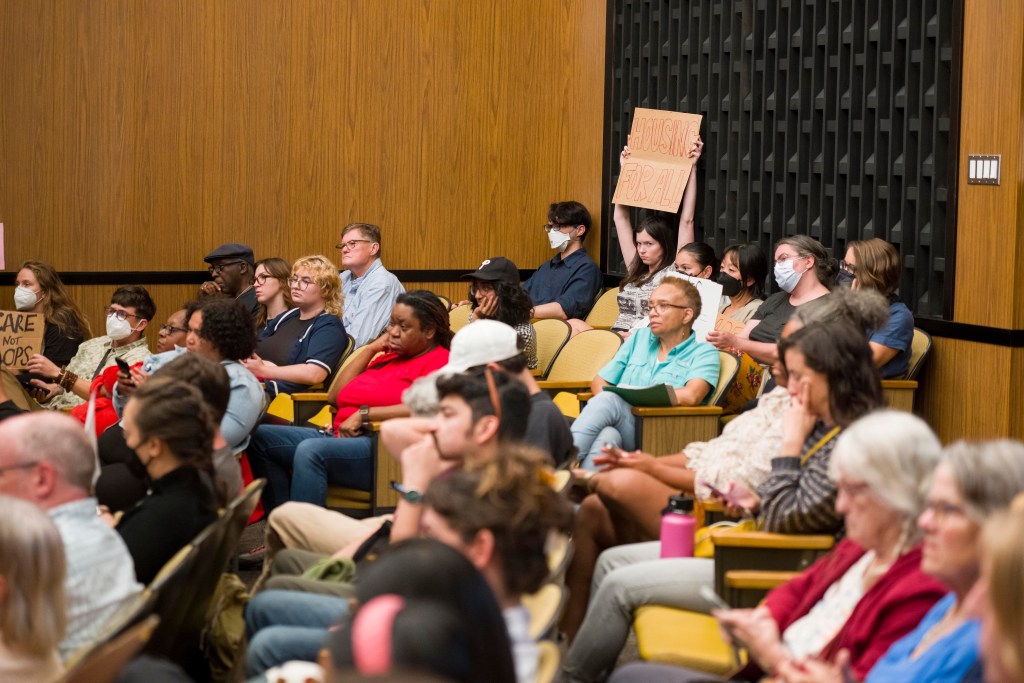
While the council heard on Monday from a handful of community members who opposed the shelter on Holiday Dr., it also heard from more than a dozen who supported it.
Learn more about low-barrier shelters in this report from January 2025.
A few of the people who own and work at the businesses on Holiday Dr. said that while they recognize the need for and support the idea of a shelter, they oppose the location.
“I fully support the goal of helping those in need and addressing homelessness in our community,” said Angela Spathos, whose family has owned and operated Aberdeen Barn, currently located at 2018 Holiday Dr., since 1965. “However, I truly believe Holiday Drive is not the right location for this facility.”
In addition to Aberdeen Barn, there are two restaurants, four hotels, and a barber shop operating on that street.
“By placing a shelter at the end of our dead-end street, you would be directing shelter residents directly past our entrances and through our parking areas,” Spathos added. “This raises serious concerns about loitering, safety — especially after dark — and the comfort of our guests and employees.”
Spathos and other employees of the businesses located on Holiday Dr. said that if the area becomes unsafe — or is perceived as being unsafe — due to the presence of a shelter, it will negatively affect their ability to attract and retain customers and ultimately, their ability to sustain their businesses.
“The ripple effects could be devastating, not only for our establishments but the many staff and suppliers who rely on us for their livelihoods,” Spathos said. “We’ve all seen how this increase in the homeless population has affected other hospitality districts in the city.”
Spathos did not say which business districts specifically. But last month, during a public hearing about a potential ban on camping, sleeping, and storing personal belongings in public places, a representative for Friends of Charlottesville Downtown said the presence of unhoused people on the Mall was negatively impacting businesses.
“When visitors encounter encampments and cluttered belongings, aggressive panhandling, the atmosphere of the mall is diminished,” the organization’s executive director Greer Achenbach told the council on Sept. 2. “This perception not only discourages tourism and local engagement, but threatens the long-term vitality of the businesses that rely on that foot traffic.”
Anup Patel, an employee of the EconoLodge on Holiday Dr., on Monday echoed many of Spathos’ concerns, including that having a shelter nearby would hurt business — and therefore the city’s tax revenue.
(The city’s 9% lodging tax is expected to bring in $9.1 million in revenue, and its 7% meals tax is estimated to bring in $21.2 million in fiscal year 2026, according to the city’s budget summary. Revenues for both have been declining despite a tax increase, the document says.)
Patel asked whether the city had conducted a “community impact study” for the area. He wanted to know what security measures would be in place, how the city would handle safety-related issues and incidents in the area.
“There are still too many unanswered questions,” he said. “Please don’t turn your backs on small businesses and families who have supported the city for over 50 years.”
Samantha Hudson, general manager at the Country Inn and Suites, said that it wasn’t the location that bothered her so much as the fact that the city didn’t contact the Holiday Dr. businesses before making their plans. She asked the council to “pause and reevaluate this location.”
The comments against putting a shelter on Holiday Dr. provoked a few people in the audience who hadn’t intended to speak during the public hearing, to do so in support of the shelter.
“I wasn’t intending to speak tonight, but apparently NIMBYism is everywhere,” said Shayla Washington, executive director of the Blue Ridge Area Coalition for the Homeless (BRACH), a local nonprofit that coordinates services and funding for local organizations that serve unhoused community members.
“Trust me, our city staff and stakeholders have been very involved in this low-barrier shelter project,” Washington said. “We’ve been meeting for countless weeks — I was in a three-hour meeting today, and have more this week.”
For over a year, Washington has been meeting regularly with other homeless services leaders, including those from The Haven, a day shelter open 365 days a year, and People And Congregations Engaged In Ministry (PACEM), which runs an overnight low-barrier shelter in the cold months, strengthening their relationships so that they can work together with the city on getting a low-barrier shelter off the ground. Between them, they have more than 40 years of combined service experience, Washington pointed out in an email she sent to City Manager Sanders and the Council, and which she shared with Charlottesville Tomorrow.
The group is currently working on creating a preliminary shelter plan for the city, though as the Holiday Dr. acquisition has moved quickly, the planning has picked up speed, too. In her email to city officials, Washington called the current timeline “ambitious.” Still, she said, local service providers are committed to making the shelter work for the community’s unique needs.
“I encourage you all to have some compassion,” Washington said to everyone gathered in City Council chambers Monday night, “because God forbid, many of you working in those very businesses could be one or two paychecks away from needing to use that shelter yourself.”
A few of the Holiday Dr. employees had mentioned in their comments that they themselves were living paycheck-to-paycheck.
Multiple people urged city officials to prioritize the needs of the unhoused people, and not businesses, when considering where to put a shelter.
“Maybe we don’t just think about the hotels,” said Isis Neumann. “What if we thought about the actual people who need a place to stay at night? What a lot of people want is to push these people out, and that doesn’t work for the actual people who are being served. This is really frustrating.”
Neumann said that when she was unhoused, there was no place outside where she knew she could lie down without making someone unhappy. But by the end of the day, she had to lay her head down somewhere.
“People can be in the safety of their $200-a-night hotel and there can be a shelter nearby. Those two things can exist within the same plane,” she said.
Others pointed out that unhoused community members are often themselves hotel guests, particularly at low-cost hotels like Econo Lodge.
“I know countless individuals who have experienced homelessness, or people who are supporting people who are experiencing homelessness, pay for hotel rooms without any issue in that area already,” said Leah Leon, who currently works at The Haven day shelter, but was not speaking on behalf of the shelter.
After Monday’s public hearing on purchasing the Holiday Dr. property, the five councilors deliberated briefly before casting their votes. They all acknowledged that it was a great opportunity the city should seize, quickly.
“We are a city of 10 square miles, and opportunity like this does not come up,” said Mayor Juandiego Wade.
“Particularly after we’ve been searching for a couple of years and have not found another spot, I think this is what we have to try,” said Councilor Lloyd Snook.
“As we heard tonight, there is literally no location in the city that is not going to garner opposition,” said City Councilor Michael Payne. “I think we just have to ground our decision in what is going to be the most successful intervention, and what’s a location that has the space to fit enough low-barrier shelter beds.”
Payne later expanded on his decision to vote for the purchase of 2000 Holiday Dr. in an email to Charlottesville Tomorrow.
Not only is the shelter near a bus line, he said, the building is large enough to contain sufficient shelter beds — possibly 200 or more — and on-site services. Retrofitting the existing building will be cheaper than building a new one, he added, and the undeveloped land adjacent to the existing building could be used for services, or even other housing options in the future.
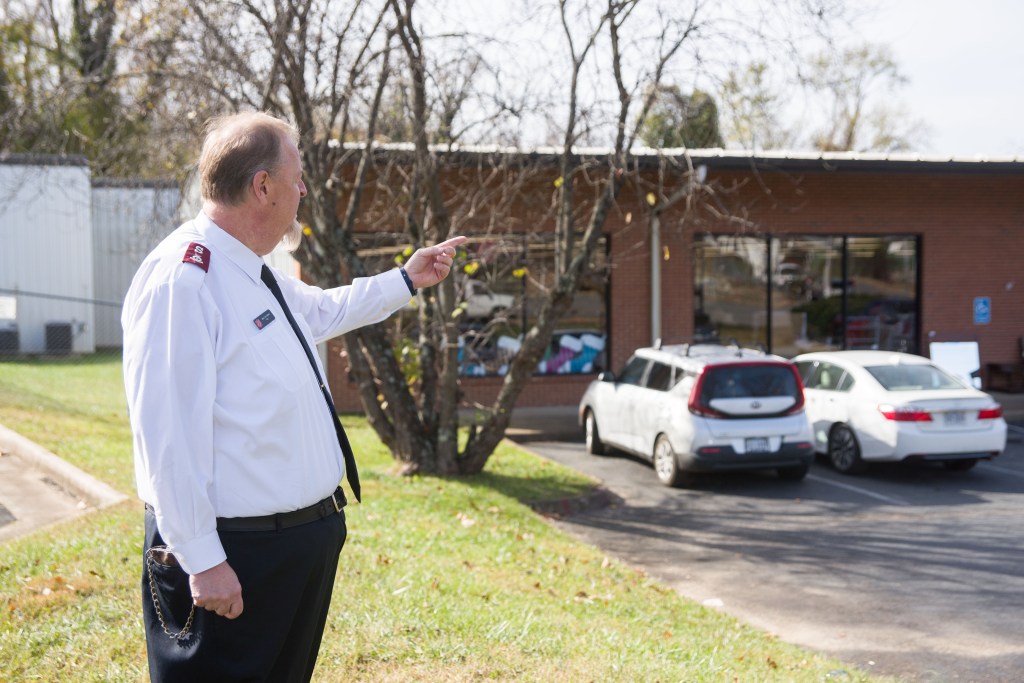
Plus, he said, this leaves The Salvation Army thrift store on Cherry Ave. open for a possible family shelter.
In his remarks, Councilor Brian Pinkston reassured the business owners who’d spoken that night that the shelter could coexist with local businesses.
People working in homeless services “are very thoughtful, very kind, and very reasonable people, and our staff is as well,” said Pinkston. “The concerns you have, I am confident that there will be ways in which they can be mitigated, and your businesses protected.”
“I do think this is where we need to go and what we need to do,” he said. “I think that it’s going to be okay.”
In response to some of the public comments about tax revenue and the city tending to prioritize money over people, Snook said that it’s not about prioritization, but balance.
“The only way we can deal with governance in this world where we rely on businesses, among other people, for tax revenues — the tax revenues that would go into homeless shelters and so on — the only way we can make this happen is if we’re balancing the two,” Snook said.
The plan for the shelter “has got to be balancing both people and businesses,” he added, “the people we serve and the businesses who, frankly, produce the income that we serve the people with.”