


On Saturday, March 15, David Plunkett’s phone rang off the hook. Every time he picked up, the person on the other end asked a version of the same question.
“How is this going to affect the downtown library?”
“What’s going to happen to the Crozet Library?”
“Will anything change at the Gordon Avenue Library?”
The night before, President Trump issued an executive order to effectively dismantle the Institute of Museum and Library Services (IMLS), an independent federal agency that provides grants to libraries and museums throughout the United States.
Upon hearing the news, local folks immediately started worrying about how this would affect them personally, said Plunkett, who is director of the Jefferson-Madison Regional Library system.
“The conversation wasn’t ‘what does this mean for the country?'” Plunkett told Charlottesville Tomorrow by phone on March 26. “It was ‘what does this mean for my library?'”
Two weeks after the executive order, on March 31, all IMLS employees were placed on leave. They had to turn in all government property and their email accounts were disabled, according to an NPR report.
The shuttering of the IMLS will affect JMRL, Plunkett said — but not in the way people might expect.
That’s because the local library system doesn’t receive any direct funding from the federal government. The vast majority of its funding comes from local and state funding.
All of the operational costs for its nine branches, including staff salaries and keeping the physical library buildings running, are paid for by the five localities JMRL serves — the City of Charlottesville and Albemarle, Greene, Louisa, and Nelson counties. That came to just under $9 million for the 2025 fiscal year, according to the library’s adopted budget.
JMRL’s collection — the books, CDs, DVDs, audiobooks and more — is paid for by the state. State Aid for Public Libraries, which was established by the Virginia General Assembly in the 1942-43 fiscal year, legally obligates the state to help public libraries build and maintain their collections. Currently, JMRL receives about $1 million per year for its collection, Plunkett said, though that amount is subject to change.
The library receives additional money from Friends of JMRL, a nonprofit organization with a mission to raise money for the local library system. Membership fees and individual donations are a core part of the fundraising, in addition to a twice-yearly book sale, Friends of JMRL President Wendy Craig wrote in an email to Charlottesville Tomorrow. The fall 2024 book sale raised $166,367.
Funding from the Friends of JMRL goes toward things like enhancing the library’s book and audio-visual collection, a monthly book review/newsletter, and three hours of free parking in the Water Street Garage for patrons of the Central Library branch on Water Street in Charlottesville. In 2017, the Friends of JMRL provided a major grant to help JMRL acquire a new Bookmobile, a portable library that makes regular stops throughout the community at places like senior residential centers, preschools, public parks and recreation centers.
“We have great local support at JMRL,” said Plunkett. “Having said that, the support JMRL’s patrons have from IMLS, they will notice” if that support goes away.
While JMRL doesn’t receive direct funding from the IMLS, many patrons do rely on resources provided by the Library of Virginia — which is funded in part by the IMLS.
In 2024, the Library of Virginia received $4.3 million, or 16% of its budget, from IMLS. The rest comes from state taxes and private donations.
That funding from IMLS partially supports between 30 and 35 employees — 25% of the Library of Virginia workforce, said Dennis Clark, the state librarian.
IMLS funding for Virginia is split into two buckets. About $4.3 million of the IMLS money Virginia received is from the “Grants to States” program, the largest source of federal funding support for library services in the U.S. The Library of Virginia is responsible for administering that program in Virginia, and that money goes to supporting public and school libraries throughout the state. The rest, $5.4 million, goes to individual museums and libraries throughout the state.
For example, the “Toward a Lineage of Self” exhibition at the Jefferson School African American Heritage Center, which maps the physical and social development of Black neighborhoods and institutions throughout the City of Charlottesville, was funded by a $110,000 IMLS grant in 2022.
(Learn more about IMLS funding to the state of Virginia on this dashboard.)
The resources funded by Grants to States are statewide ones, meaning they’re accessible in every public and K-12 library throughout the state.
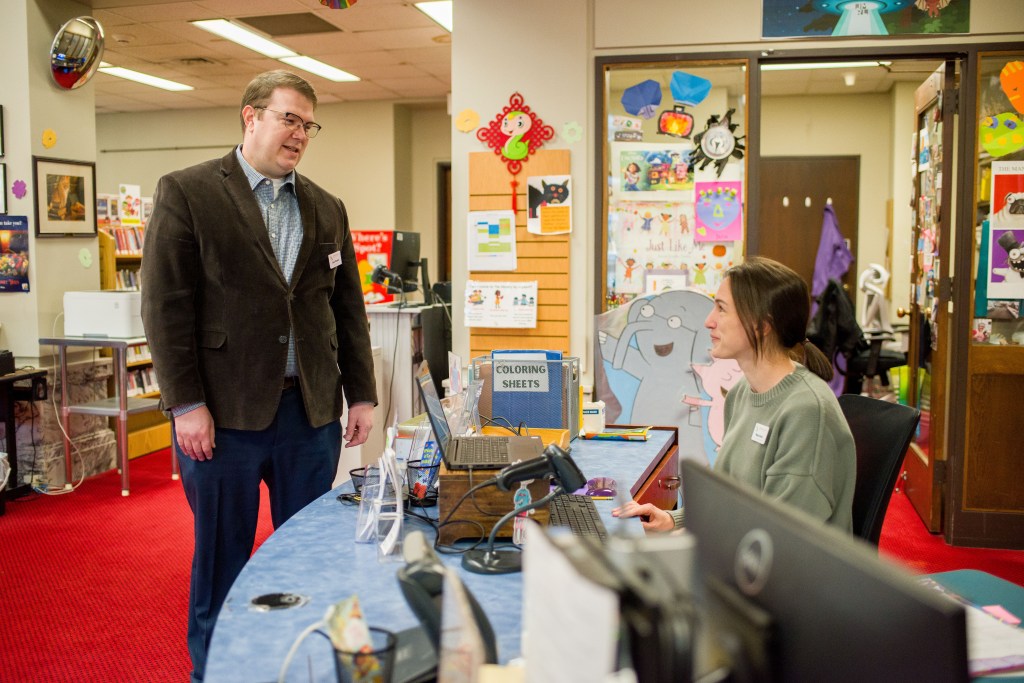
The largest of those initiatives, FindItVirginia, is an online database that is very popular with library patrons, said Plunkett. People can access it at any public library, or at home with their library card number. The Library of Virginia maintains the database.
FindItVirginia is rich with resources. It has a periodical search where people can find and read newspaper articles without a personal subscription. It has information on inclusive resources for people with dyslexia, autism, and hearing and vision impairments.
Librarians use its book recommendation program, NoveList, to make recommendations to readers of all ages, said Plunkett.
“It’s just amazing,” Plunkett said of NoveList. “It’s like a curated GoodReads. If you want to read reviews about books, if you want to know what some read-alikes are, it’s the best reader’s advisory tool that any librarian has.”
FindItVirginia also offers direct person-to-person services. Students can get online homework help from a live tutor seven days a week, between 2 and 11 p.m., in both English and Spanish. Veterans can get live online help applying for benefits, a notoriously complicated process. Adults can connect with certified career coaches to help with a job search.
FindItVirginia used about $1.6 million in IMLS funding in 2024.
“IMLS funding is essential in ensuring all Virginians have access to fundamental library services,” Clark wrote. “Libraries are the nexus of community and civic engagement, and are available to every Virginian, regardless of education, income, or status, and the elimination of the IMLS puts that in jeopardy.”
If IMLS funding goes away — and it’s looking like it will — most, if not all, of the 15 programs funded by Grants to States in Virginia, including FindItVirginia, “will cease or greatly diminish,” because the state probably won’t be able to make up for it, Clark wrote.
“It is extremely unlikely that the Library of Virginia would be able to make up a substantial amount of the difference in funds,” he added.
There are 14 other programs that are potentially affected, including: creating and distributing youth summer reading program materials for every library in the state ($184,241); the Virginia Newspaper Program, which offers digitization and searchable access to Virginia regional newspapers ($156,378); information technology support for all Library of Virginia digital and physical collections ($712,817); Document Bank, which is a searchable site of important Virginia documents, organized by historic era, theme, and the Virginia Standards of Learning ($10,714).
The future of these IMLS-supported programs is unclear, said Clark. He expected the Grants to States funding to be available through September 30, 2025, the end of the federal fiscal year.
But as of April 1, the Library of Virginia had not received its last funding infusion, and Clark wasn’t feeling hopeful about receiving it.
Nor was he hopeful about the $5.4 million in IMLS funding that goes to libraries and museums throughout the state.
That “would likely be considered discretionary, and it’s unlikely those obligations will be met, as there are no longer active IMLS employees,” Clark wrote.
The law that authorizes the IMLS, the Museum and Library Services Act, was established by Congress in 1996 and has had to be periodically re-authorized, according to this fact sheet from the American Library Association, a nonprofit organization that supports and advocates for libraries.
That law expires this year.
“Given the intent of the executive order, [it] seems unlikely to be reauthorized,” Clark wrote.
Rural public and school libraries will be particularly affected by these cuts, Clark wrote — they rely heavily on the summer reading programs and the interlibrary loan services that IMLS finding provides.
Charlottesville-area libraries are not part of that group, but Plunkett does worry about how changes at the federal level will affect the library system that he loves so much. Plunkett grew up in Charlottesville, devouring biographies pulled from the kids and young adult shelves of the Central Library branch. He started working for JMRL in 2002, at the Gordon Avenue branch, before he was selected to lead the entire regional system in 2017.
“I have a concern that, if the state needs to fund some of these things, they might decide that they need to dip into State Aid for Public Libraries, which could mean less funding directly for books and materials,” Plunkett said.
“Frequently when there are budget cuts to be made, that’s an area that gets cut,” he added.
And if the state has to dip into those coffers to support the resources IMLS money has covered, local jurisdictions will have to decide whether or not they can pick up that slack.
That’s another of Plunkett’s worries. With potential cuts to federal funding for all sorts of local projects, including infrastructure, transportation, public health and education, local governments might be faced with more budgetary requests — and therefore forced to make increasingly difficult funding decisions.
“I don’t want to have to go back to Charlottesville, Albemarle, Greene, Louisa and Nelson and ask for more money in order to provide library services because something that was formerly provided by federal funding is now unavailable,” he said.
“We try to be mindful of that, to run a very lean operation,” Plunkett said. “There are a lot of needs in our communities.”
Editors’ note: This article was updated on April 10, 2025, to correct the amount of funding that the Library of Virginia received from the Institute of Museum and Library Services.