

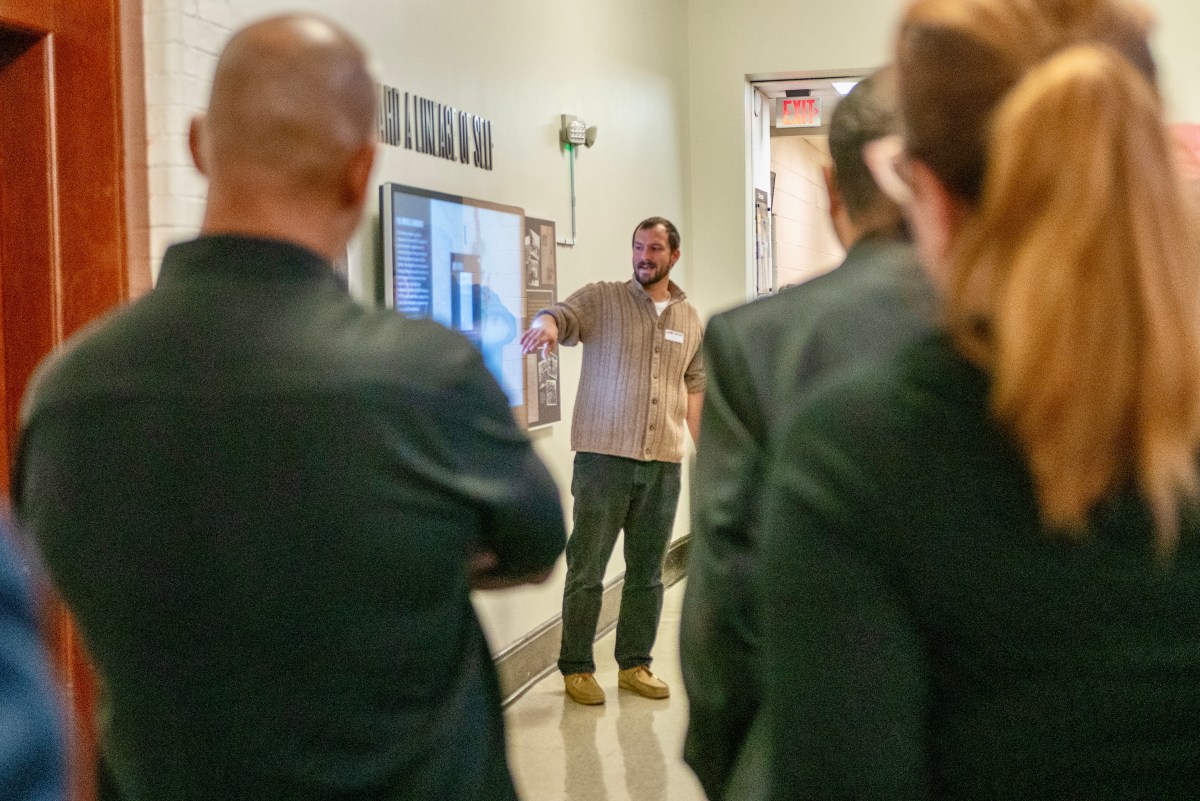
In 2022, Jordy Yager received a Virginia Humanities Public Fellowship to support his final year of research and writing for “Toward a Lineage of Self,” a permanent exhibition at the Jefferson School African American Heritage Center that traces the history of Charlottesville’’s Black neighborhoods.
The project includes a digital interactive map to guide people through 120 place-based stories and images that document the families that settled in those neighborhoods and established businesses, churches, schools and political power.
Yager, director of Digital Humanities at the JSAAHC, said such projects provide a better understanding of “the world, our communities and ourselves.”
But the recent cancellation of grants and funding by the National Endowment for the Humanities threaten opportunities for these kinds of local histories, he said.
“Without it, public history projects will be forced to fight harder for support, and we’ll lose essential opportunities for communities to tell their own stories, for public storytellers to do this work, and for all of us to deepen our understanding with the goal to reflect, reckon, and repair,” said Yager.

Indeed, when Virginia Humanities’ Executive Director Matthew Gibson learned about funding cuts at the National Endowment for the Humanities, the federal agency that provides grants to the nation’s 56 humanities councils, he knew that much of his council’s work could be impacted.
He was right. NEH’s termination of about $1.6 million of Virginia Humanities grant funding meant there would be layoffs at his Charlottesville-based organization that has a current budget of “a little north of $6 million,” said Gibson. Its annual expenses were $7.34 million in 2023, according to the organization’s most recently available tax filing.
Gibson said on a call with Charlottesville Tomorrow that he received a “missive” on April 3 at 12:51 a.m. stating that the general operating support grant to help staff provide programs for Virginians was terminated.
“And so, we’re looking at, right now at just this fiscal year, an immediate reduction of about $350,000 to $360,000,” said Gibson. “But beginning with the new fiscal year starting July 1, $1.37 million is gone just for that fiscal year. That’s about 20% of our budget.”
The federal funds from NEH, along with $2.4 million from the state, are Virginia Humanities’ two main sources of money that keep them operating.
“And when you take one of those away, that’s a heavy hit,” said Gibson.
The nonprofit also depends on its strong donor base as well as funding and grants from the Virginia Commission for the Arts, the University of Virginia and private corporations and foundations to support its mission.
Gibson said that while Virginia Humanities have had no layoffs as of April 15, two positions that were included in next fiscal year’s budget have been frozen. The positions were assistant director for the Virginia Center for the Book and the Virginia Indian programming coordinator.
Virginia Humanities’ Virginia Center for the Book represents Virginia as the state affiliate of the National Library of Congress, according to its website. It works within a network of state-wide and national affiliates to promote books, reading and literacy throughout Virginia. It also hosts the annual Virginia Festival of the Book in Charlottesville each March and produces literary programs and education initiatives year-round. The Virginia Indian Program provides workshops and events to educate audiences about Native American communities and culture.
Gibson said it remains uncertain how the freezes will impact the two programs.

“It’s just too early in this crisis to fully know what the impact will be on the festival and on the statewide book efforts,” he said.
“Regarding Virginia Indian Programs, Virginia Humanities has and always will remain committed to serving and partnering with Virginia’s 11 state recognized tribes, seven of which are also federally recognized,” Gibson noted. “Even if we do not have a Virginia Indian program coordinator, our commitment is infused throughout our work and programs.”
Virginia Humanities board members have seen plans for how the nonprofit will continue its work, said Gibson. Certain roles will not be part of that future, he said, adding that his goal is to “move toward layoff decisions before May 1.”
In turn, the board has “provided prudence, wisdom and thoughtfulness” regarding how to move forward given its reduced budget, he said.
“They believe in the work that we do and they know we’re going to come out of this,” Gibson continued, “but they also know that we’re going to look different.”
“Looking different” means that Virginia Humanities will provide fewer fellowships, grants and programming each year, Gibson said.
An act of congress created federal funding for the humanities, but DOGE is stripping the agency that makes grants
Virginia Humanities’ funding cuts were among more than 1,000 NEH grants that were eliminated at humanities councils throughout the country. A week after state humanities councils learned about their funding cuts, the NEH sent termination notices to 65 percent of its employees, according to Inside Higher Ed. The dismissals are part of the Trump administration’s efforts to reduce the size of government through the Department of Government Efficiency (DOGE). The NEH had a $200 million budget.
The National Humanities Alliance, a nationwide coalition of organizations advocating for the humanities, condemned the NEH layoffs and funding cuts. “Cutting NEH funding directly harms communities in every state and contributes to the destruction of our shared cultural heritage,” the National Humanities Alliance said in April 1 statement.
The National Endowment for the Humanities was founded by an act of Congress, largely due to legislation driven by U.S. Sen. Claiborne Pell of Rhode Island. Pell, also the creator of Pell Grants, served in the Senate from 1961 to 1997.
President Lyndon Johnson signed the act into law in 1965. The NEH since has awarded more than $6 billion in grants to museums, historic sites, colleges, universities, K–12 teaching, libraries, public television and radio stations, research institutions, independent scholars, and to its humanities council affiliates in 56 of the nation’s states and jurisdictions, according to the NEH website at the end of April.
Virginia Humanities, founded in 1974, is currently celebrating its 50th anniversary. Gibson said that in the past two years, his organization has provided grants to more than 130 organizations that include libraries, museums and community organizations that produce community festivals and programming.
Over those two years, Virginia Humanities has invested $1.35 million into 160 projects, including research at universities, in nearly every county in Virginia, he said. “We also support a lot of rural and urban populations that really rely on this programming for access and education and understanding about their community, their history.”
Former Virginia Humanities fellowship and grant recipient Yager said these kinds of awards had a transformative impact on his work.
Before receiving his Virginia Humanities Public Fellowship for $15,000 in 2022, Yager helped create the JSAAHC African American Oral History Project. The oral history project, which involved Black residents sharing their lived experiences growing up in Charlottesville, also was funded by a $7,500 Virginia Humanities grant that Yager received in 2017. Yager said the funds were used to pay filmmakers for the project.
Such stories, said Yager, “preserved invaluable firsthand accounts and added to an immense oral history archive, more than 50 years in the making.”
You’re stifling their creativity. You’re stifling their intellect. You’re stifling their cultural curiosity.
—Hashim O. Davis on cuts to federal funding for the humanities
Hashim O. Davis, an assistant dean and director of the Luther P. Jackson Black Cultural Center at the University of Virginia, taught history to middle and high school students for 25 years. In 2022, while teaching at Albemarle County High School, he received a $3,000 Virginia Humanities grant for educators to expand his teaching pedagogy in the humanities.
“It is my hope that I can create a project that will honor the voices of survivors of genocide and the Holocaust,” he said when receiving the fellowship award.
That same year, Davis received a $3,245 National Education Association grant to travel to Yad Vashem, Israel’s official memorial to victims of the Holocaust, as an Echoes and Reflection Advanced Seminar Teaching Fellow.
He said that both trips helped further develop his research and teaching about the Holocaust and genocide so that his students would have a deeper understanding of the antisemitism that allowed the Holocaust to occur.
Davis told Charlottesville Tomorrow that his interest in the Holocaust was prompted by his studies at Virginia Union University in Richmond after one of his professors took his class to the city’s Holocaust Museum.
The field trip to the museum, with its images of tattooed prisoners, reminded Davis of his childhood in Brooklyn, New York where he recalled seeing tattoos on the arms of a local storekeeper. In spring 1942, the Schutzstaffel (SS), a major paramilitary organization under Adolf Hitler and the Nazi Party in Nazi Germany, began tattooing all incoming Jewish prisoners, according to the Holocaust Encyclopedia.
“That trip to the museum made my encounter with the store owner more nuanced,” Davis said.
Grants are important to Davis’s ability to continue his Holocaust research. Fellowships and grants from organizations such as the Museum Teaching Fellow for the United States Holocaust Memorial Museum, the Rafael Schachter Defiant Requiem, and the The Olga Lengyel Institute for Holocaust Studies and Human Rights (TOLI), helped Davis to study and conduct research in the Czech Republic, Germany and the Auschwitz and Dachau concentration camps.
“It just would be incomprehensible to think how these types of projects would even get off the ground if we didn’t have these types of assistance,” Davis said. He believes that stripping the NEH and Virginia Humanities of crucial funding is a form of suppression.
“What you’re seeing is a stifling of the next generation of leaders,” said Davis. “You’re stifling their creativity. You’re stifling their intellect. You’re stifling their cultural curiosity.”
Shortly after Virginia Humanities’ learned about the NEH budget cuts, the organization issued alerts by email and is calling for advocacy against the decision.
Despite the uncertain road ahead, Gibson believes that Virginia Humanities will survive the cuts simply because it is critical to support cultural engagement and preserving and documenting community stories, histories and artistic traditions.
“I think those are critical not just for ourselves, but also for our communities and community well-being,” Gibson continued. “So, we’re going to get through this, but we’re going to look a lot different and there’s going to be a lot of pain and there’s going to be some layoffs, which is hard.”