


Real Quick
- Pro bono attorneys say that they regularly hear stories about poor conditions in rental properties, but the Virginia Residential Landlord and Tenant Act leaves tenants with few options for holding their landlords accountable.
- Advocates say that renters in Virginia have two options when conditions are bad: they can move, or they can sue for damages, both of which aren’t practical for people with low incomes.
- At Park’s Edge in Albemarle County, one tenant faced eviction but against all odds successfully countersued her landlord over a breach of contract in 2025. She had an attorney willing to take her case without fees, extensive records detailing her attempts to get the problems solved and expert testimony about a mold test.
Take action
If you’re a tenant in need of legal advice and can’t afford a lawyer, you may be eligible to receive legal aid. These programs offer free legal advice about eviction and other housing issues, and their attorneys go to court with tenants to fight their cases. Central Virginia residents have two options:
Legal Aid Justice Center Charlottesville Office
Serves City of Charlottesville and counties of Albemarle, Fluvanna, Greene, Louisa and Nelson.
1000 Preston Ave. Suite A, Charlottesville, VA
(434) 977-0553
Office hours: 8:30 a.m. to 5 p.m., Monday through Friday
Central Virginia Legal Aid Society Charlottesville Office
103 E. Water St., Suites 1 and 2, Charlottesville, VA
(434) 296-8851 or 1-800-390-9983 (toll free)
Office hours: 9 a.m. to 4 p.m., Monday through Friday.
Not in central Virginia? The Virginia Poverty Law Center has a tool for finding legal aid services all over the state.
Sitting alone on a bench outside the Albemarle County General District Court, Lanika Hester took a deep breath, exhaled slowly, and checked the time — 1:12 p.m. She’d been there for nearly an hour, trying to memorize the statement she wanted to give to the judge.
Against all odds, she had sued her landlord over the conditions in her apartment, and the trial was scheduled to start at 1:30 p.m.
She looked down at a piece of paper in her hand with her words written out in blue ink.
“This experience has had a profound impact on my life,” she whispered to herself. “I’ve spent thousands of dollars staying in hotels, buying devices to fight mold, which created a financial burden I wasn’t prepared for. I also faced constant worry about health risks, which disrupted my peace of mind.”
She took another breath, closed her eyes, and tried to repeat those lines.
“This experience has strained my resources and my ability to plan for the future.”
She stood up and walked in a small circle, smoothing the fabric of her blue slacks.
It was January 24, 2025, more than two years after a putrid flood upended her life, and she was hoping for a modicum of justice — compensation for the money she’d spent, but also acknowledgement that what she’d been through was not okay, she said.
Hester’s attorney, Victoria Horrock, arrived a few minutes before the trial was due to begin, a hefty bundle of paper in her arms.
Hester’s case was a rare one, she said.
Attorneys and lawmakers who work with low-income renters throughout the state told Charlottesville Tomorrow that they regularly hear stories like those coming from Park’s Edge — floods, roaches, rats, mold, sparking electrical sockets and more.
In many of those cases, property owners and managers do not address the problems — at least not quickly.
Why?
Under the Virginia Residential Landlord and Tenant Act, landlords are, for the most part, responsible for the living conditions in their properties. But that law offers no way for a tenant to force a landlord to address maintenance issues. So when a landlord is unresponsive, or fails outright to maintain a safe living environment, tenants in Virginia have few options, attorneys say.
One option is to move. But not everyone can afford to do that — particularly those like Hester who have secured one of the area’s scarce federally subsidized units.
For tenants who can’t move, their only other recourse is to sue for damages. This gives the tenant a way to recoup any money that the landlord’s actions cost them — but that’s just about monetary damages. A ruling in favor of the tenant in this kind of case does not force the landlord to fix anything in the rental unit.
And suing for damages has other limits.
“It’s really hard to sue your landlord,” said Horrock.
As a result, cases like Hester’s that do make it to court are rarely the result of a single incident. They are the culmination of years of unresolved problems. This was true for Lanika Hester. She’s been dealing with maintenance issues in the aging building for years.
Park’s Edge was called a ‘great complex’ by an Albemarle County supervisor, before is was sold multiple times without repairs
Park’s Edge sits in Albemarle County’s urban ring, on the edge of the City of Charlottesville. It is one of dozens of similar complexes in the area constructed in the 1970s, ’80s, and ’90s to meet the housing demands of a growing population.
These buildings are now aging, and not all of them are aging well, former Albemarle County Supervisor Diantha McKeel told Charlottesville Tomorrow in March 2024. At the time, McKeel represented the Jack Jouett District, which includes Park’s Edge.
Park’s Edge is one of the ones that’s aging poorly, its residents say.
Built in 1977, Park’s Edge is an eight-building, 96-unit apartment complex located at 181 Whitewood Rd., on the edge of the 25-acre Charlotte Humphris Park. It’s a few minutes’ walk to Albemarle High School and a 15 minute drive to downtown Charlottesville.
The complex had a couple owners before the Albemarle Housing Improvement Program bought it in 2002. The local nonprofit stepped in after county officials encouraged the purchase.
“At the time, the property was troubled,” AHIP’s then-Executive Director Jennifer Jacobs told Charlottesville Tomorrow in 2020. “It was affordable, but not a nice place for the residents who lived there.”
That’s fairly typical for housing of its age, said Greg Miao, a Denver-based attorney who has worked with communities across the U.S. on implementing healthy and equitable housing policies.
“There’s a life cycle for buildings that we need to budget for but never do,” Miao said. “Something new becomes a priority, the funding goes away, and then there’s no dedicated funding.”
That makes deferred maintenance commonplace, he added. Most apartment buildings built after World War II had a lifespan of about 40 years before they needed major upgrades. That timeline is even shorter — about 20 years — for most apartment buildings being constructed today, Miao said.

On top of all that, Park’s Edge’s federal rental subsidy was about to expire in 2002, and county leaders feared it would be sold off and turned into condos or student housing.
AHIP stepped in and bought the property for nearly $4.4 million. A few years later, in 2005, the organization renovated the complex using Low Income Housing Tax Credit (LIHTC, pronounced “lie-tech”) funding. That’s taxpayer money.
The funding came with strings. By accepting it, Park’s Edge had to remain a LIHTC property, meaning it must accept housing vouchers, the federal government’s rent subsidy program. Its current affordability contract expires Dec. 31, 2034, at which point the owner could opt to renew the contract or exit the program.
Today, many residents at Park’s Edge use those vouchers. They pay a portion, usually 30%, of their income toward rent, and the government picks up the rest, up to market rates.
For years after AHIP purchased the property, life at Park’s Edge was relatively uneventful, residents told Charlottesville Tomorrow.
Jojo Robertson and her family moved into Park’s Edge over a decade ago, when AHIP owned it.
“It was very quiet,” Robertson said.
Then, in 2018, AHIP started thinking about selling the property.
“We don’t have the infrastructure to do this,” Jacobs said about a potential sale in 2020. The organization wanted to go back to focusing on property maintenance.
One of the interested buyers was Piedmont Housing Alliance. PHA is a local housing nonprofit that started managing the property for AHIP in early 2019 (via Internet Archive). Hoping that PHA would buy the property, the Albemarle County Board of Supervisors voted to financially support a round of renovations and allocated up to $325,000 for it in late 2018.
“It really is a great complex,” Supervisor Diantha McKeel said during a meeting at the time. “It’s getting old.”
McKeel also mentioned that she was impressed by how satisfied residents seemed to be with management at Park’s Edge, which helped convince her to vote in favor of the funding.
But PHA did not purchase the property. And that round of renovations never happened.
Instead, AHIP put Park’s Edge on the market in 2020. That December, a company called TRC Parks Edge LLC bought it for $7.4 million. That LLC owned the complex for less than two years before selling it to a Bethesda, Maryland-based company called RailField Realty for $11.7 million in 2022. RailField is the current owner.
It really is a great complex. It’s getting old.
—Albemarle County Supervisor Diantha McKeel said of Park’s Edge during a 2018 Board meeting
Looking back, Park’s Edge residents say they noticed a few maintenance issues here and there over the years, but nothing really grabbed their attention until 2020, at the beginning of the COVID-19 pandemic when maintenance was curbed by stay at home orders. And not long after TRC Parks Edge took over, residents say conditions inside the complex began to deteriorate. Small problems started to go unaddressed and snowballed into big ones.
Charlottesville Tomorrow tried multiple times over a year to reach representatives from TRC Parks Edge LLC, a company whose only web presence is a few founding documents in a Virginia state database. As of publication, no one associated with the company has responded to those inquiries.
TRC’s property management company for Park’s Edge, Franklin Johnston Group, did not respond to multiple requests by email, phone and through their website to speak with Charlottesville Tomorrow.
Letters from lawyers prompt repairs — but some residents say it was just cosmetic
Park’s Edge residents were not able to reach TRC Parks Edge, either. And by September 2022, they desperately wanted to. Lanika Hester’s basement apartment, and the ones next to hers, had flooded with what looked and smelled like sewage. Some of their neighbors complained about roaches and rats. Others were concerned about mold, and their electrical outlets sparking when they plugged in appliances.
The conditions prompted a local legal advocacy organization that provides services to low-income people to take up their cause. On Sept. 26, an attorney at the Legal Aid Justice Center in Charlottesville sent a letter on behalf of Park’s Edge residents to management. The four-page document outlined various issues with the buildings, as well as problems with how on-site staff handled residents’ concerns and maintenance requests.
“We have learned of an extremely high number and variety of substandard conditions,” the attorney wrote. “The most urgent matter is that deferred and poor-quality maintenance have led to various health and safety problems.”
The letter cited 18 different concerns, along with the sections of the Virginia Residential Landlord and Tenant Act that the attorney alleged the company was violating.
The letter also included 10 suggested solutions for those problems, most of them focused on improving the frequency, quality and responsiveness of property management and maintenance.
Residents hoped that a letter from an attorney would escalate the issue and prompt either the property manager Franklin Johnston Group or the owner of the complex to respond.
TRC Parks Edge never responded. That’s because, unbeknownst to residents, the company had already sold the complex to RailField Realty.
RailField had owned the property for less than a week when it received the residents’ letter.
The letter “came as a surprise,” Todd Watkins, RailField’s Chief Operating Officer and general counsel, said in an email to Charlottesville Tomorrow on Feb. 14, 2024.
“It was clearly written to the organization who owned the property before us and certainly did not give us enough time to make any repairs to the property,” Watkins wrote. “We knew when we purchased Park’s Edge that work needed to be done to bring it up to our standards, so we got to work as quickly as possible.”
Watkins, as well as representatives from Franklin Johnston Group, met virtually with tenants and the Legal Aid Justice Center in November 2022, about two months after receiving the letter.
“At that meeting we stressed that Rome wasn’t built in a day, but we moved quickly,” said Watkins.
Residents waited about four months. But after seeing little improvement, they sent another letter, and RailField and Franklin Johnston Group met with them a second time, in March 2023.

Watkins told Charlottesville Tomorrow that since those meetings, RailField has made numerous improvements to the property.
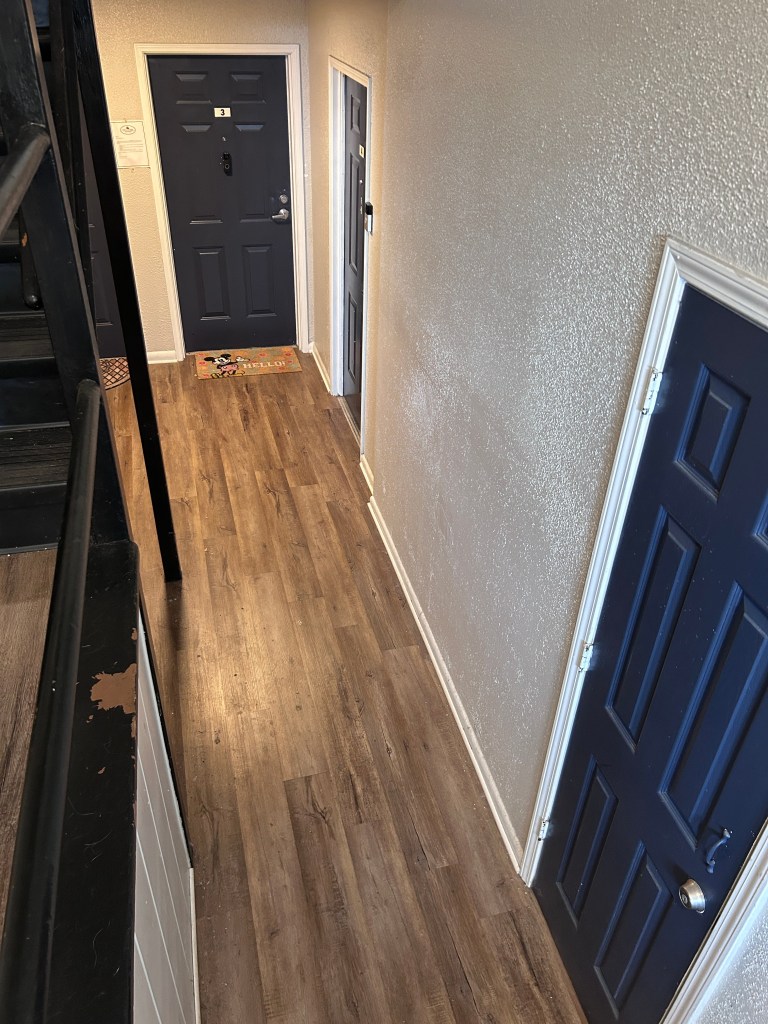
One of the biggest was replacing roofs and gutters on four of the complex’s eight residential buildings. RailField has also painted the building exteriors and shutters, repaved the parking lots, repainted interior hallways, installed new light fixtures and replaced the rubber coating on the stairs. The company also replaced the flooring and appliances in some units.
While many residents expressed gratitude, they also had concerns.
“I remember sitting with the owners,” Hester said. She recalled that they told residents that the buildings had a lot of issues and therefore couldn’t be tackled all at once. But she questions the things they prioritized.
“He is investing a lot of money on things that do not matter to the health of the people. He’s painting shutters outside, from burgundy to blue. Now what does that do for us? It was fine being burgundy. We need to figure out what’s inside the walls, what’s going on.”
“They’re trying to make us look beautiful,” Hester continued, “but on the inside, it’s no good.”
In February 2024, Watkins said that the company had additional projects planned, such as replacing HVAC units and other appliances as necessary. Since then, RailField has spent about $250,000 improving the interior unit finishes and replacing appliances, Watkins told Charlottesville Tomorrow in an email in May 2026.
Those improvements came too late for Hester.


After the various floods that left the floors in her apartment wet for days at a time, Hester had another concern: mold.
Email records she shared with Charlottesville Tomorrow show that she had mentioned it to property management a few times over the years, including when her apartment flooded with what she believed to be sewage in September 2022.
But on Feb. 27, 2023, she sounded the alarm bells in earnest.
That afternoon, Hester sent an urgent email to her property manager with photos of what looked like mold in the kitchen and in the air vents. She also mentioned getting a positive result from a mold test kit she purchased at the hardware store.
The property managers responded immediately, sending a mold remediation company to inspect the unit. About two weeks later, they gave Hester the all clear.
“There is nothing to be concerned about,” the property manager told Hester in an email on March 8, 2023.
The trouble was, the black stuff still looked like mold to Hester. She never quite understood how the company determined it wasn’t — and she never got an explanation from them that made sense to her.
The property manager seemed to think the company tested the apartment for mold. Hester claimed that someone from the company told her that they don’t test for mold, that someone else tests and they treat.
A representative from the company, Paul Davis Restoration, declined to comment on this inspection with Charlottesville Tomorrow.
As Hester continued to press for more mold testing, property management set to work fixing a leak that the remediation company had identified in the ceiling. Hester was terrified, believing the work was disturbing mold spores and spreading them through her unit.
As she pushed for more information, she became increasingly desperate. That’s because her daughter had fallen ill.
In addition to extreme fatigue, Hester’s 18-year-old daughter, Elesia Cooper, suffered from overwhelming nausea. They had been spending nights in the emergency room. Doctors repeatedly told Cooper to go home and hydrate. She would try, but she struggled to keep food or water down, and she’d be back in the hospital a few days later.
Without clarity on the mold situation or Cooper’s condition, Hester was becoming increasingly concerned the two might be related.
“It was so bad, to the point where — I’m trying not to get emotional,” Hester said, her voice cracking and her eyes welling up with tears. “My kid, I knew she was sick. I couldn’t sleep from the sounds and the pain and the aches she would have in the middle of the night. The scariest part was not knowing when my daughter was going to get well.”
Hester’s own health also wasn’t great. She was working two jobs and taking care of Cooper, she said. And some nights, she slept for just a couple of hours. She had headaches and sinus problems, but couldn’t afford treatment for herself and her daughter.
Then, in June 2023, Cooper’s nurse practitioner documented a suspicion that validated Hester’s fears — the source of Cooper’s illness might be mold in the home.
“I urgently recommend your home get tested thoroughly by the below recommended experts given lab results that show immune suppression and symptoms consistent with mold exposure,” the nurse practitioner wrote in the visit summary, which Cooper shared with Charlottesville Tomorrow.
“I strongly suspect that the current mold exposure is contributing to your symptoms. I am medically requiring past home/mold testing given recent lab results and the known negative impact of mold exposure on humans’ immune system. And to be given access to any future mold testing results as this will guide my management.”
The nurse practitioner treating Cooper declined to comment on Cooper’s case because of patient confidentiality laws.

Hester shared the medical provider’s recommendation with property management, but it didn’t move the needle very far. Property management agreed to hire a mold inspector to test her apartment in March 2023, but Hester never saw the report.
She struggled to find out why, and a few months later asked the Legal Aid Justice Aid Center for help. In an email exchange shared with Charlottesville Tomorrow, Joel Loving, a local mold inspector, told LAJC that he had conducted a test and written a report, but he could not release it. His client, Park’s Edge property management, had not paid for it. If they paid him for it, he said he could ask their permission to share the report with LAJC.
That never happened. Instead, LAJC secured $600 from a private donor for Loving to conduct another test and write a report Hester could finally put in front of property management.
In that report, dated Sept. 24, 2023, Loving said he found three types of mold in the kitchen ceiling and in the HVAC vent, the same spots Hester photographed months earlier for property management. He suspected that a leak was causing the mold in the ceiling, and that the mold in the HVAC vent was due to the wrong filter being installed, backward.
For renters to take landlords to court, they need resources and records
By the time Hester sat in the courthouse lobby in 2025, she had made it further than most tenants ever will under the state’s current Residential Landlord and Tenant Act.
The first hurdle most tenants face is getting their case into court at all, said Horrock. She’s a housing attorney with the Legal Aid Justice Center in Charlottesville, and before that, she handled similar cases in New Orleans and New Hampshire.
Some low-income tenants qualify for representation from nonprofit legal aid organizations like LAJC, but those organizations are often resource-strapped and cannot take on every case.
And even when tenants can afford to pay an attorney, few lawyers take on these types of cases, said Horrock.
And that’s just the first hurdle. Even with representation, there are few legal remedies for them in Virginia.
One of the simplest is called the “tenant’s remedy by repair.” This is when a tenant notifies a landlord of a problem, and if the landlord has not fixed it within 14 days, a tenant can pay a licensed third party contractor (or pesticide business, if that’s the problem) to fix it. The thing is, the tenant must pay for the repair out of pocket. The law then requires the landlord to pay it back — up to a certain amount.
This only works in cases where the cost of repairs is relatively low. Under this law, the landlord is responsible for bills up to either $1,500 or the cost of one month’s rent, whichever is greater. If the repair is more expensive than that, the tenant is stuck paying the difference.
“Low-income tenants basically can’t do that. They don’t have the money,” said Horrock. “If they had $1,500 to pay up-front, they probably wouldn’t live in places that have this type of problem.”
A second possible remedy is for a tenant to file a “tenant’s assertion” against their landlord for bad conditions. It’s basically saying that the landlord, who is responsible for maintaining fit and habitable premises, is failing to do so. That worked for one Park’s Edge tenant in March 2022.
But filing a tenant’s assertion is harder than it sounds, said Daniel Rezai, an attorney with the Virginia Poverty Law Center who works with low-income tenants in southwest Virginia.
The main reason is that the tenant must have written proof of everything — of all the conditions issues they’re suing for, plus proof that they’ve communicated these issues to property management — to have a strong case. Most people aren’t keeping track of conditions issues in writing.
“A lot of people call maintenance,” said Horrock. “When your apartment floods, you tend not to send a letter.”
Rezai estimates that a paper trail would make a difference for about 90% of the cases he’s worked on.
“I don’t think I’m exaggerating,” he said. “They never wrote it down, and because they never wrote it down, all of those protections immediately don’t exist. If you didn’t put it on paper, did it happen? In the court, it didn’t.”
Rezai encourages his clients to keep a log of every communication they have with their property management and ownership, especially phone calls, text messages, and any submissions to a property management portal. Email and written letters hold up in court, but other forms of communication don’t always, he said.
If you didn’t put it on paper, did it happen? In the court, it didn’t.
—Daniel Rezai, an attorney with the Virginia Poverty Law Center who works with low-income tenants in southwest Virginia
But even if a tenant has documentation and could feasibly pursue either of the available legal remedies — a tenant’s assertion or remedy by repair — they’re often nervous to do so out of fear of retaliation, the attorneys say.
Legally, landlords are not allowed to retaliate against tenants for any of this, but retaliation is a tricky thing to prove, said Rezai.
“Let’s just say there’s no retaliation, but your lease is coming up to be renewed in three months. Then they send you a notice of non-renewal. Did they retaliate?”
With the odds stacked against them, tenants might feel more confident suing a landlord if they could do it with other tenants in their building or complex who are experiencing similar issues. That way, they might have a stronger case that the entire building has plumbing issues, for instance, the attorneys said. But that’s out of the question, too: You can’t file a class-action lawsuit in Virginia courts.
It’s hard to sue your landlord.
Still, some cases do progress. And, despite the odds, Lanika Hester’s case was one of them.
How one renter was able to sue their landlord in a rare court case
The case Horrock ended up filing for Hester wasn’t a tenant’s assertion at all. Instead, Hester sued Park’s Edge under breach of contract.
“This was a funny one,” Horrock said.
The basis of the suit itself was simple: Park’s Edge and Lanika Hester signed a contract — the lease. Park’s Edge affirmed in that lease that it would maintain the property up to a certain standard. The company breached the contract, the suit alleged, and Hester was damaged by that action.
Normally, this kind of case would be filed as a “warrant in debt,” which moves slowly through the court system.
A “warrant in debt” case is basically a “money owed” case. In order to file one, a tenant must have accrued monetary damages. It often takes months, even years, for those damages to build up, said Horrock, so it’s not an option for tenants when they first begin to have problems with conditions.
But it was an option for Hester, who has years of documented complaints about the conditions in her apartment. When Hester had the chance to file a case, she had everything she needed.
That chance came on Aug. 22, 2024. Park’s Edge sued Hester that day for not paying rent that month and filed an unlawful detainer — the start of the eviction process — against her.
She did miss rent that month, she told Charlottesville Tomorrow, because she was confused about how to pay it. Multiple residents have said that property management has changed the rent payment method at Park’s Edge a few times in recent years.
The court scheduled a hearing for the suit for just a few weeks later, Sept. 12. By then Hester was caught up on rent payments, and the Park’s Edge attorney dropped the eviction suit.
While RailField Realty answered some questions about their property, neither their attorney nor the company responded to multiple inquiries Charlottesville Tomorrow made about Hester’s case.
Unlawful detainer cases move quickly, much faster than warrant in debt cases. And even though Park’s Edge ended up dropping the eviction suit against Hester, Horrock saw an opportunity: She filed Hester’s suit as a counterclaim, asking for about $8,000 in damages.
A few months later, Hester sat on the bench outside the courthouse trying to memorize her statement.
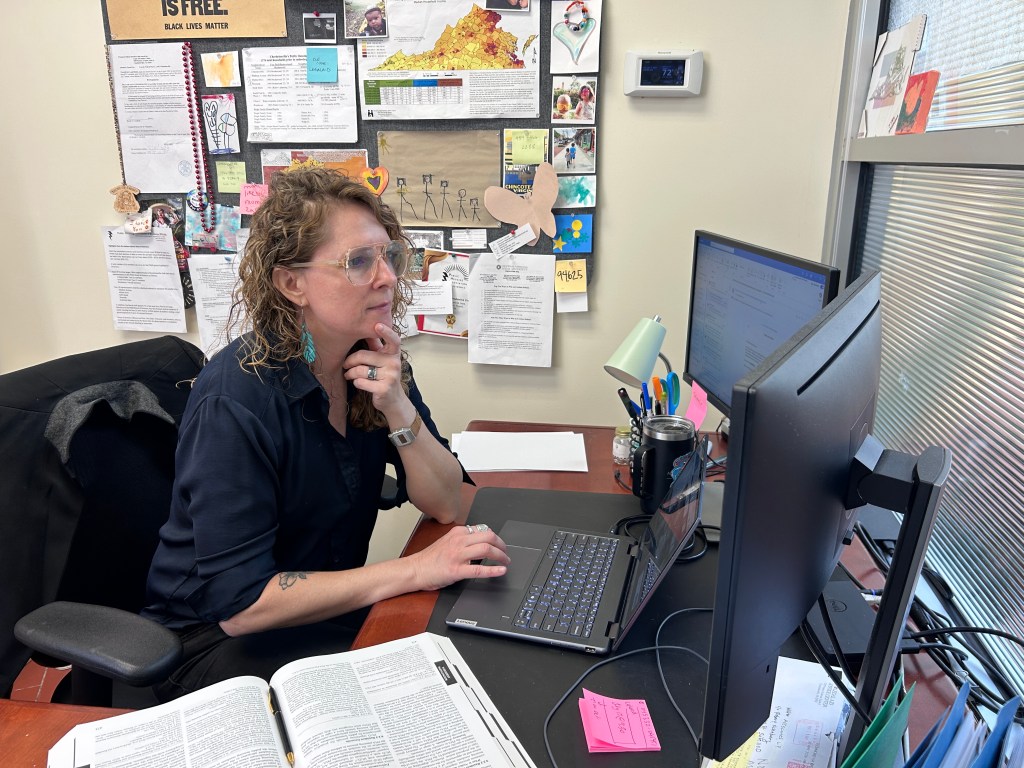
The courtroom was warm, bright, and quiet that afternoon when Horrock made her opening statement. She held a copy of Hester’s most recent lease agreement and read from it.
“The landlord will ‘maintain in good and safe condition, all electrical, plumbing, sanitary, heating, ventilating, air conditioning and other facilities,'” she said, arguing that Park’s Edge had breached that agreement a number of times between 2022 and 2023.
Horrock called Hester as the first witness.
The bundle of papers Horrock carried into the courtroom was evidence. Piles of it. Many months of emails between Hester and Park’s Edge property management about various problems. Photos of black stuff accumulated on the apartment wall, the ceiling and inside the air vents. Copies of bills from the hotels Hester and her daughter stayed in during the sewage flood in Sept. 2022, which happened nine days before RailField bought the property from TRC Parks Edge, and when work was being done on the black-spotted wall in Oct. 2023.
As Horrock went along, each piece of evidence she entered was given a letter of the alphabet.
“I’m running out of letters,” Presiding Judge Matthew J. Quatrara said when Horrock entered a packet of hotel bills as exhibit O.
As Horrock presented each piece of evidence, Hester confirmed them and along the way told bits of her story.
Hester talked about the flood that covered her apartment floor in sewage. She testified that liquid bubbled up from both of the bathtubs in her apartment, from the laundry room and the kitchen sink.
“It smelled horrible and was black and brown in color,” she said, describing how it “chunked up” in the bathtubs. It got into the living room and soaked through the carpet, she said. It seeped into the hallway, where it mingled with the substance that had leaked from her neighbors’ apartments, too.
Property management put two large fans in her apartment for two weeks in an attempt to dry out the floors and the carpet, she said. When the carpet was replaced, Hester noticed the padding between the carpet and the flooring had disintegrated.
She talked about the material items she’d lost during the flood — all the clothes in the laundry closet, as well as some furniture. She was able to save a table with metal legs since she just had to wipe it clean. The same couldn’t be said for her couch, or other items that were soaked. She took multiple trips to the complex’s dumpster and local stores to buy cleaning supplies.
And when the carpet replacement happened, Hester said, she lost even more belongings. Property management required her to move all of her furniture out of her apartment in order for the carpet to be replaced, but she didn’t have anywhere to put it, she said. A friend let her put some things in the bed of their truck, but that wasn’t enough space for everything. With no place to store her bedroom set and to avoid having the repairs delayed, she threw it out.
She didn’t just lose belongings. She lost work and therefore wages. She detailed for the judge how many hours of work she missed when things went wrong in her apartment.
She talked about being afraid to stay in her apartment when she suspected mold was growing there. She talked about staying with her mother, or sleeping on friends’ couches, and about paying for hotel rooms when she worried that she’d overstay her welcome.
She explained how she worried about her health, and her daughter’s. How she bought expensive purifiers to pull what she feared was mold from the air. How she notified property management, over and over.
Cooper’s medical bills weren’t included in the list of things Hester was asking to be reimbursed for. That is an entirely different kind of lawsuit, and the Legal Aid Justice Center does not take on personal injury cases.
As Horrock wrapped up her first round of questions, she asked Hester, “How did this process make you feel?”
It was time for Hester to make her statement. She didn’t get it out word for word, but she gave the gist.
“It was extremely stressful,” Hester said quietly. She started a new job while all of this was going on. “It felt like we didn’t matter. It really took a toll.”
For some renters, moving out is either unaffordable or ‘trading rats for roaches’
Then it was time for cross examination.
Robert Harris, the attorney representing Park’s Edge in Hester’s case, didn’t have many questions but for one big one: If it was so bad, why didn’t you just move out?
“I couldn’t afford it,” Hester said from the witness stand.
But she has help paying rent, in the form of a Housing Choice Voucher from the federal government, the attorney replied. Why didn’t she take her voucher somewhere else?
That is something tenants could do — and for anyone unwilling or unable to go to court, it’s really the only other option. But it’s not always realistic.
To do this, a tenant must send their landlord a notice giving them 21 days to fix a problem. If the landlord doesn’t fix the problem, the tenant can terminate the lease 30 days after sending that notice.
“But then they have to have somewhere else to go, which is a challenge in this rental market,” Horrock told Charlottesville Tomorrow before the trial.
Having a housing choice voucher doesn’t guarantee someone housing, and in some cases, it can make searching for a home in an already tight market even more difficult. When someone receives a voucher, they have 60 days to find a place that fits both the financial parameters of the voucher and meets the federal government’s condition standards. If they can’t find that place, they have to forfeit the voucher and return to the waiting list. Those lists are long, and people are often on them for years.
So, if Hester chose to leave Park’s Edge, she would have 60 days to find a new home, or lose her voucher. On top of that, vouchers don’t cover first and last month’s rent, security deposits or movers.
Hester couldn’t afford to move, she said from the stand.
She’s not alone in this. The seven Park’s Edge residents who spoke with Charlottesville Tomorrow said they also cannot afford to move.
“And then, most of the units you’re going to get into are in a complex that’s just going to have a different set of similar conditions problems, if not the exact same problems,” said Horrock. “Maybe you’re trading rats for roaches, and that might be as good as it gets.”
After Hester’s explanation, Harris, Park’s Edge’s attorney, didn’t press his question about moving. Nor did he argue with much of the evidence Horrock presented during Hester’s testimony.
But that changed when Horrock called her second witness, Joel Loving.
Loving is a mold inspector with Environmental Health Consultants, Inc., a Charlottesville-based company that specializes in indoor air quality testing for contaminants like mold, lead, radon and asbestos. He testified that he has worked in air quality testing since the 1980s, and is regularly hired by agencies all over the state, including school systems.
Getting an expert witness like Loving to testify in a trial is challenging, said Horrock. But without it, tenants can struggle to establish that the conditions they are suing over exist at all.
In order to show there was mold in an apartment, for example, an attorney must admit evidence of it — like a mold inspector’s report. But to do that, the mold inspector must be present at the trial to confirm that he did indeed write that report.
The reason it’s so hard to get expert witnesses, people like mold inspectors, maintenance workers and HVAC specialists, to testify on behalf of tenants is they frequently work for the landlord.
For Hester’s trial, Loving did agree to testify. Why is unclear; Loving did not respond to Charlottesville Tomorrow’s request for comment. But as he sat on the stand, it became clear that the outcome of Hester’s case would revolve around his testimony.
Loving confirmed that he prepared a “molds inspection report” for Hester’s apartment in September 2023.
Loving described his testing process, saying that he uses a high-intensity flashlight to examine every surface. When he sees something suspicious, he collects samples and sends them to Hayes Microbial Consulting, a lab in Midlothian. He then prepares a report based on what the lab finds, explaining what it means and what to do about it.
What did he find in Hester’s apartment? Horrock asked.
“We detected mold,” Loving testified.
Harris quickly objected, asking Loving if that was based on what he saw, or the results from the lab.
Loving said both — based on his experience, he can usually tell. But the test results from Hayes confirmed there was mold.
Harris objected to Loving calling the substance “mold” because no one from Hayes Microbial was present to confirm the origin of the report so it could be entered as evidence.
Horrock assured Judge Quatrara that Loving was “very expert.” She had a copy of Loving’s report from September 2023, as well as the accompanying results from Hayes Microbial.
Quatrara acknowledged Loving’s experience, but still, he sustained Harris’ objection.
“So, ‘suspect mold,'” Harris said.
“Yeah, but I’ll say this: His ‘suspect mold’ carries a lot more weight than the average Joe,” Quatrara said, pointing at Loving.
Loving continued his testimony.
Legal Aid Justice Center hired and paid him for the September 2023 test and report, he said. Park’s Edge hired him twice more after that. Once to re-test Hester’s apartment two months later, in November 2023, and another time for another unit.
Loving testified in court that Park’s Edge had not paid him for the November 2023 report.
With final arguments and a swift judgement, one Park’s Edge resident gets some resolution
Horrock’s final witness was a Park’s Edge property manager working for Franklin Johnston Group. That witness allowed Horrock to enter into evidence multiple work orders the company had recorded for Hester’s apartment.
Then the attorneys made their final arguments.
Harris didn’t object to some of the damages Hester sought payment for, including a few of the hotel stays. He said he was “not sure” about some of the lost wages claims or the necessity of the air filters. There was no evidence that Hester needed the air filters, he said, because Hester had testified that both she and her daughter have breathing problems. If Park’s Edge did end up paying for the air filters, Harris said, then Park’s Edge would own them.
Moreover, Harris said, his client, Railfield Realty, didn’t own the property when the September 2022 flood occurred, and therefore it should not be liable for damage caused by it.
RailField bought the building from TRC Parks Edge on September 21, 2022, nine days after the flood.
But on top of that, he argued, the lease says that Park’s Edge is “not responsible for loss or damage of personal property” due to many things, including floods. That makes his client not liable for property damage, and Hester agreed to that when she willingly signed the lease.
Harris claimed that Hester had a number of legal remedies available to her. Under the Code of Virginia, she could have lawfully terminated her lease. She could have moved out. Because she did neither of those things, she “is not entitled to anything,” Harris said.
“She chose to stay there, live, and pay rent,” Harris said.
“There are lots of protections for tenants in there,” he continued, referring to the Virginia Residential Landlord and Tenant Act section of the Code of Virginia. He specifically cited a newer section of the Code, added in 2023, that states that if at the beginning of a tenancy, a tenant finds the unit they have leased in unacceptable condition, they can terminate the lease and receive all paid deposits back without consequence.
It is unclear whether that law would apply to Hester, for two reasons: She signed her most recent lease in May 2022, before the law took effect, and has lived in the same apartment for more than 16 years.
Horrock began her closing argument simply: Park’s Edge and Lanika Hester had a contract, and Park’s Edge breached it. She pointed out the eight-month delay between when Hester first told property management she was concerned about mold, and when Park’s Edge finally started remediating it.
“Eight months is a long time to wait,” she said.
Horrock cited the part of the Residential Landlord and Tenant Act that outlines the landlord’s responsibility to “maintain in good and safe working order and condition” things like electrical, ventilation and plumbing. Park’s Edge did not do that, she argued. What’s more, Park’s Edge also violated the part of the law that requires the landlord to “maintain the premises in such a condition as to prevent the accumulation of moisture and the growth of mold and promptly respond to any notices from a tenant.”
A landlord cannot waive the law in a lease, she said.
Yes, Hester had a few remedies available to her through the law, but she was unable to seek them because she is a low-income tenant, Horrock added.
This was not only financially damaging to Hester, it was stressful and took an emotional toll, Horrock said, touching back on points Hester made in her statement.
“We are just asking that she be compensated for these things,” Horrock said in conclusion.
Quatrara was silent as he looked over the papers in front of him. After two or three minutes, he announced his decision, quickly rattling off instructions to the attorneys. Park’s Edge would pay Hester $8,193 in damages, plus $2,048.25 in attorney’s fees. The company had 10 days to appeal the decision.
It took a moment for the meaning of the judge’s words to sink in.
Hester won.
Hester and Horrock stood slowly from their seats and hugged. There was no big celebration, no jumping or crying, but Hester smiled quietly as she walked out of the courtroom, Horrock at her side.
Once outside, Hester and Horrock locked eyes and breathed a sigh of relief.
Hester sat in the same spot she’d been in a couple hours earlier and looked at Horrock expectantly, wanting to know what was next.
“Keep looking for a new place,” Horrock told Hester. She’d soon have the money to move.
Horrock explained that Park’s Edge had 10 days to appeal the judge’s decision. If they didn’t appeal, Horrock could start working on getting the money for Hester. She said it would take a few weeks.
“I feel like she was owed what we sued for and more, monetarily,” Horrock told Charlottesville Tomorrow a couple weeks after the trial. “But I also think the trial judge, by granting her exactly what we sued for, was confirming that she was right, that what her landlord had done was actually wrong.”
The fact that Hester had accrued money damages that she could articulate to the judge, and prove with documentation, helped her case tremendously, Horrock said.
“A really cruel part of the legal system is that when you’re poor, you don’t have money to spend on things, and then you don’t incur charges,” Horrock said. “Like, if you go and sleep on a friend’s couch, you’re not out any money. And that’s the main kind of damages that, in a contract case like this one, the court is going to award.”
Additionally, Hester’s issues at Park’s Edge occurred over many months, which is part of how she was able to incur the damages she sued over and won.
That’s why tenants who have not incurred money damages and are looking for their landlord to fix a problem — even if it’s for a major problem — are stuck with just three legal remedies: tenant’s right to repair, tenant’s assertion and terminating the lease.
But what if there was a way to prevent many of these conditions problems from happening in the first place? In the next report in this series, one process could force a landlord to act on conditions issues — that is, if lawmakers and local officials want it to.

Floods, roaches, rats, mold — these are just a few of the issues in Charlottesville Tomorrow’s investigation into how Virginia law often fails to protect vulnerable renters.

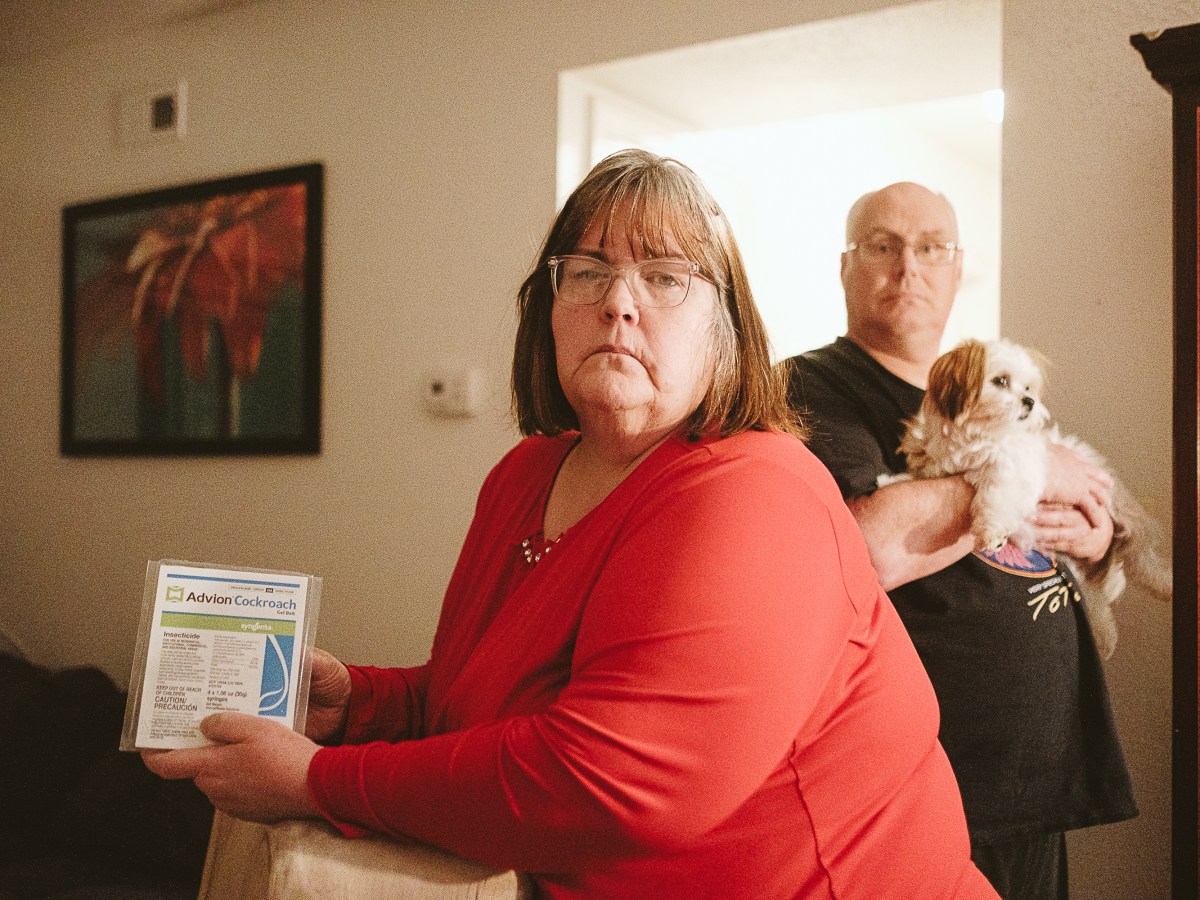


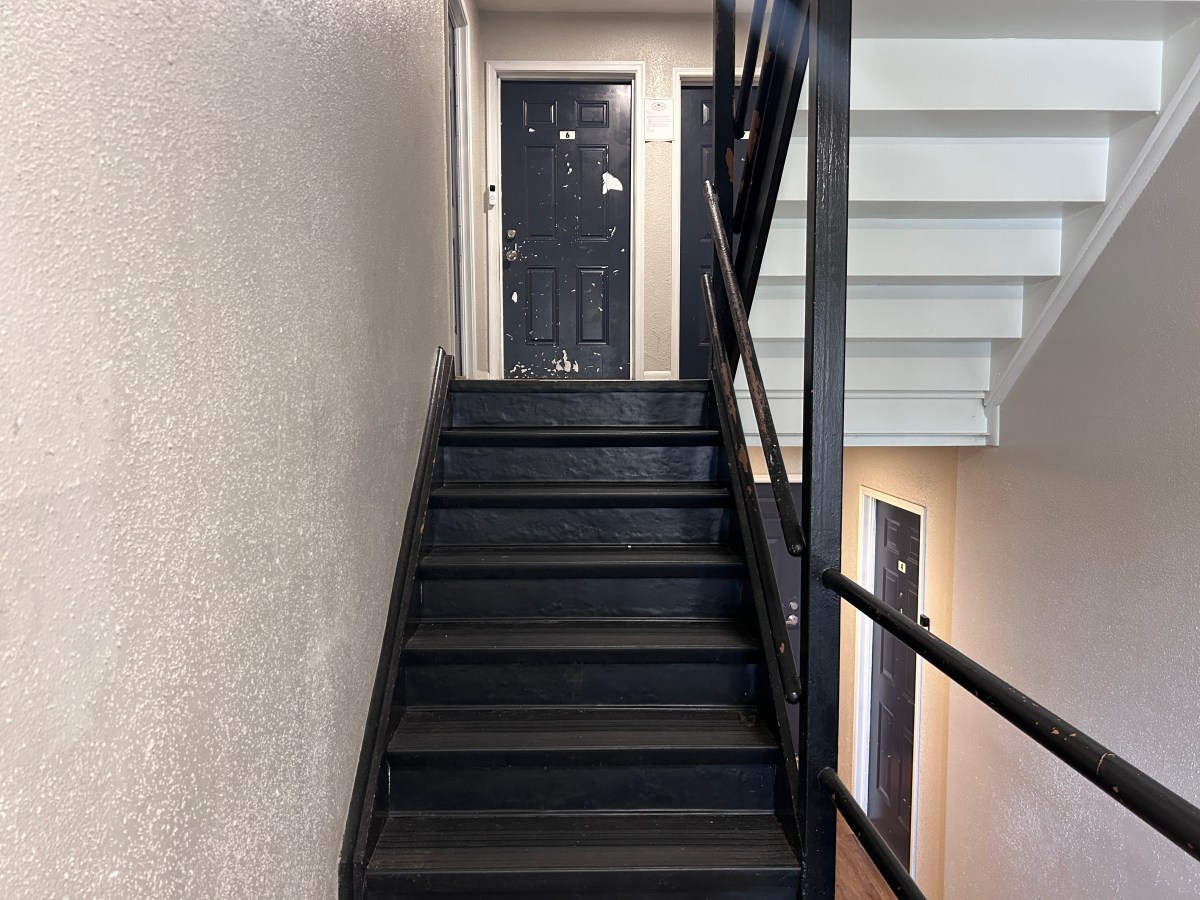
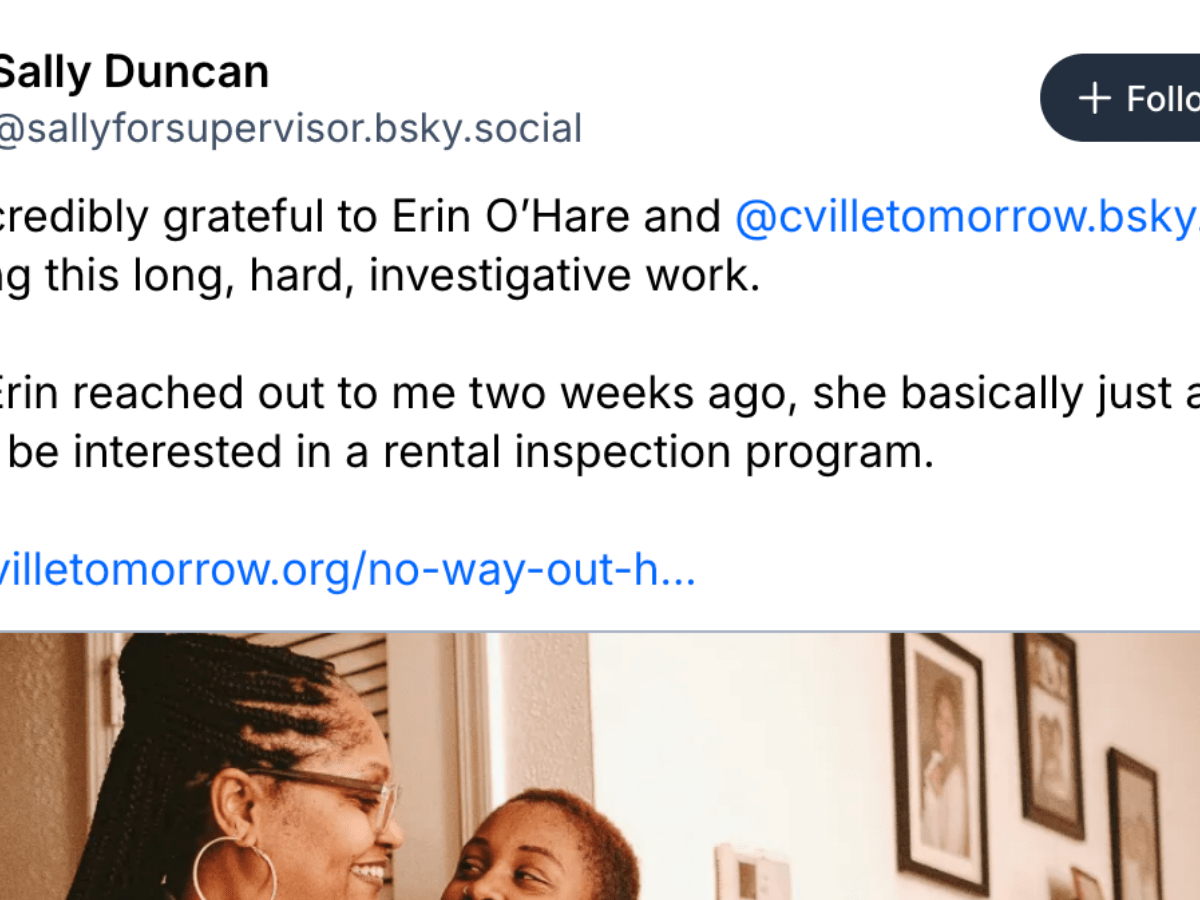
This series, reported over years of following tenants’ stories, is about what happens when renters in Virginia try to improve the conditions of their homes. It took reviewing images and records, hundreds of emails between residents of Park’s Edge, their landlords and advocates, court records and legislative efforts.
It was reported by Erin O’Hare with editing by Jessie Higgins, photography by Ézé Amos and O’Hare, with images and documents provided by residents of Park’s Edge, editing and design by Angilee Shah and Ashley Harper.
Follow the series over the week of June 1, 2026 by subscribing to Charlottesville Tomorrow’s free Beyond the Headlines newsletter.
Erin’s reporting is a testament to what can happen when journalists listen to their community, paving the way for change when other systems fail.
Investigative journalism is essential to a healthy democracy — it informs citizens, holds institutions accountable and catalyzes action. If you believe these stories deserve to be told, consider donating. Together, we can ensure that more voices are heard and that the stories that matter most do not go untold.
This article appears in No Way Out.