
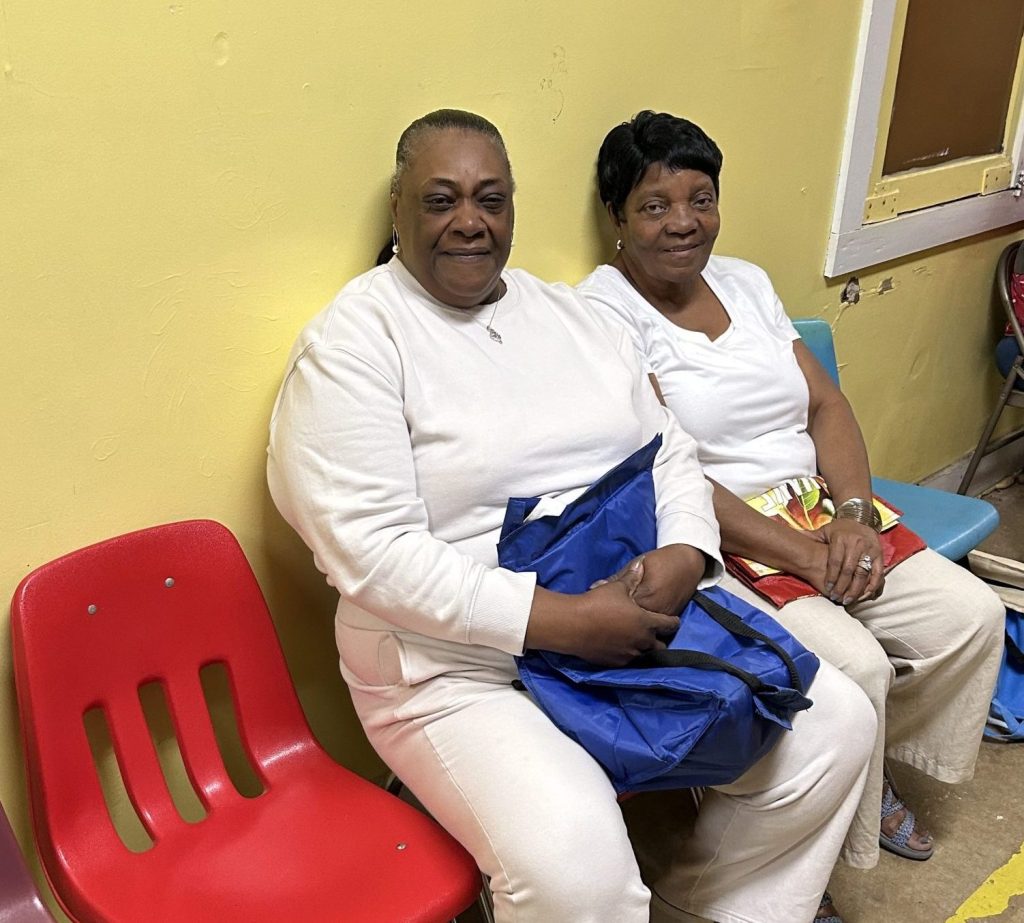
Kim Jefferson, who rents a modest house in Lake Monticello, drives to the Community Food Pantry in Palmyra several times a year for groceries. On a Tuesday morning in late August, she sat quietly in a hallway outside the pantry, waiting for her name to be called.
Four or five other pantry patrons waited nearby, either chatting among themselves or listening to Jefferson explain why she and others were at the pantry.
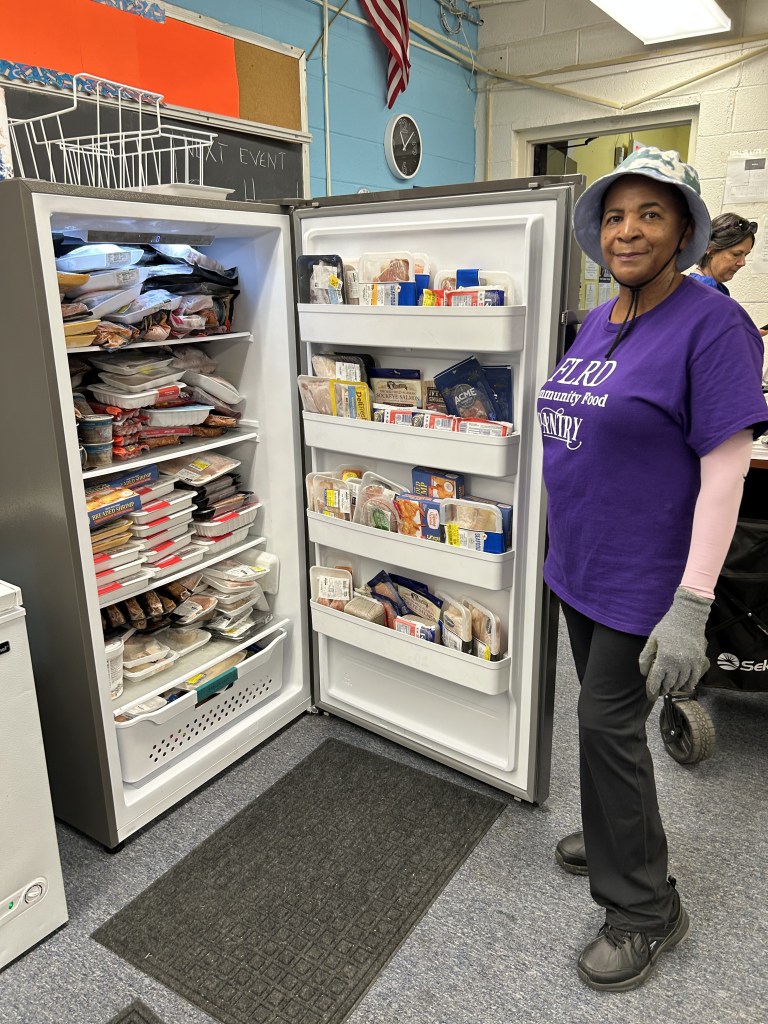
Inside the pantry, which is about the size of an average school classroom, shelves and tables were stocked with fresh produce, canned goods and staples arranged for patrons to choose what they needed. Two freezers near the front of the pantry were stuffed with frozen meats and seafood.
For many in the community, it’s not only a haven, but a lifeline.
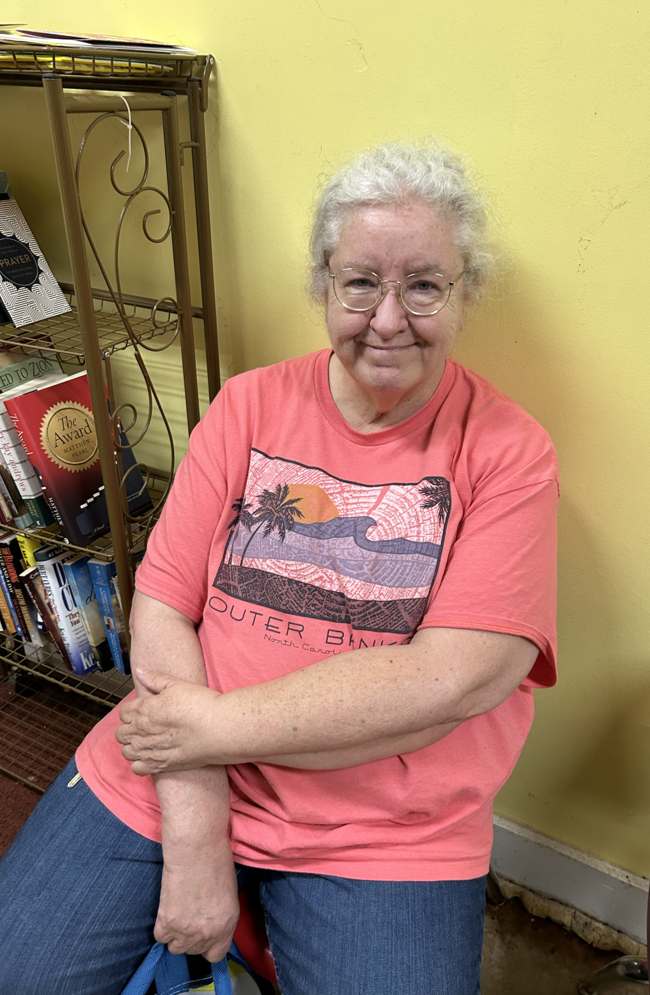
“It’s either come here or not eat,” Jefferson said. “I come every few months, but I use everything they give me, and then I come back.”
Jefferson, 65, prides herself on stretching whatever she receives from the food pantry, operated by the Fluvanna Leaders for Race & Diversity (FLRD). The local nonprofit was established on June 18, 2020 in Fluvanna County to bring racial diversity to the county, according to its website.
“We care about our county and our citizens, and we want to make Fluvanna a great place to live and work for all people,” the site states.
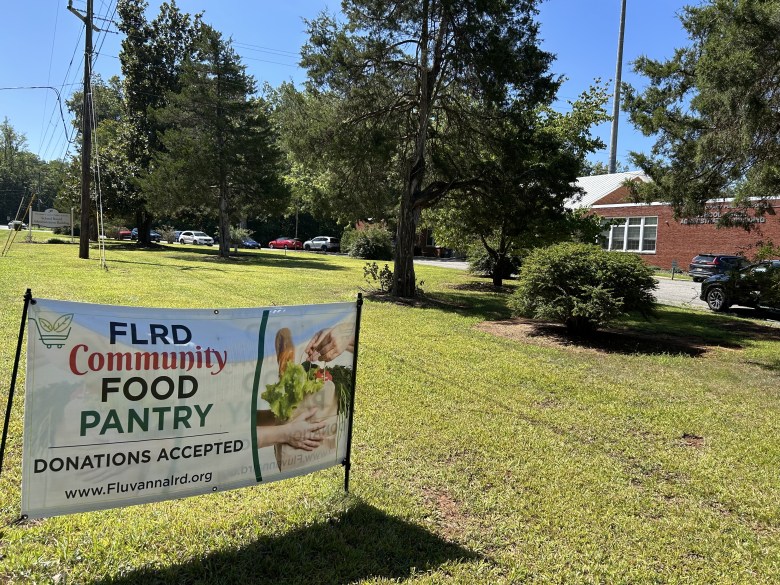
FLRD expanded its mission two years ago by opening the food pantry — the first in Fork Union — before moving to an annexed building behind the Fluvanna County Public Schools administration headquarters on James Madison Highway in Palmyra.
The building is a 15-minute drive from Lake Monticello, where Jefferson has lived for 12 years. And even though she doesn’t come often, she makes good use of the grocery items she selects.
“I can make all kinds of meals,” Jefferson said. “If they’ve got beans, I can make chili. I like a lot of green beans. I like canned stuff. You can eat that with instant mashed potatoes. I do that a lot.”
Jefferson is among a growing number of older residents who rely on the pantry to ease the gap between their limited incomes and the rising cost of food and housing.
A March 2024 article in JAMA Health Forum, a peer-reviewed journal about health, medicine and healthcare published by the American Medical Association, cites a study that found food insecurity increased among U.S. families with older adults over the course of 20 years.
Take action
Here’s where you can find resources for food assistance near you
The Fluvanna Leaders for Race & Diversity (FLRD) Community Food Pantry is currently located in the annex of the Fluvanna County School Board office at 14455 James Madison Hwy in Palmyra. The pantry serves residents in Fluvanna, Goochland, Cumberland, Buckingham and Louisa counties as well as the City of Charlottesville. It is open on Tuesdays and Thursdays from 10 a.m. to 2 p.m.
You can also use the “Food Map of the Valley” to find community food resources — from local farms to food pantries — close to you. The Blue Ridge Area Food Bank also maintains a searchable map of pantries in its service area. You can also dial 211 to find more food banks and pantries or chat or email Virginia 211 for assistance.
“This cohort study found that food insecurity among U.S. families with older adults increased substantially over 2 decades — from 1 in 8 families (12.5%) in 1999 to 2003 to 1 in 4 families (23.1%) in 2015 to 2019,” according to the article. “Rates of recurring food insecurity more than doubled (5.6% to 12.6%), whereas rates of chronic food insecurity more than tripled (2.0% to 6.3%).”
The article further states that food insecurity adversely affects virtually every “health domain” for older adults. Those domains are recognized by medical professionals as physical, emotional, environmental, social, intellectual, financial and spiritual.
A new study about hunger in Virginia revealed that over half of its families with children are experiencing food insecurity. The study also found that the state’s Supplemental Nutrition Assistance Program (SNAP) participation has declined by more than 110,000 people in Virginia after the program experienced $200 billion in federal funding cuts last year.
The nonprofit No Kid Hungry Virginia partnered with the Federation of Virginia Food Banks and the Virginia Department of Social Services to measure food insecurity using the U.S. Department of Agriculture’s (USDA) standard 18-item Household Food Security Survey Module, according to No Kid Hungry Virginia’s website.
More than 5,600 Virginia households were surveyed to “understand the prevalence, drivers and health impacts of food insecurity on households.”
Sarah Steely, director of No Kid Hungry Virginia, said the survey findings are “alarming and heartbreaking” brought on by Congress passing “the largest and most damaging cuts to SNAP in the program’s history.”
The 2025 reconciliation bill for the federal budget, also known as H.R. 1 and dubbed the “one big beautiful bill” by President Donald Trump, was enacted in July 2025. It made many sweeping budgetary changes, including over $1 trillion in funding cuts to health and food assistance across Medicaid, Affordable Care Act marketplaces and SNAP. Recent news reports from WAVY in Hampton Roads indicate that, beginning Oct. 1, Virginia’s SNAP funds will be reduced by $94 million each year.
The cuts have forced people to skip meals or make trade-offs to pay for housing, healthcare and transportation costs, Steely added. “These cuts, plus high grocery prices and other budget pressures, mean that parents living on low incomes are having to make tough decisions about which basic needs to prioritize and which expenses must be delayed or sacrificed.”
Efforts to fill the gap are underway. The Virginia Hunger Survey states that the Virginia 2026 state budget includes $135 million in new state SNAP funding to cover some of the costs the federal government is “no longer providing to the commonwealth.” When asked whether those funds are included in Virginia’s passed budget or if the amendment is still pending, Cletisha Lovelace, director of Public Affairs for the Virginia Department of Social Services responded in an email: “Virginia’s enacted budget includes $135 million in reserve for a potential SNAP benefit cost share.”
Jefferson said a series of health challenges, the result of a concussion 10 years ago, drew her to the food pantry. Dizziness and imbalance from the head injury forced her to stop working as a licensed practical nurse in local hospitals and nursing homes.
“They say a lot of older people come here,” she said. “I took care of myself until I couldn’t. So some days I’m OK, and other days I’m just shaking and just dizzy and you know, just off my balance. I’ve fallen a lot, but I always pick a soft space to land.”
Jefferson received disability benefits for eight years, and currently lives on $2,200 a month in Social Security benefits, which covers her $750 rent in addition to utilities, gasoline for her car and other expenses, she said.
She is grateful that her landlord has not raised her rent over the past few years.
“If they hadn’t, I don’t know what I would have done.”
Organizers behind food pantry also helped with COVID relief at height of pandemic
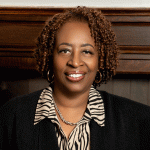
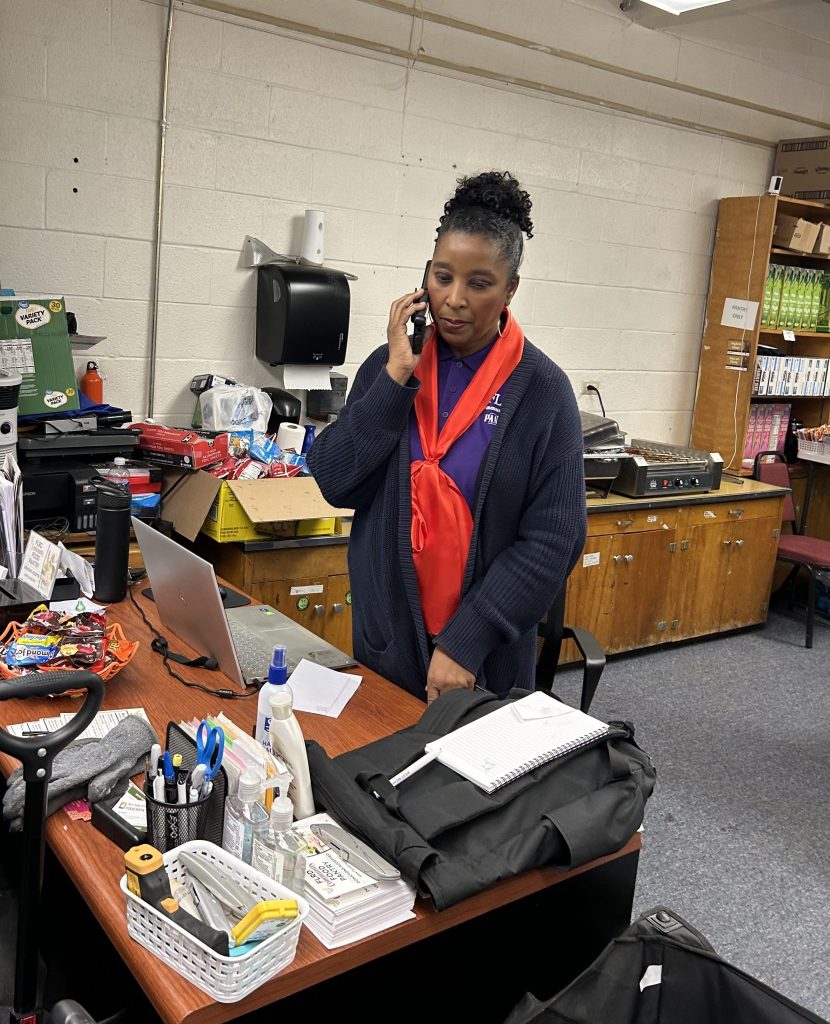
Loretta Johnson-Morgan, the food pantry’s director, officially opened the nonprofit two years ago.
She said the organization grew out of concerns raised by younger Fluvanna residents following the 2020 death of George Floyd, who was killed by a police officer in Minneapolis. Johnson-Morgan said she is not a founder of the group, but she became involved as the group’s adviser and board member.
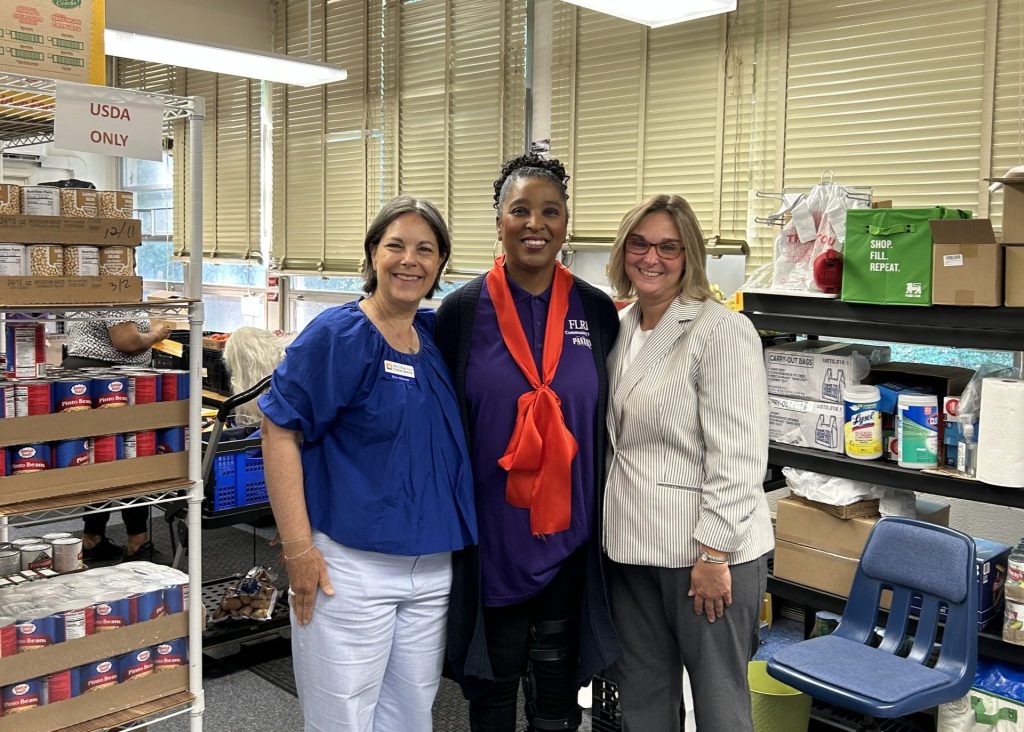
“Once I became an adviser, I ended up becoming a member of the board, and I pretty much came up with everything to do after that,” including the organization’s name, she told Charlottesville Tomorrow.
“Their major concern was the unfair treatment of African Americans,” in Fluvanna County, said Johnson-Morgan. “That’s how they started out — they wanted to create a group to try to bring some awareness to everybody, and that we’re not just one race. We’re multiple races.”
She said the group organized a rally and march following Floyd’s killing, but deliberately sought a broader focus than a single racial group.
“We just wanted to get out and help everybody,” Johnson-Morgan recalls. For example, the organization also was concerned about small businesses and minorities being left out of COVID-era assistance. Some small businesses lacked the paperwork or knowledge needed to apply for grants, so the group sought ways to help “small businesses and minorities and keep us going as a community,” said Johnson-Morgan, 61, a retired UVA software engineer.
She also became concerned that minority residents in Fluvanna were having difficulty accessing COVID vaccinations. She contacted the Blue Ridge Area Food Bank (BRAFB) and other organizations and helped organize a vaccination drive with Charlottesville’s Sentara Martha Jefferson Hospital. That effort resulted in more than 500 people being vaccinated, she said.
BRAFB provided food “care packages” for people receiving vaccinations. That relationship eventually led the food bank to approach FLRD about opening another food pantry in Fluvanna.
“That’s how I connected with Blue Ridge and the health department, and from there, Blue Ridge reached out to our organization about the possibility of running a food pantry,” Johnson-Morgan explained.
The existing pantry run by the Monticello Area Community Action Agency (MACAA), was still operating, but Johnson said there was a need for another option because of staffing and volunteer shortages during the pandemic.
Johnson-Morgan describes the FLRD pantry as a “choice pantry,” which means it allows people to select what they need rather than receiving a predetermined box of goods.
FLRD’s pantry is also USDA-affiliated and, according to Johnson-Morgan, was the first USDA pantry in the county. The USDA administers a federal program called the Emergency Food Assistance Program, which is meant to provide food at no cost to people with lower incomes. Nonprofits can distribute USDA foods through the program.
Another significant distinction is eligibility. Johnson-Morgan deliberately chose the USDA model because it allowed her to serve people regardless of where they live.
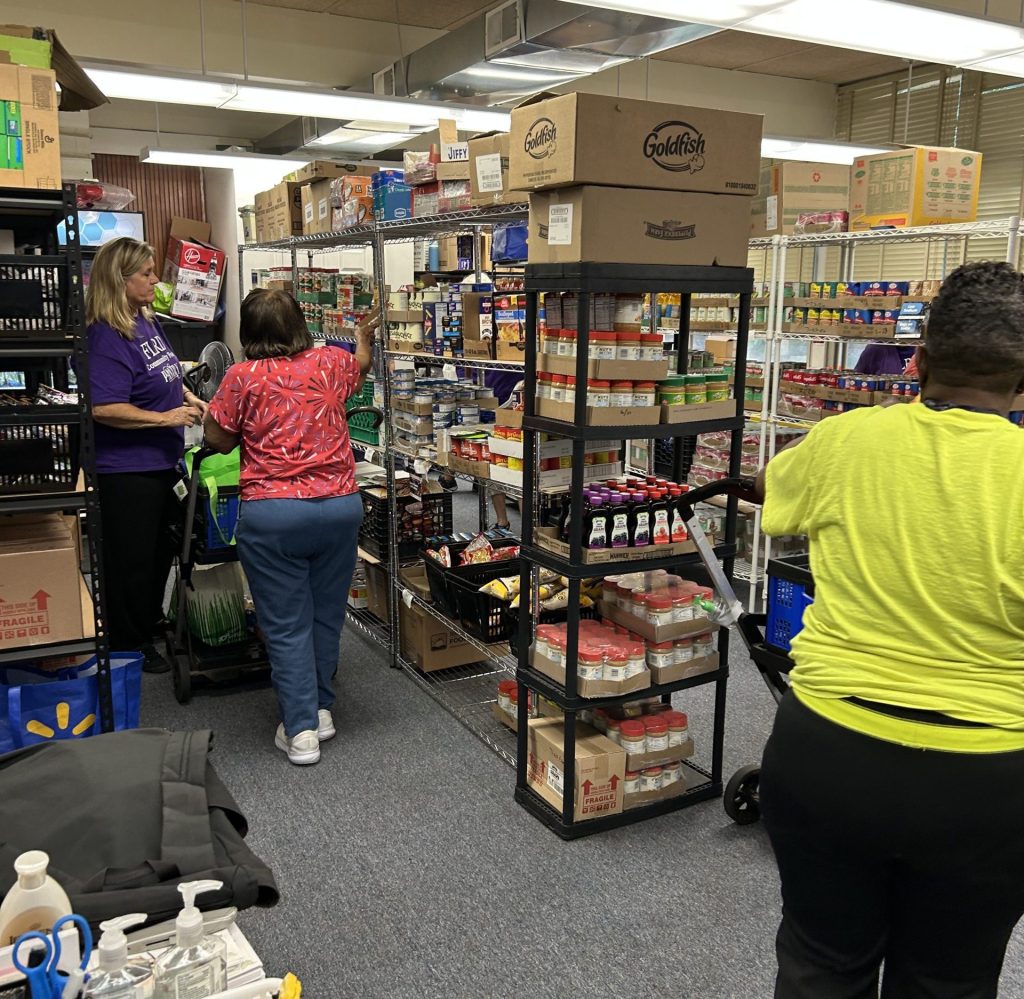
“That’s why we chose the USDA because we can serve anybody” in surrounding localities such as Goochland, Cumberland, Buckingham and Louisa counties as well as the City of Charlottesville, said Johnson-Morgan.
“I would say we’re between 75 and 80 people, sometimes more,”she said, referring to the number of people coming through the pantry each week. But the households they represent can be much larger, she added. “These are families. These are people that have four, six and eight people in their families.”
The pantry is open Tuesdays and Thursdays from 10 a.m. to 2 p.m. Johnson-Morgan explained that 39 individuals may visit on one day and said that, counting the family members, the food from the pantry could help about 150 people.
‘You can’t have a strong local economy without a healthy workforce’
Jennifer Schmack, Fluvanna’s director of economic development and tourism, attended a ribbon-cutting ceremony at the pantry shortly before Jefferson and other patrons arrived to shop that late August morning.
Johnson-Morgan and Schmack applaud each other for helping the pantry get established.
“Loretta was the impetus,” Schmack said. “She is being very gracious when she says I was. It’s all her. She’s amazing. A lot of this comes from word-of-mouth and just hearing what’s going on in our community. Then you find that powerhouse who can really grab it by the horns and just do it. That’s Loretta. She knows everybody. She’s from here.”
Schmack helped connect Johnson-Morgan with the owner of the Fork Union property. The pantry operated there for a year until the building went on the market. By then, the pantry had outgrown the space in part because it was attracting people from surrounding communities.
Fluvanna County officials then searched for a larger building that was accessible for people with disabilities, and easier for residents to reach given the area’s lack of public transportation.
“When this space near the schools became available, I thought it was much better than where she was,” said Schmack. “It’s right off the main road, but it also offers a bit of privacy, which matters when you’re dealing with food insecurity and the stigma that can come with needing help.”
Fluvanna’s population is approximately 28,000 people with a poverty rate around 7%, said Schmack. That figure aligns with U.S. Census data.
“On paper, that (7%) sounds relatively low, but it’s still significant,” said Schmack. “A lot of that 7% is our aging population. We do have families in need as well, but they can often connect through the schools. I worry more about our older residents, especially because we’re rural and don’t have public transportation. That makes it harder to reach them.”
Schmack added that in the absence of buses or other public transit, Johnson-Morgan and her team of volunteers have also made efforts to reach out to their at-risk neighbors. “Loretta visits our senior centers — we have several throughout the county — and she’s very outward-facing in the community. She’s truly an asset. She’s our gem.”
While a food pantry may not seem like a traditional part of economic development, Schmack, who serves on the Virginia Career Works Piedmont board, sees a direct connection between economic development, tourism and food insecurity.
They “all go hand in glove,” said Schmack. “You can’t have a strong local economy without a healthy workforce, and food security is part of that.
“Food security is one of their (Virginia Career Works) priorities, too,” she continued. “Their executive director, Sarah Morton, has done a lot around food security throughout the region — partnering with farmers, making sure seniors can get healthy foods. I know Loretta has worked with them as well.”
Along with providing food, volunteers offer tips for patrons
Helen Johnson, a volunteer at the Fluvanna food pantry, believes that healthy eating and staying active is essential at any age.
“I’ve loved to walk all my life,” she said, noting that walking is part of her daily routine, which includes multiple trips in and out of the food pantry to help patrons load groceries into their vehicles on days the pantry is open.
As Johnson, a former home economics teacher, spoke with Charlottesville Tomorrow about good nutrition and tips for interacting with healthcare providers, pantry patrons seated nearby listened closely to her words. Their ages ranged from 64 to 78.
“People will help you, but you have to be an advocate for your own health if you want to be happy,” Johnson said. “Because you don’t go to the doctor every day, you need to pay attention to your own body.”
She encourages seniors to use tools such as online medical portals to monitor their personal health information, doctors’ appointments, test results and more.
“Now that we have MyChart (an online patient portal for the University of Virginia Health System) and those kinds of systems, I use them,” she said. “I want to know my numbers. I want to know my balance.”
Johnson is just as intentional about what goes on her plate.
“I do raw beets, bananas, blueberries, pomegranates, kiwis — that’s my big thing,” she said. “Some of that you can’t get here at the pantry; you have to go to the grocery store, and pomegranates are expensive. But you do what you can. I know that if anything happens to me, I tried to take care of myself.”
She wishes more people would eat fresh produce.
“People get scared of salads and things like that, but there are ways to make them taste good,” Johnson said. “Guava is good for you — it’s hydrating, like cucumber. They’re delicious. I love cucumbers and I buy one every Friday if we’re not going to Richmond.”
Her simplest piece of advice is also her most practical:
“When you get up in the morning, drink water first before you do anything else,” she said. “Drink that. It flushes you out.”
Johnson hopes that one day the pantry will be able to offer more formal nutrition education.
“I don’t really do nutrition counseling here,” she said, “but I think that’s something Loretta is working toward. She’s trying to get a grant so the pantry can expand, and maybe that can be part of it.”
Loretta Johnson-Morgan said that a larger facility can help serve more people and possibly include a clothes closet to provide free clothing to residents in need. She’s also excited that an Amazon distribution center is under construction not far from her home and the current FLRD food pantry.
“I can buy bulk items there for the food pantry, but I want to see if they have bulk items or overstock items that they can actually donate,” she said.