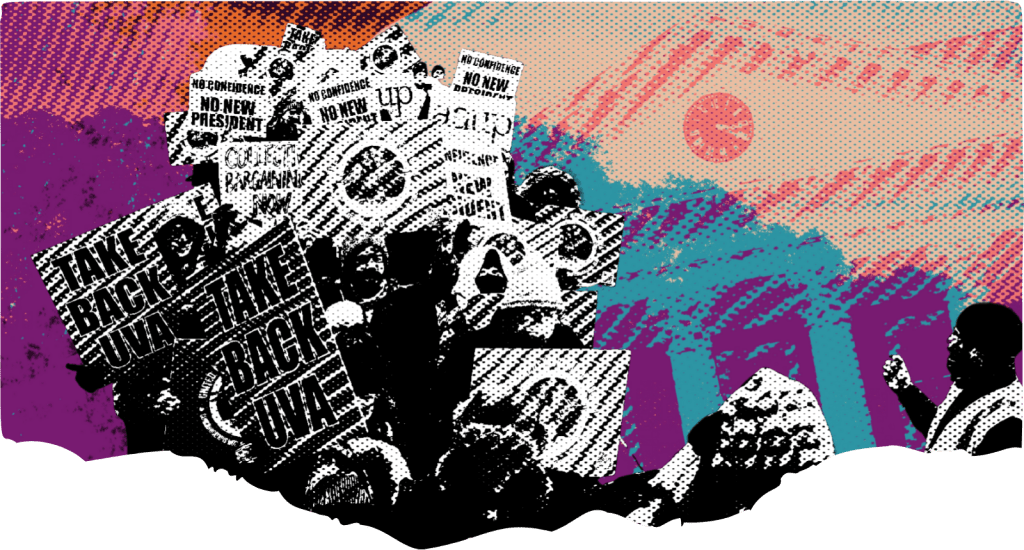


University of Virginia faculty and staff told Charlottesville Tomorrow that a growing wave of outside scrutiny, from online harassment to sweeping demands for their course materials, has left them feeling exposed and increasingly unsafe, with little protection or responsiveness from the university.
Some had hoped a long-awaited collective bargaining bill could help secure stronger protections against harassment as outside groups increasingly monitor activity on college campuses. Instead, the legislation, if enacted into law, would exclude most public university workers, leaving some UVA employees unsure how to navigate the escalating scrutiny with limited institutional support.
UVA professor A.D. Carson, who has written about race and inclusion, was added to Turning Point USA’s “Professor Watchlist” in 2024. The list claims to “expose and document college professors who discriminate against conservative students and advance leftist propaganda in the classroom,” placing faculty in categories like “LGBTQ,” “Antifa” and “Socialism.” Turning Point USA describes itself as a “conservative grassroots activist network” focused on high school, college and university campuses.
Educators on the list have said they have been targets of harassment, intimidation and violent threats, according to reports from Capital B, NBC News and The Grio. The list disproportionately targets academics of color and those who belong to other historically marginalized groups, The Guardian reported.
Carson told Capital B that he has become numb to threats and intimidation, but his students have not. Carson recalled one of his students making sure the door to his classroom was locked after Charlie Kirk, the founder of Turning Point USA, was assassinated on a college campus in Utah in September 2025.
UVA spokesperson Bethanie Glover told Charlottesville Tomorrow in en email that “faculty or staff members who believe they have been harassed or discriminated against should contact the University’s Office for Equal Opportunity and Civil Rights,” adding that “resources are also available to our employees on preventing and addressing discrimination and harassment.” She linked to a UVA website that lists resources for “Preventing and Addressing Discrimination, Harassment and Retaliation” using the acronym PADHR.
The Jefferson Council, an organization formed by conservative UVA alumni in 2020, has also targeted diversity, equity and inclusion initiatives at the university and those who support them.
The group runs a website called “DEI at UVA,” which it says exposes “under the radar” DEI practices at the university. A “See DEI at UVA” tab features screenshots of university webpages and recordings of UVA employees that the group claims show DEI efforts continuing despite the UVA Board of Visitor’s March 2025 resolution to dissolve the programming (PDF). A “Submit A Report” link asks visitors if they “know where DEI is still hiding at UVA” and encourages them to file a complaint.
The Jefferson Council has also published posts on social media criticizing individual members of UVA’s faculty and staff and has used public records requests under Virginia Freedom of Information Act (FOIA) to obtain the syllabi and communications of specific faculty and staff at the university. The Cavalier Daily reports that some faculty describe the requests as a form of “curriculum policing” and harassment. Virginia’s Freedom of Information Act allows the public to request records from state and local government entities, including public universities.
Between January 1, 2025 and December 17, 2025, of the 978 requests UVA’s FOIA office received, 19 were seeking more than 200 syllabi, according to information Charlottesville Tomorrow obtained through its own records request. They included a request from Walter Smith, the chair of The Jefferson Council’s research committee, who asked for the syllabus of a UVA professor because that professor spoke at a March 26, 2025 walkout at Columbia University. The walkout was a response to the Immigration and Customs Enforcement detention of pro-Palestinian activist Mahmoud Khalil. The requests did not seek to review all coursework at UVA holistically, but focused on specific professors and topics related to people of color, LGBTQ subjects, gender studies and other specific subjects.
Sixteen of the requests for syllabi came from Stu Smith, a conservative social media poster and self-described “citizen journalist.” The Jefferson Council posted on its website that in May 2024, Smith was part of a virtual conversation series “to discuss the condition of free speech on university campuses across the US, why it’s important to capture and distribute multiple sides of each story, and what this looks like in practice at UVA specifically.” In a personal blog post on Dec. 26, 2025, The Jefferson Council co-founder James Bacon called Smith a “comrade in arms.”
Associate sociology professor Ian Mullins told Charlottesville Tomorrow that, while his syllabus was the subject of a FOIA request from The Jefferson Council, it was a subsequent request for “anything related to UVA” in his personal text messages that felt targeted and especially invasive.
“I wasn’t worried that they were going to find something incriminating on me,” he said. “I viewed it as an act of intimidation.”
“While having a small regional organization that criticizes us online might not seem like much, it’s part of something bigger that’s happening where faculty protections are being eroded,” Mullins added. “There’s no accountability, no protections, no due process. The protections of higher education are being eroded little by little, attack by attack, and it’s something that’s going to affect us all.”
Mullins pointed to Virginia State University, where the university fired five faculty members, four of whom had tenure. The fired faculty, some of whom had worked at the university for over a decade, were terminated without written explanation for their dismissals, according to Inside Higher Ed.
Associate UVA politics professor Kevin Duong told Charlottesville Tomorrow that he also received FOIA requests for his teaching materials and was the target of posts on the social media site X by affiliates of The Jefferson Council.
In October 2024, for example, The Jefferson Council shared a video of an Oct. 6 Faculty for Justice in Palestine meeting, and later removed the video because it violated the privacy policy of YouTube. Since then, other accounts anonymously cited the video and repeated the names and titles of UVA professors who attended, though Faculty for Justice in Palestine chapters are independent of the universities where they are based.
In a Jan. 7, 2025 post, anonymous X user @CvilleBubble shared screenshots of the video and criticized multiple faculty members by name, including Duong, for attending the meeting. The post referred to the meeting as “faculty agitation.” A separate June 1, 2025 post advocated for Faculty for Justice in Palestine to be classified as a terror organization, adding, “Enough is enough. It is time to call evil for what it is.”
Duong said that being called out this way for speaking on his political views is intimidation and harassment. And it has increasingly become a point of concern in his job, especially considering the prevalence of gun violence on American campuses.
“I teach a giant lecture class of 180 students, and there’s an emergency padded button right next to me that auto locks and shuts every door,” Duong said. “So when The Jefferson Council is putting our names, our departments, pictures of our faces, our salaries, all on Twitter. What are we supposed to do?” (Twitter was acquired by X Corp. in 2023.)
Joel Gardner, a class of 1970 UVA alumni and the president of The Jefferson Council, told Charlottesville Tomorrow that he’s “very supportive of faculty” and doesn’t consider The Jefferson Council’s actions as harassment or curriculum policing, but rather part of an effort to “inform the university community of what is actually going on at UVA.” The group doesn’t distort the truth or take things out of context, he said.
But Mullins disagreed. He told Charlottesville Tomorrow that The Jefferson Council published a blog post that included a list of unverified incidents of antisemitism at UVA following the Oct. 7, 2023 attacks by Hamas-led militants in Israel. The Jefferson Council’s blog post included fabricated claims that Mullins showed his students a video of Hamas attacking Israel and praised Hamas in class.
I teach a giant lecture class of 180 students, and there’s an emergency padded button right next to me that auto locks and shuts every door. So when The Jefferson Council is putting our names, our departments, pictures of our faces, our salaries, all on Twitter. What are we supposed to do?
—Associate UVA politics professor Kevin Duong
The Jefferson Council’s unverified list of antisemitic incidents was compiled by anonymous UVA parents and did not include evidence of the allegations, but directly named student organizations, faculty and even a student, as reported by The Daily Progress (subscription required).
Mullins said that The Jefferson Council posted a correction of the allegations after his students attested to the fact that none of it was true. A Jewish student and her family, who Mullins said was upset about The Jefferson Council “weaponizing antisemitism,” also reached out to the group directly.
In the correction posted to their website on April 18, 2024, The Jefferson Council co-founder James Bacon acknowledged the mistake but added that the organization “disclaims any responsibility for the error.”
But at that point, Mullins said, the harm had already been done. Not only had The Jefferson Council already sent the list to the rector and president of the university at the time in an attempt to get Mullins fired, but the list had already started to circulate around right-leaning media.
“So that’s a type of targeted harassment which got a lot of publicity,” Mullins said. “And I wasn’t the only one included on that list. It wasn’t the only fabricated claim. There were a number of professors included.”
“What I’ve come to realize about this type of harassment is that it’s not really intended at giving information,” Mullins said. “Really what they’re doing is they’re letting people know they’re watching and they’re trying to get them to self-censor. They want us to do the job in accordance with their distorted idea of what higher education should be.”
A member of UVA’s staff, who asked to remain unnamed out of concerns of potential retaliation from The Jefferson Council, told Charlottesville Tomorrow that staff also “face harassment from outside groups like The Jefferson Council.”
While faculty are “the main targets as their research and teaching is more public,” the source added, staff members, such as student advisors and librarians, also publish and teach. “For example, many staff teach in the first-year Engagements program and many of those instructors have received FOIA requests for their syllabi,” the source said.
“In my experience, staff who have been harassed are more often, though not always, harassed for First Amendment-protected activity outside of their work, such as personal activism or statements on social media,” they said. “However, their employment at UVA is public and so the harassment can bleed into their work.”
UVA spokesperson Glover said the university is committed to protecting faculty members’ academic freedom in both research and teaching, as well as upholding freedom of expression. While faculty might face “public scrutiny and criticism of their teaching and research,” she added, the Provost’s office has created an online resource hub “for faculty members” to help those who feel targeted (accessed by Charlottesville Tomorrow on May 8, 2026), including guidance for department chairs and deans on how to support them. While some of these resources also apply to staff, Glover did not respond to follow-up questions about staff support in time for publication.
Gardner of The Jefferson Council told Charlottesville Tomorrow in an almost hour-long interview that, while he rejects the term “course policing,” there are “many courses being taught, particularly in the College of Arts and Sciences” that he described as “ridiculous” or “not serious” and that shouldn’t be taught at a public university like UVA.
He pointed to specific courses that he said were “politicized” and difficult to understand, including an “Ecofeminist Poetry & Poetics” course and a course titled “Queer Judaism,” which he said was insulting to him as a Jewish man.
“When you read the course description, it’s basically, you can’t understand even what they’re talking about,” Gardner told Charlottesville Tomorrow. “There are many, many courses that only exist to further political and social agendas, which we think is inappropriate. They aim at a particular point of view, which is a progressive or a social justice agenda point of view.”
Such scrutiny isn’t limited to UVA. The University of Texas Board of Regents has imposed limits on the teaching of “unnecessary controversial subjects,” reported in the Texas Tribune, and the University of North Carolina system now requires all syllabi to be shared online in a public database, according to WUNC.
Mullins, however, told Charlottesville Tomorrow that targeting certain courses or professors because they don’t align with The Jefferson Council’s political views is not only hypocritical, but harmful to principles of academic freedom, the idea that faculty should be able to freely teach, research and express ideas without fear of censorship or retaliation.
“When we look at the syllabi that they put online and the criticisms they wage, those criticisms are dumb. They have no idea what a poetry class is, or what it takes to teach poetry at an MFA level,” Mullins added. “They don’t understand the idea of having different disciplined critical perspectives, and how that opens you up to new forms of thought. They just see something they don’t like, and they say this shouldn’t be funded by tax dollars, but they don’t understand it.”
“They have a political agenda, and it’s not about improving higher education. They are there to stoke outrage,” he said. “They want to infantilize students, and they say they’re against indoctrination, but what they want is a very limited list of courses and ideas that students can be exposed to. That’s indoctrination.”
Duong, the UVA politics professor, told Charlottesville Tomorrow that he and other faculty and staff members met with lawyers at UVA to discuss their concerns about harassment from groups outside the university and potential legal options to defend themselves. However, he said, the meeting left him with the impression that there was nothing the university could do “until something happened.”
“We discovered that the university counsel’s job is not, in fact, to defend us, but to limit the university’s liability,” he said. “Part of the reason I want tenured faculty to care about unionization is, the university is not going to protect us. Basically they’re asking us to be sitting ducks until something bad happens.”
Through collective bargaining, a union could negotiate protections for UVA faculty and staff facing harassment, Duong said. This could include, for example, the continuation of pay and benefits for professors who have to temporarily go on leave for their own safety, he added.
Those who spend additional time and labor addressing doxing, threats or exhaustive public records requests as part of their employment at UVA could also receive some form of compensation or support to account for the additional work.
“These are direct things that only a union can bargain for, that would provide us some kind of safety net if something bad like this happens,” Duong said. “That’s the kind of thing that universities just never think about, but that a union would be in a position to ask for.”
Mullins agreed.
“It is really dangerous to live in a world where truth is whatever people in power want it to be, and I’m terrified of that world coming into existence for us,” Mullins said. “This collective bargaining fight is about more than fair wages and a better work environment. It’s about academic freedom and our ability to install protections that can outlast these assaults.”
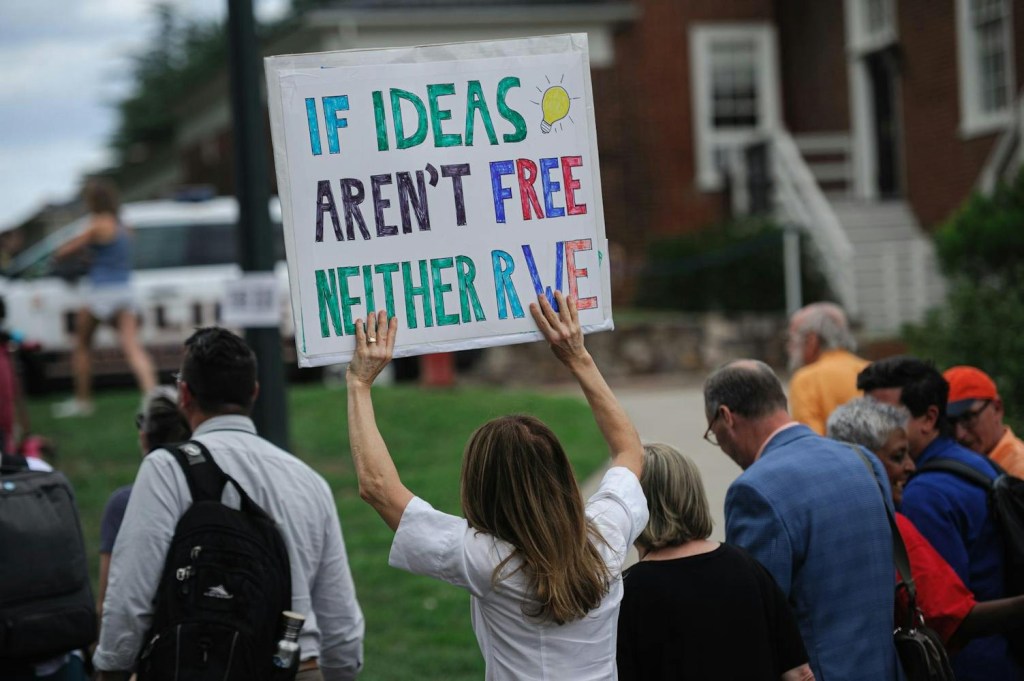
Another UVA faculty member, who asked to remain unnamed because she is concerned about potential retaliation by The Jefferson Council, told Charlottesville Tomorrow that she personally experienced gun violence on a campus setting in the past. The incident, the details of which Charlottesville Tomorrow reviewed and corroborated in multiple news reports, resulted in the deaths of multiple colleagues. She fears that having any classroom information advertised publicly on a social media post that is meant to stoke outrage could make every faculty member, staff and student a target for real-world harm.
Take action
Have more to say about coursework and safety at UVA?
There are many ways you can reach the Charlottesville Tomorrow newsroom. Use our contact forms — these messages go to a real person and we do our best to respond to every message. You can also reach our newsroom on Signal at (434) 218-3649 or @cvilletomorrow.05. Signal is a chat and voice app for your smartphone that has end-to-end encryption and is run by a nonprofit organization.
Researchers have increasingly documented connections between online ecosystems and real-world violence.There are several cases in which universities have become targets of threats and harassment campaigns amid right-wing ideological attacks. In 2025, for instance, multiple historically Black colleges and universities, including Virginia State University and Hampton University, received racist threats and were forced to go into lockdown following the murder of Charlie Kirk, according to USA Today.
Widespread doxing as a political tool to punish academics is not new, but is particularly virulent right now, Yale Law School Professor and free speech expert Keith Whittington told Inside Higher Ed.
“Universities feel like they’re under intense pressure to mollify right-wing activists and try not to draw negative attention from the [Trump] administration,” he said.
According to the Inside Higher Ed report, most college and university employees targeted for doxing are first identified in social media, such as Facebook or X, and then anonymous accounts share more about who they are, where they work and call for their firing.
These risks are what the UVA faculty member who asked to remain anonymous is concerned about. She attempted to work with UVA’s threat assessment office in the past to receive support for a potential safety concern, but she didn’t feel anything came of it. She also sent an email requesting a meeting with university counsel, she said, but received no response.
Meanwhile, she said, the constant feeling of outside scrutiny and hours spent gathering materials to fulfill records requests and responding to queries is exhausting.
“I know the effect of what happens when this stuff spreads,” she said. “I’m not willing to jockey with my life or my first-year students’ lives.”
“I am just the tip of an academic iceberg. I am just one instance. Right now, people are scared of teaching.”
Colleen Murphy of our partner publication OpenCampus contributed editing support to this report. Andra Landi and Jessie Higgins contributed research to this report.