

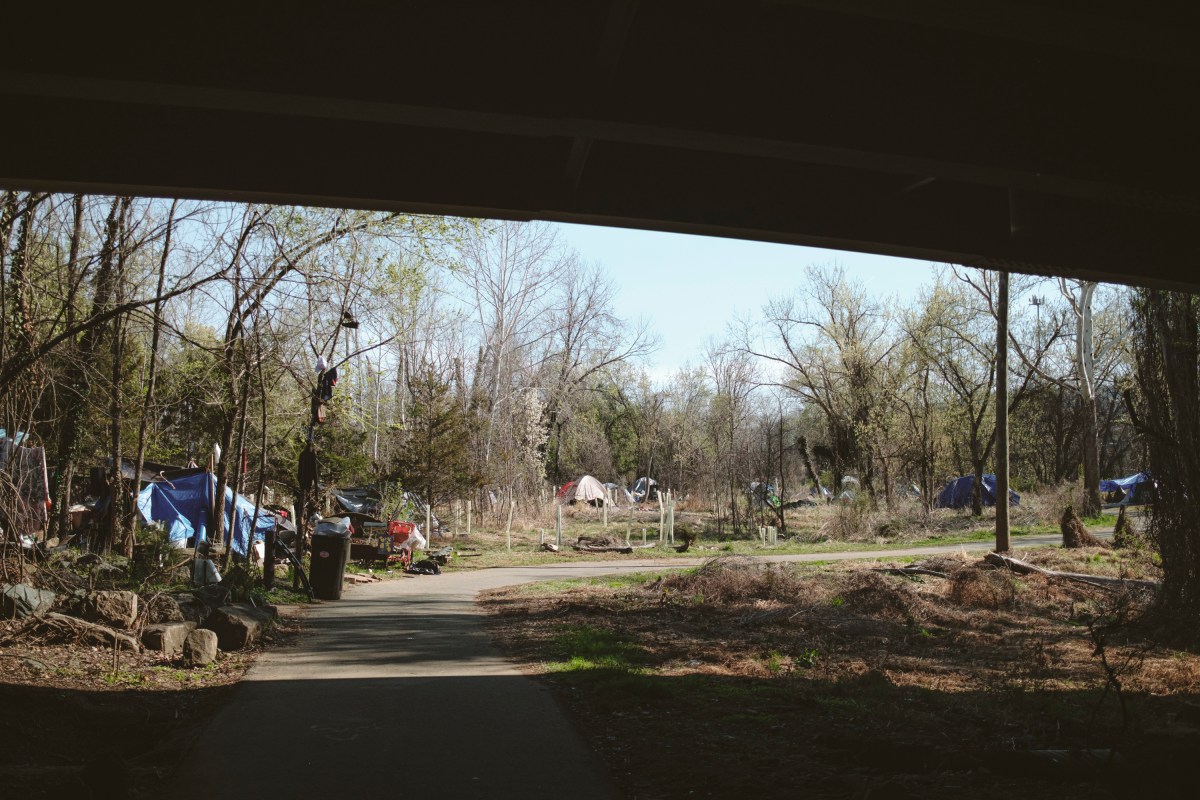
The morning of July 17, the City of Charlottesville announced that it would clear a tent community along the Rivanna River, near Free Bridge on Pantops, on Sept. 1, forcing out the dozens of people who have been living along the public trail, some of them for over a year.
City officials have claimed that it’s in the interest of encampment residents’ safety. The tent community, located along a public trail, is in a flood zone. In recent months, its residents have reported at least two fires, one death and two sexual assaults. In July, multiple people posted videos to social media in which they harassed and ridiculed encampment residents.
During the July 27 City Council meeting, some community members applauded the city’s initiative, saying they feel unsafe using the public trail as long as the encampment is there.
One man has sued the city over it, claiming that the city is selectively enforcing trespassing laws at the encampment.
But other community members, including encampment residents, say that the city’s decision is politically motivated and that its plan — or lack thereof — has already further harmed the people living there.
Josh Epstein, who has lived in Charlottesville most of his life, called the city’s plan “ridiculous” and asked officials to “act with some humanity and compassion.”
“We’re not getting heard,” encampment resident Jennifer Grant told city officials during the Aug. 3 City Council meeting. She said that some people have already barricaded themselves in their tents, not knowing where they’ll go on Sept. 1. “We’re not getting answers to our questions.”
Two weeks before the city plans to carry out the clearing, there is no public detailed plan or indoor shelter space for folks leaving the encampment to go.
On Aug. 3, City Council voted to pay up to $4 million for some outside agencies to help the city come up with one. But as of Aug. 14, no contracts had been signed.
How this unfolds can have a long-lasting impact. Done incorrectly, experts say, the city risks further harming unhoused community members and damaging their willingness to engage with city programs in the future. If the city doesn’t follow best practices leading up to and during the clearing, the city could effectively undermine its own investment of millions of taxpayer dollars in homelessness intervention.
Since City Manager Sam Sanders announced his “homeless intervention strategy” in October 2023, the city has invested more than $15 million of taxpayer money in a variety of projects aimed at solving homelessness in Charlottesville, things that have been sorely needed for years, local service providers have said. Those projects include purchasing property for possible shelters and transitional housing, contributing money to nonprofit permanent supportive housing programs, adding staff to local nonprofit service providers, and creating new positions in City Hall for street outreach.
“There’s no one project that’s finally going to get it,” Vice Mayor Natalie Oschrin said on Aug. 3. “But all of these projects combine to make a system that works, a system that hadn’t been developed or invested in in years past, and we are trying to be fiscally responsible while making up for that lack of investment over the years.”
City’s plan still unclear as deadline approaches
The most fleshed-out component of the city’s plan so far is to turn the building at 2000 Holiday Drive into an emergency low-barrier shelter.
The city bought the 2000 Holiday Drive building in fall 2025 for $6.2 million, intending to turn it into a permanent low-barrier overnight shelter complete with services like case management, counseling and, if possible, a clinic. Over the past year, local services providers who have existing relationships with unhoused community members have worked alongside city officials, architects and engineers to develop a renovation and operating plan for that shelter.

That’s still the intention, said Sanders. But before then, crucial safety modifications will be made to the building so that it can be used as an emergency shelter for at least 12 months, starting as soon as possible. He added that building renovations needed for the permanent shelter could continue while it is being used as an emergency shelter.
Central Arizona Shelter Services (CASS) will run that emergency shelter. CASS is a nonprofit that has run a handful of shelters, as well as homeless prevention and rehousing programs, in the Phoenix area since 1984. This will be the organization’s first shelter outside of Arizona.
As of Aug. 17, the city had not signed a contract with CASS for its services, which are estimated to cost up to $3 million over the 12-month period. The agency will determine ground rules and policies for the shelter, city officials said during the Aug. 3 Council meeting, and since there’s no contract yet, many of the details that encampment residents want to know about the shelter have not been sorted out.
Flooding presents safety risk, but any transition must be done carefully, expert says
City officials have said that they intend for the emergency shelter to be open by Sept. 1, but they can’t promise that it will be. Even if it’s not, the city will clear the encampment, Sanders told Charlottesville Tomorrow in an interview July 24.
“The floodway has to be cleared,” Sanders said. “It’s just not safe, and the time of year that we’re headed into is when flash flooding actually becomes more of a concern, so we just cannot allow camping to occur there.”
Once the deadline passes, camping will be prohibited and anyone remaining in the area, which is public property, will be arrested, according to new signage nearby.
During recent City Council meetings, multiple community members have accused city officials of using encampment residents’ safety as an excuse to clear the encampment, when the real reason is political pressure from housed community members who say they feel unsafe using the trail because unhoused community members are there.
People experiencing homelessness are often perceived to be dangerous, when that’s not necessarily the case, according to the national experts cited in an October 2023 ABC News report.
In fact, people experiencing homelessness are more likely to be victims of a crime than members of the general population, according to Violence and Victims, a peer-reviewed journal that covers, among other things, research and policy on interpersonal violence and victimization. It is estimated that 14% to 21% of people experiencing homelessness have been a victim of a violent crime, compared to 2% of the general population. Research has also shown that some groups of homelessness individuals, such as women, are at an even greater risk of experiencing violence.

But the floodplain is concerning, Mary Frances Kenion, Chief Equity Officer of the National Alliance to End Homelessness, told Charlottesville Tomorrow. The NAEH is a nonprofit dedicated to preventing and ending homelessness across the country by using research and data to identify solutions to homelessness. The organization also advocates for improved policies at both the local and federal levels. Kenion has nearly two decades of experience in the field.
“You always have to worry about a floodplain,” she said.
“Part of the issue with folks being unsheltered outdoors is those very real impacts of climate change and weather patterns,” Kenion said, mentioning the severe thunderstorms that have hit the area recently. “I can’t overstate that enough. There are so many other factors that go into why the only path forward is to bring people inside.”
But bringing people inside must be done carefully, she said. Unhoused community members should be treated with dignity and respect, and their personal property must be protected.
“The very best practice when it comes to clearing an encampment is, first step, engaging with the residents of the encampment to understand what their needs are and what their preferences are,” Kenion said. Most people experiencing homelessness are not in that situation by choice, and would much rather be in a home, she said.
“Folks have the ability to direct their own lives and can tell you exactly what they need, why they can’t get it, and what barriers you can support in helping them remove [those barriers] so that they can get on that path,” Kenion added.
City officials and staff started visiting the encampment and talking to residents about the clearing in late July — after announcing the Sept. 1 date.
City Councilor Jen Fleisher, who has worked in public health for the Blue Ridge Health District, and a few city staff spent hours at the encampment every day for a week, conducting needs assessments of folks living there, Fleisher told Charlottesville Tomorrow.
As of July 31, they had surveyed 38 people, Fleisher said from the dais.
That’s around half of the 70 or so folks estimated to be at the encampment. There had been more, but some decamped to other locations after hearing about the planned clearing, Shayla Washington, executive director of the Blue Ridge Area Coalition for the Homeless (BRACH), a local nonprofit agency that coordinates efforts between Charlottesville-area homeless service providers, told Charlottesville Tomorrow on July 27.
Not everyone at the encampment wanted to fill out a needs assessment. By the time city officials arrived to conduct them, encampment residents’ trust in the city was already eroding.
Encampment residents worried about increased policing of the area
The Charlottesville Police Department installed two cameras at the site and, after a reported rape on July 27, increased police patrols of the area.
The cameras were installed because both individuals staying in the encampment and people using it for recreation, expressed concerns about safety in the area, Kyle Ervin, the city’s Public Safety Information Officer, told Charlottesville Tomorrow in an email on Aug. 17. The cameras continuously record video only. They do not record audio and are not outfitted with facial recognition or biometric data-collecting technology.

“The cameras serve as an additional public safety tool to help document incidents if they occur, support emergency response efforts, assist with post-incident investigations, and enhance situational awareness during the transition,” Ervin added. “Their placement is based on operational and public safety needs and is not intended to monitor any specific individual or group.”
Some encampment residents, however, say the cameras make them feel surveilled rather than safe.
“They say these cameras are for safety,” encampment resident Joshua Ballou told the Council on Aug. 3. “If they’re for safety, I wonder why there are only two. There are several access points that are not on that camera whatsoever. People can walk onto that trail and mess with people that are not protected by those cameras in any way, shape or form.”
“I’m just getting tired of, every time the city says something to me, it gets proven wrong, or it gets proven that it’s a lie, or they say stuff before they even check if they can do it or not,” Ballou added.
The cameras do more than record. The evening of Sunday, Aug. 16, Charlottesville Tomorrow was standing near one of the cameras during a visit to the encampment when a female voice was broadcast loudly from the camera tower.
“This site is video monitored and the authorities have been dispatched. Please leave the premises,” it said.
Community members familiar with the system said that it’s unclear what triggers the voice. Sometimes no one is standing near it when it goes off, they said. It startles people during the day and wakes them up at night.
Unhoused community members say they need more information, city says situation is evolving quickly
Grant, the encampment resident who spoke up during the Aug. 3 City Council meeting, accused city officials of not listening to the people they claim to be helping.
“I have spoke and spoke about the concerns that we all have down there,” Grant said at the meeting. She has spoken about conditions at the encampment, and what residents need, at multiple recent Council meetings, including some before the city decided to clear the encampment. “We’re not saying that we will not give the shelter a try, but we want answers to our questions.”
The city is expecting people to go to a shelter that isn’t yet operational, which they know nothing about, run by a group of people they don’t know or trust, and who don’t know Charlottesville, Grant said.
Grant insisted city officials and the outside groups get to know people at the encampment and ask what they need in a shelter, before moving forward with the Sept. 1 clearing.
“There is no reason why you cannot put us somewhere we are comfortable with,” Grant said.
Displacing people can also lead to more distrust. People living together in encampments can often become surrogate family, or chosen family, Kenion said.
“There’s safety in numbers. People can look after one another. They can share resources,” she added. “Oftentimes, displacement really severs those bonds. It undermines trust” in whoever is carrying out the displacement. In this case, it’s the city.
That worries local service providers, who themselves have spent years building trust in their day shelter (The Haven) and seasonal shelter (PACEM) services and case management, said Washington.
In their own planning for the permanent shelter at Holiday Drive, they’ve emphasized the importance of involving unhoused community members in the process in order to create a shelter that would actually work for them and that they would want to go to.
Throughout the Aug. 3 meeting, Sanders and Assistant City Manager Sam Roman talked about their vision for the emergency shelter. It will be on the first floor of the building, with a men’s side and a women’s side, and the city hopes CASS will work out a way to accommodate couples as well as people with pets. There will be actual beds, no bunk beds or cots, and people will not be packed in like sardines.
Communicating the information to people staying in the encampment had been difficult, Sanders said, because of how quickly the conversation about the shelter was moving and changing.
“Details are coming together rapidly,” he said. “There is no intention of us trying to hold back and keep people in the dark.”
As of the Aug. 17 City Council meeting, not much had progressed in the way of planning, though Roman said that the city had done a few more needs assessments.
Grant and another encampment resident, Donnas Chambers, said that in the past couple of weeks, they and others hadn’t had any updates from city staff about shelter progress, and they still don’t have answers to their questions regarding safety at the shelter.
They worry that people who already don’t get along at the encampment, and who can have space from one another outside, will be in close quarters in the shelter. That could create problems, they said. They worry that, in a shelter without individual, locked rooms, women staying there will be vulnerable to sex offenders also staying there. They worry that staff won’t be equipped to deal with folks’ mental health problems.
“Think about what I’m saying, please,” Grant pleaded, close to tears.
The encampment clearing date is just two weeks away, and none of the city’s plans have been finalized and therefore not fully communicated to the people staying at the encampment.
“If there’s opportunity to push that back for some better planning and intentional planning alongside the residents of the encampment, I would 100% recommend it,” Kenion said.
Not enough shelter space and transitional housing exists today
Making sure that people have a place to go, indoors, is another best practice, Kenion said.
Another crucial component of planning for encampment clearing is making sure everyone cleared from the encampment has a safe place to go, but that’s easier said than done, Kenion said.
“We already know that there is not a single place in the entire United States that has enough emergency shelter, permanent housing or transitional housing,” Kenion said.
Currently, the city has just one overnight emergency shelter, The Salvation Army, and not only does it not have room for everyone at the encampment, not everyone at the encampment would be eligible to stay there. The Salvation Army shelter requires guests to be clean and sober, and people convicted of violent crimes like sex offenses are also unable to stay there, because there are families on site.
The community also needs more transitional housing, Sanders said, calling it “an additional gap in our continuum of care.” The city recently received $7 million from the state to add transitional housing capacity and to increase life skills training services in order to help local individuals and families who are experiencing homelessness. It cannot be used for the emergency shelter the city intends to open in the coming weeks. Sanders said during the Council meeting that he hopes to use $4 million of it to create more transitional housing in the city, perhaps on the property the city owns at the corner of Avon Street and Levy Avenue.
The remaining $3 million of that state money will go to The Salvation Army for its shelter expansion.
But those projects are years away from completion.
There is also not enough permanent supportive housing for everyone who needs it, Washington told Charlottesville Tomorrow earlier this year. Vista 29, an 80-unit permanent supportive housing community currently under construction, will help when it comes online late this year, but it still might not be enough.
If adequate shelter for encampment residents doesn’t exist, Kenion suggests using hotels as a temporary, non-congregate housing pathway. Offering temporary accommodations via hotel can serve as a bridge to getting people into permanent housing or transitional housing, if they choose.
“That’s really the safest and most effective strategy to use after the residents of the encampment have been engaged,” Kenion said.
Encampment residents, however, have repeatedly said the city, which is leading the effort, is not engaging them like city officials’ reports claim. Roman told the Council that the city has safety crews that warn people at the encampment of impending bad weather.
That didn’t sit well with Chambers.
“They said there’s been services coming down there, checking on us, making sure we’re good, letting us know the weather, stuff like that,” Chambers said during the Aug. 17 Council meeting. “Unless I’m blind, or these people are invisible, we haven’t seen nobody down there.”
City planning to spend up to $4 million on out-of-state agencies to add capacity
As city officials have publicly discussed options over the past few weeks, multiple community members have suggested that instead of paying outside groups to run an emergency shelter, the city could use that $4 million to house people.
“The salary that you guys will pay these people to come in and work at this shelter, and they don’t know anything about the residents of Charlottesville, they don’t know anything about Charlottesville period, that is absolutely incredible, when it could go to housing,” encampment resident Grant told the Council.
“Moving encampments or clearing them is very expensive,” Kenion said, citing a variety of studies, including one from the Urban Institute about how homeless encampment sweeps drain local budgets. “Those are resources that could be better used to simply rehouse them or invest in systems that may not currently have capacity to be able to support them.”
Hiring external agencies was necessary, City Manager Sanders told Charlottesville Tomorrow in an email on Aug. 12.
“The needed capacity did not exist locally for the emergency shelter operation desired by the City,” Sanders wrote.
With the self-imposed Sept. 1 deadline approaching quickly, the city is currently focused on getting a contract in place with CASS for the emergency shelter, Sanders said. The city also hopes to work with an organization that can provide direct-to-housing services and has reserved $1 million of that $4 million for that purpose. So far, the city has been in touch with Clutch Consulting and Community Solutions, two additional outside groups.
Clutch is a Texas-based national consulting firm that in 2013 helped overhaul Houston’s homelessness response system, resulting in a 60% drop in homelessness. Community Solutions is a national nonprofit organization that works to visibly reduce homelessness by preventing people from losing their housing in the first place and quickly moving people experiencing homelessness into housing.
Consultants can play a role in solutions, said Kenion, who has worked as a consultant. But they’re often hindered by the resources available in the communities they come into.
“If you’re bringing in a consultant that is going to be focusing on reducing homelessness in your community, you also have to scale up the resources that are available to maximize that investment so that the community can see the return on investment,” she said.
Local nonprofit homeless service providers like The Haven, People and Congregations Engaged in Ministry (PACEM) and the Blue Ridge Area Coalition for the Homeless have programs that place clients in housing, and they say that it’s challenging based on the lack of housing that meets the variety of needs people exiting homelessness often have.
In addition to broken trust, the city should be concerned about the personal property loss — especially regarding identification — encampment residents often experience during a forced clearing.
“That can be so devastating, and can set people back by years,” Kenion said. Losing one form of ID often sets off a cascade of issues. For instance, if someone loses their social security card while being displaced, they have to get a new one. But, an individual is limited to 10 replacement social security cards in their lifetime, according to the U.S. Social Security Administration.
People experiencing homelessness who are displaced over and over could potentially max out on replacement social security cards. Without that form of identification, other forms, like birth certificates and ID cards, are difficult to obtain. No one can get an apartment, a job, or benefits without one.
Clearing an encampment “doesn’t solve what folks are trying to solve for,” Kenion said. Moving unhoused community members to another location might make them less visible, but they’re still homeless. “That is the core issue.”
Chambers told city officials something similar.
“Y’all can allocate funds to this building, but y’all forgetting the main thing. The main thing is the people,” Chambers said. “What’s the purpose of this building that nobody’s going to be in if you don’t work with the people, asking what’s their problem, why are you out there, why are you homeless? Let’s start there and then move to the building.”
“If you don’t fix the problem,” he added, “you gonna have people going to these buildings and back out to the streets again.”
Editor’s note: This article was updated on Aug. 20, 2026, to correct the spelling of Donnas Chambers’ name.