

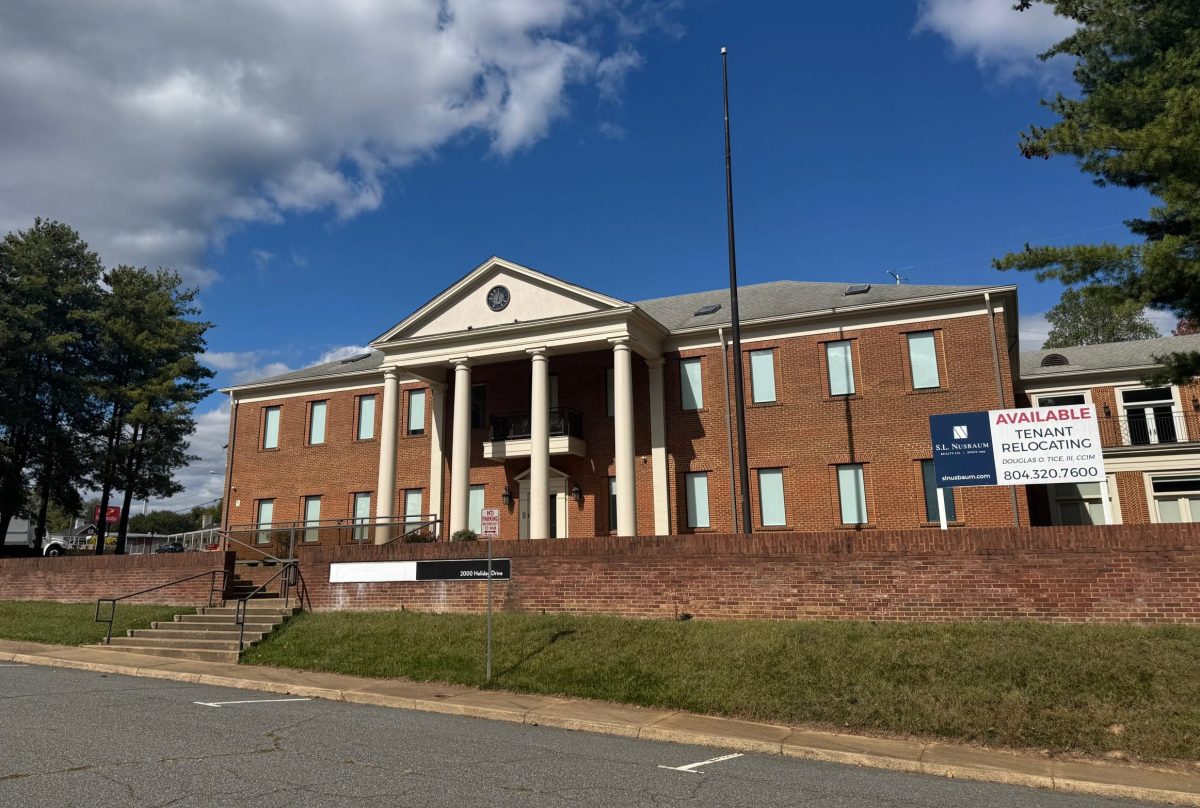
Just a few months after the City of Charlottesville purchased a building to convert into a low-barrier shelter for people experiencing homelessness, three local service providers have a plan for how it could work — if they’re able to pay for it.
During a March 25 work session, the Blue Ridge Area Coalition for the Homeless, The Haven day shelter, and People and Congregations Engaged in Ministry (PACEM), which runs a seasonal overnight low-barrier shelter, presented their proposal for City Council to consider.
They’ve proposed an overnight shelter with 80 beds as well as a day shelter that would offer laundry, showers, computers, mail service and places for guests to store their belongings, among other things. There would be a commercial kitchen, a dining room and supportive services for guests that includes case management and help finding housing. There could be a health clinic and a designated public transit shuttle, too.
The building, located at 2000 Holiday Dr., off of Rt. 29 N, would also have offices for all three service providers — meaning they’d be operating under one roof.
“We want to turn Holiday Drive, to the best degree possible, into a housing machine,” Cameron Moore, executive director of PACEM, said during the work session. The goal, therefore, would be to get people into the shelter, set them up with any services they need to help get them ready for housing, whether it’s proper identification, income from a job or Social Security benefits or medical and mental health care, and then move them into safe, secure, permanent housing.
Learn more about low-barrier shelters in this report from January 2025
As proposed, retrofitting the building into an 80-bed shelter would cost about $8.6 million, not including the additional money all three nonprofits would need to expand their operations to meet the needs of shelter guests. If the groups get the money they need, either from donations, grants, support from local governments or some combination of the three, the shelter could open in two to two-and-a-half years, at the earliest.
Throughout the meeting, the organizations, along with City Manager Sam Sanders, emphasized that the City of Charlottesville is not expected to use taxpayer dollars to foot the entire bill. The city has taken the lead on the project by purchasing the building for $6.2 million, and by working with service providers on the shelter plans. However, Sanders and the service providers are asking for help from surrounding counties as well because, as they reminded the community throughout the meeting, homelessness is a regional issue.
Homelessness service providers want to make ‘a housing machine’
The service providers created their shelter proposal with input from their clients and shelter guests, as well as staff, board members and volunteers.
They envision a sort of one-stop shop for 2000 Holiday Drive, in which The Haven runs a day shelter, PACEM runs an overnight shelter, and case management and other services are available on-site to minimize guests’ need to travel.
The Haven’s day shelter on the first floor would have bathrooms, showers, laundry, hygiene product storage and distribution and a lounge area. Shelter guests would be able to receive mail there (like they do at The Haven) and would have access to computers, internet connectivity and phones, which help with applying for jobs and benefits and staying in touch with their case managers, healthcare providers, family and friends.
PACEM’s overnight shelter, on the second floor, would have separate sleeping quarters for men, women and nonbinary guests. Most of the rooms — with the exception of a few isolation rooms for people who are sick or who need some space — have between four and eight beds.
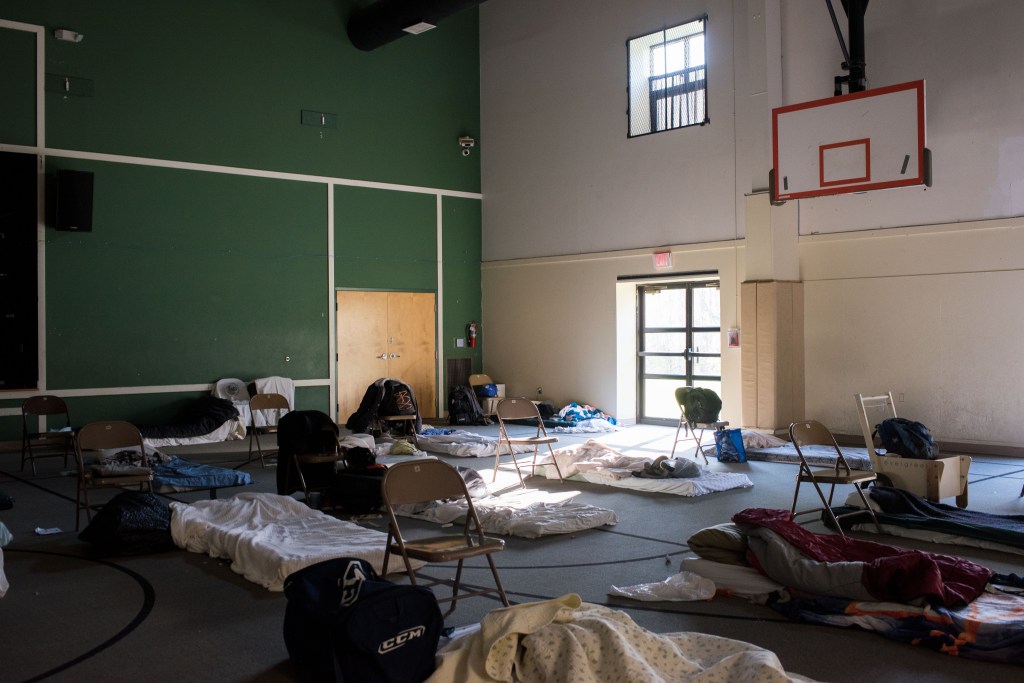
There would be a commercial kitchen and a dining room, plus classrooms for life skills classes, recreational activities, Alcoholics Anonymous and Narcotics Anonymous meetings, staff and volunteer trainings and more.
BRACH, PACEM and The Haven all would have administrative and staff offices throughout the building. They would operate independently, but collaboratively.
Service providers are hoping to include a clinic as well, to help better serve their clients. While the discussions are in early stages, project partners could work with the University of Virginia Health system or Sentara Martha Jefferson to fund and run the clinic component.
People who experience homelessness die nearly 30 years earlier than the average American, often from preventable and treatable illnesses, according to the United States Interagency Council on Homelessness.
This is for a variety of reasons, according to peer-reviewed studies collected by Community Solutions, a nonprofit organization working to end homelessness nationally. Homelessness puts people at greater risk for contracting infectious disease, suffering traumatic head injury and being the victim of a violent crime, just to name a few.
Since 2010, the experience of homelessness has contributed to the death of at least 137 community members in the Charlottesville area, including at least 14 of them in 2025, according to The Haven’s records.
There are still things to figure out, like policies, procedures and how to help couples and folks with pets, said Shayla Washington, BRACH’s executive director. All of that will be fleshed out in the next phase of the planning process.
Some Councilors ask if more shelter beds are possible, but they would come at an increased cost
All told, the shelter would have at least 80 beds, which would add to the 50-60 beds in PACEM’s seasonal shelters.
That’s more than the number of existing low-barrier shelter beds in the area, but significantly fewer than the 200 beds that city officials initially talked about when deciding whether or not to purchase the building.
It is also smaller than the number — 108 to 113 — service providers and the project architect proposed to Sanders in November 2025. That initial proposal, which was not presented in a public forum, included two different scenarios, both of which involved utilizing the current building and adding on to it via new construction. Those options were priced at roughly $9.7 million.
The current proposal instead involves renovating and retrofitting the existing building, at a cost of about $8.6 million — $1.1 million less than the previous plan. It also doesn’t have enough space for all of the programs the service providers want to have. The plan presented in November 2025, however, included that space.
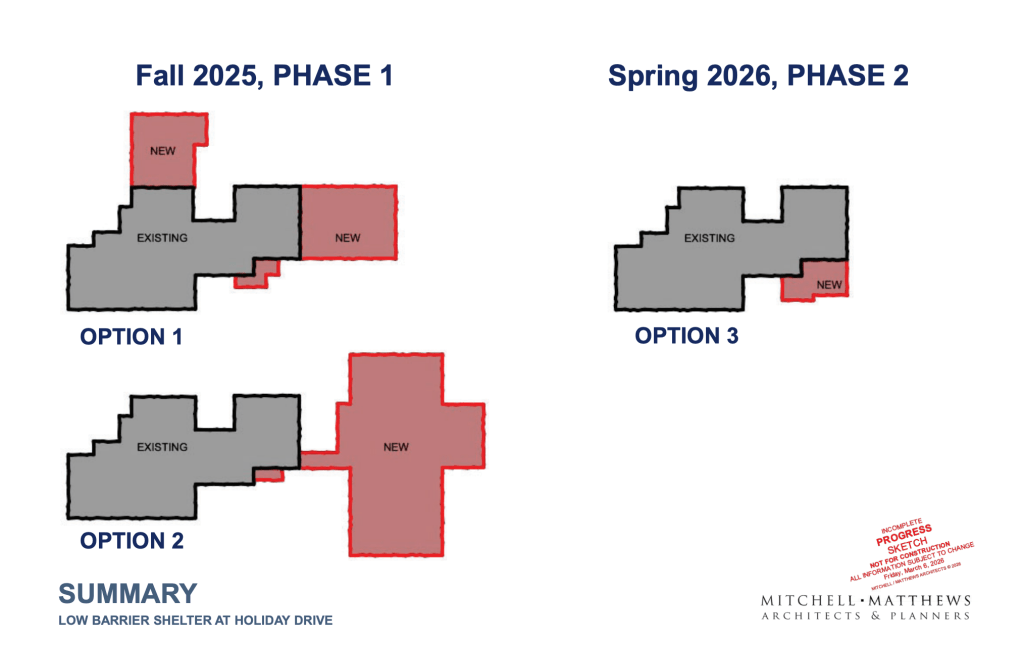
“We were asked if we could reduce the size of the project, try to get everything into the existing building and still keep all the programmatic functions that we were initially providing,” Erin Hannegan with Mitchell-Matthews Architects told Council during the most recent meeting.
Later in the meeting, Sanders said he’d asked the group to focus on the building’s existing 27,000 square feet. Charlottesville Tomorrow reached out to a city spokesperson to ask why, but at the time of publication had not received a reply.
Some councilors questioned whether 80 beds would be enough.
In the month of February, at least 369 people experienced homelessness in the Charlottesville area, according to BRACH’s website. That number comes from the “by-name list,” a running, collaborative list that service providers keep with the names of every individual they know is experiencing homelessness at that time. The list is updated regularly, and it’s likely an undercount. February’s number was up from 362 in January and 280 in December 2025. When this report was published, March data was not yet available.
With such numbers in mind, councilors wondered aloud whether it would be worth it to spend the additional money to, as Mayor Juandiego Wade put it, get the most bang for their buck.
“I’m looking at the big picture,” Wade said. “If we as a community are going to lean into this, we need to get as many beds as we can out of it, within the right environment.”
Councilor Lloyd Snook said something similar. If it’s going to cost $8.6 million for 80 beds, but $9.7 million for 108, he said, “it would seem to me that it might be worthwhile to shoot for the larger number.”
Those numbers do not include operating costs for all three of the partner organizations, costs that go up depending on the number of shelter beds and services offered. That’s mostly because more clients require more staff in order to maintain an effective client-to-staff ratio, said Moore. If a case manager has too many clients, they’re not able to sufficiently help each one.

The Haven, PACEM and BRACH all said that opening an 80-bed shelter would increase their annual operating costs.
BRACH’s would increase from about $398,000 to about $573,000, Washington said. The bump would come mostly from hiring two additional outreach workers. Outreach workers locate and get to know unhoused community members with the hope of connecting them with services and resources. Currently, there is just one outreach worker employed by BRACH for the entire region — the city of Charlottesville as well as the counties of Albemarle, Fluvanna, Greene, Louisa and Nelson, an area that stretches over 2,100 square miles according to U.S. Census data.
The Haven’s annual operating budget would increase from about $2.42 million to a little over $3 million, mostly tied to its rental assistance program that helps more people out of the shelter and into stable housing. They’d need more money for that, as well as additional staff to grow that program to accommodate more people, said Owen Brennan, The Haven’s executive director.
PACEM’s budget would increase the most, more than tripling from $942,000 to $3.7 million. The organization would go from operating a 50-60 bed shelter for a few months out of the year and providing case management throughout the year, to operating a larger shelter full-time.
Altogether, the groups estimate that the total annual operating cost for the proposed 80-bed shelter at Holiday Drive would cost $7.3 million, and that number would increase with additional beds.

A progress sketch of what the first floor of the Holiday Drive shelter could look like. This is where the day shelter, run by The Haven, would be located. Credit: Mitchell-Matthews Architects & Planners 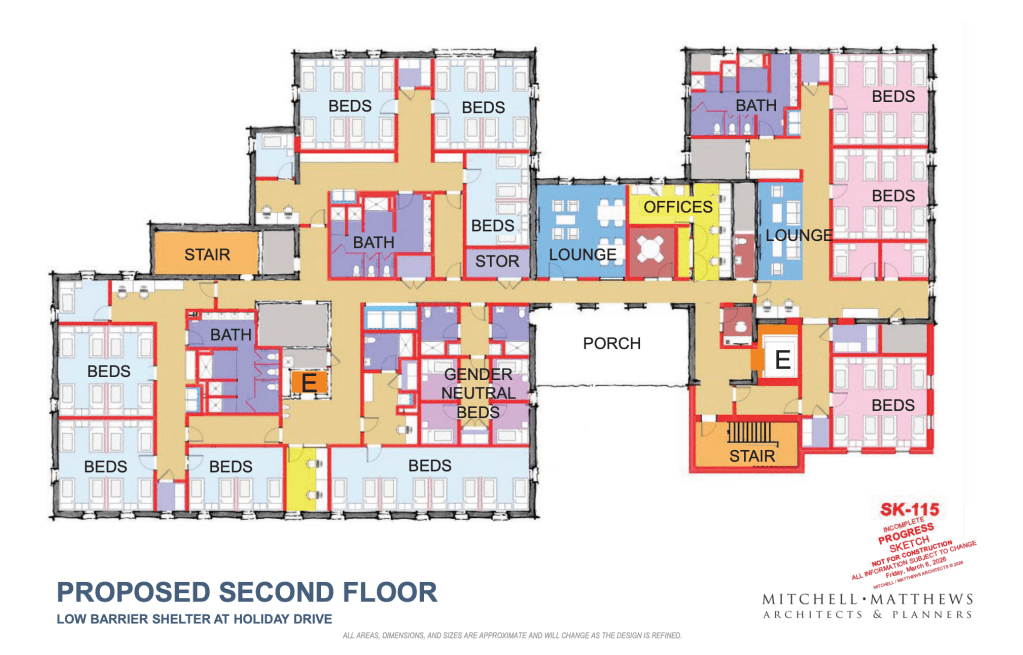
A progress sketch of what the second floor of the Holiday Drive shelter could look like. This is where the day shelter, run by The Haven, would be located. Credit: Mitchell-Matthews Architects & Planners
Brennan seemed hopeful that between a regional partnership among local governments and growing community support for a low-barrier shelter project, the fundraising could go well.
During the ice storm in late January, The Haven and BRACH partnered to put people who were not already in shelters into hotel rooms to get them out of the dangerous cold.
“The public support for that was overwhelming,” Brennan said. “We raised 400% of what we asked for. So there’s great appetite for a strong plan that’s really well-communicated to the public.” It could open up opportunities for large philanthropic gifts, but also smaller, ongoing gifts from community members. The majority of the donations for the emergency hotel stay project were around $75, Brennan said, and they raised $150,000 that way in just a few days.
Councilor Michael Payne agreed that it could be successful.
“We are a community with a lot of millionaires,” he said. “I think this would be a very compelling capital campaign and a lot of people would want to donate.”
Still, getting buy-in from surrounding counties would be crucial to maintaining shelter operations long-term.
“This is a regional investment,” said Washington. BRACH helps coordinate efforts among other homeless services providers, including The Haven and PACEM. Her organization is mandated by the U.S. Office of Housing and Urban Development to serve not just Charlottesville, but Albemarle, Fluvanna, Greene, Louisa and Nelson counties.
People experiencing homelessness in those counties often come to Charlottesville because it has become a hub for accessible homeless services, Brennan said.
“The city is taking point on this because the city purchased the building,” he added. “But 100%, we envision this to be a regional partnership.”
During a May 2025 presentation on the state of homelessness in the area, local service providers shared data on their guests and clients. Most of them were from Charlottesville and Albemarle County, but some were from Fluvanna, Greene, Louisa and Nelson counties as well. That year, at least 29 people — approximately 10% of PACEM’s guests — came from those counties.
So far, the service providers have not given their presentation to any of the surrounding counties, and therefore none of the other counties have made formal commitments to the project.
“The city’s efforts regarding a low-barrier shelter are still in preliminary stages, and formal partnership discussions with the county have not yet occurred,” Jeff Richardson, Albemarle County Executive, wrote in an email to Charlottesville Tomorrow.
“Homelessness is a regional challenge, and the county is engaged with the city, local service providers and other organizations on the broad range of solutions being developed. We will continue working alongside our regional partners to support effective approaches as they develop,” Richardson added.
“No decisions have been made to date, but we have been in conversations regarding the effort at a high level,” Cindy King, Louisa County’s community engagement manager, said.
Cathy Schafrick, Greene County Administrator, told Charlottesville Tomorrow that she and Sanders have discussed the project, but that so far, their conversations have been more informational and brainstorm-based, than anything else.
“I don’t see Greene County participating in it any time soon,” Schafrick said, citing money as a possible obstacle. “But I’m always curious about what other people are doing.”
“We don’t have the same issues that the city has with the homeless population,” she added.
Schafrick would like to see more data on how many people are experiencing homelessness in Greene County, or who might be going to Charlottesville from Greene County to the city seeking services.
“More information is better,” she said.
Charlottesville Tomorrow reached out to Eric Dahl, Fluvanna County Administrator, but did not hear back in time for publication.
Candy McGarry, Nelson County Administrator, was out of the office when Charlottesville Tomorrow reached out and had not returned by the time this report was published.
Holiday Drive shelter could become a new ‘center of gravity,’ but homelessness services still needed in downtown Charlottesville
Councilors also asked questions about a possible dedicated transportation service. The project partners suggested a route running every hour for 10 hours each day from Holiday Drive and stopping at places shelter guests frequent, like the U.S. Social Security Administration office on Pantops, the Downtown Transit Center, UVA Medical Center and Free Bridge, where there is currently an encampment of unhoused community members.

That transportation would be crucial to the shelter’s success, Brennan said. When the organization talked with shelter guests, staff and volunteers, none of them were confident that the shelter could fulfill its mission without “dedicated, reliable, and frequent shuttle service,” according to the presentation. People need to get to their jobs, to job interviews, doctor’s appointments and more. Currently, the Holiday Drive site is not served by a southbound bus line, which would be crucial for shelter guests to get to the aforementioned locations.
The groups talked with JAUNT, a mostly publicly funded on-demand transit service for people whose disabilities prevent them from using the Charlottesville Area Transit service, about creating that line. It would cost about $411,000 annually to run that service.
Councilor Natalie Oschrin suggested that if those locations are already along established CAT bus routes, adding a southbound stop closer to Holiday Drive could be helpful.
One thing that came up multiple times throughout the meeting was how the proposed shelter would shift in the “center of gravity” for homeless services.
“It’s really complex to analyze the potential costs and benefits of a move, of the homeless response system, moving the hub from downtown where it is currently, which exists not just because of The Haven but all of the support networks” that existed before The Haven opened in 2010, Brennan said. Those services include the city’s department of social services, the public library and various soup kitchens.
“That was the web 16 years ago, and it’s only deepened and become more complex,” Brennan said. “A move to Holiday Drive is not going to eliminate the visible presence of unhoused community members downtown. So, one of our questions is, how do we continue to service the folks who are downtown, once Holiday Drive is the center of gravity?”
Snook asked whether The Haven would continue serving folks from its 112 W. Market St. location in addition to Holiday Drive.
That wouldn’t be a feasible operating model for the organization, Brennan said. Plus, having the opportunity to design a shelter space nearly from the ground-up, with so much input from shelter guests and service providers with years of experience, is hard to pass up.
“Staff are excited about the opportunity to design a space for our culture and our needs, and using what we’ve learned in our space over the last 16 years, how to improve the guest experience,” he said.
Snook also suggested that the organization could sell the building to help offset operating costs at Holiday Drive, but Brennan reminded him that The Haven does not own 112 W. Market St. Hollywood film director and UVA alumnus Tom Shadyac bought the building for an organization to turn into a shelter, according to this C-VILLE article from 2009.
What’s more, there will still be a shelter near the downtown area: The Salvation Army.
The Salvation Army will not be moving to the proposed Holiday Drive shelter, but Charlottesville Corps Officer Maj. Donny Wilson has been part of the low-barrier shelter working group and was in the room on March 25 to show his support for the project.
The Salvation Army is currently fundraising for its own shelter project, an expansion of its current shelter at 207 Ridge St., which has 55 emergency shelter beds for men and women, plus 10 extra beds for cold weather sheltering and 28 beds in a separate area for families. Its dining room seats 60.
The new shelter, to be called the Center of Hope, would have 114 emergency beds for men and women as well as 28 beds in a separate area for families. It will also have 120 seats in the dining room. All told, that project is expected to cost $28 million. The city has given $3 million toward it, and The Salvation Army is in the middle of a fundraising campaign for the rest.
Throughout the meeting, councilors, city staff and a few community members praised the service providers and the low-barrier shelter working group for their efforts and expressed hope that the shelter project, in conjunction with the Center of Hope and the Vista 29 permanent supportive housing project, would be an important step toward expanding the area’s homeless response network.
Vista 29 is 80 units of permanent supportive housing, which is meant to get community members experiencing chronic homelessness who are also seniors or have disabilities, off the streets and into housing. It’s expected to be done in late 2026 or early 2027. Virginia SupportWorks housing is constructing the building and will manage it when it opens. The same organization runs The Crossings at Fourth and Preston near downtown Charlottesville. When The Crossings opened, it cut the number of people experiencing chronic homelessness in the Charlottesville area by more than half.
About half of those units have been earmarked for the Albemarle County Housing Office. The office will work with local service providers on placing clients in those units, Washington said.
The remaining units will be available for whoever meets the criteria and wants to apply, said Sunshine Mathon, executive director of Piedmont Housing Alliance, a local housing nonprofit that plans to build low-cost housing for individuals and families next to Vista 29.
“I’m so stoked that we are tackling this now. We’re so ready to do this, and I’m so glad you guys are, too,” Councilor Jen Fleisher said about the low-barrier shelter proposal. “It’s great timing, and thank you for the work you’ve done.”
Sanders also thanked the group, multiple times, for their work and mentioned next steps. While the working group has done a lot of preliminary work, there’s still more to be done.

“I’m sure you’ll begin to hear from folks who want to give you advice on how to consider our next steps,” he added, addressing Council directly. “I know I’ll be hearing more. I don’t think there’s a reason for us to do anything but to thank this group for their efforts, give you time to think about this, and then hopefully start to circle back up and move forward on the timeline.”
Sanders also reminded community members who might be upset to learn that the shelter project is not only expensive, it won’t solve homelessness, that he never promised otherwise.
“Some may be disappointed in hearing that Holiday Drive is not the solution to homelessness,” he said. “I said that clearly to everyone, that I didn’t think it could be that. I think what you have seen is a very good opportunity to model a best practice in a single service center. I think that’s what this is really meant to be, a way to address needs for those that we can serve at this location. It is very expensive. We knew that it was going to be expensive. I reminded everyone that I thought it would be expensive, and that has proven to be the case.”
Sunshine Mathon applauded the working group for its hard work and dedication to the community.
“From the outside, it’s difficult to understand why this kind of process seems to take a long time,” Mathon said. “And to be clear, in the best of times, this work is H-A-R-D, hard. But we are not in the best of times. This work has blossomed during the most hostile federal environment that this work has ever seen, particularly to the unhoused services sector.”
In 2024, a Supreme Court ruling made it easier for local governments to fine, ticket and arrest people living outside, even when there is no adequate shelter available to them. Then, in July 2025, President Donald Trump linked crime and homelessness and the following month ordered law enforcement to start clearing encampments around Washington, D.C. The administration has also attempted to cut funding for homelessness programs, potentially shifting the financial burden for crucial, lifesaving programs to communities themselves, including in the Charlottesville area.
That’s not the only challenge the group has faced, Mathon said.
“It has also taken root during one of the most difficult winters in recent memory, that has stretched the day-to-day operations to their limits,” he said, “let alone being able to maintain the capacity to plan long-term for transformational change that their respective organizations and the system as a whole desperately needs.”
Editor’s note: This article was updated on Wednesday, April 8, 2026, to correctly attribute a quote to Cameron Moore, executive director of PACEM, and to correct the purchase price of the building at 2000 Holiday Dr.